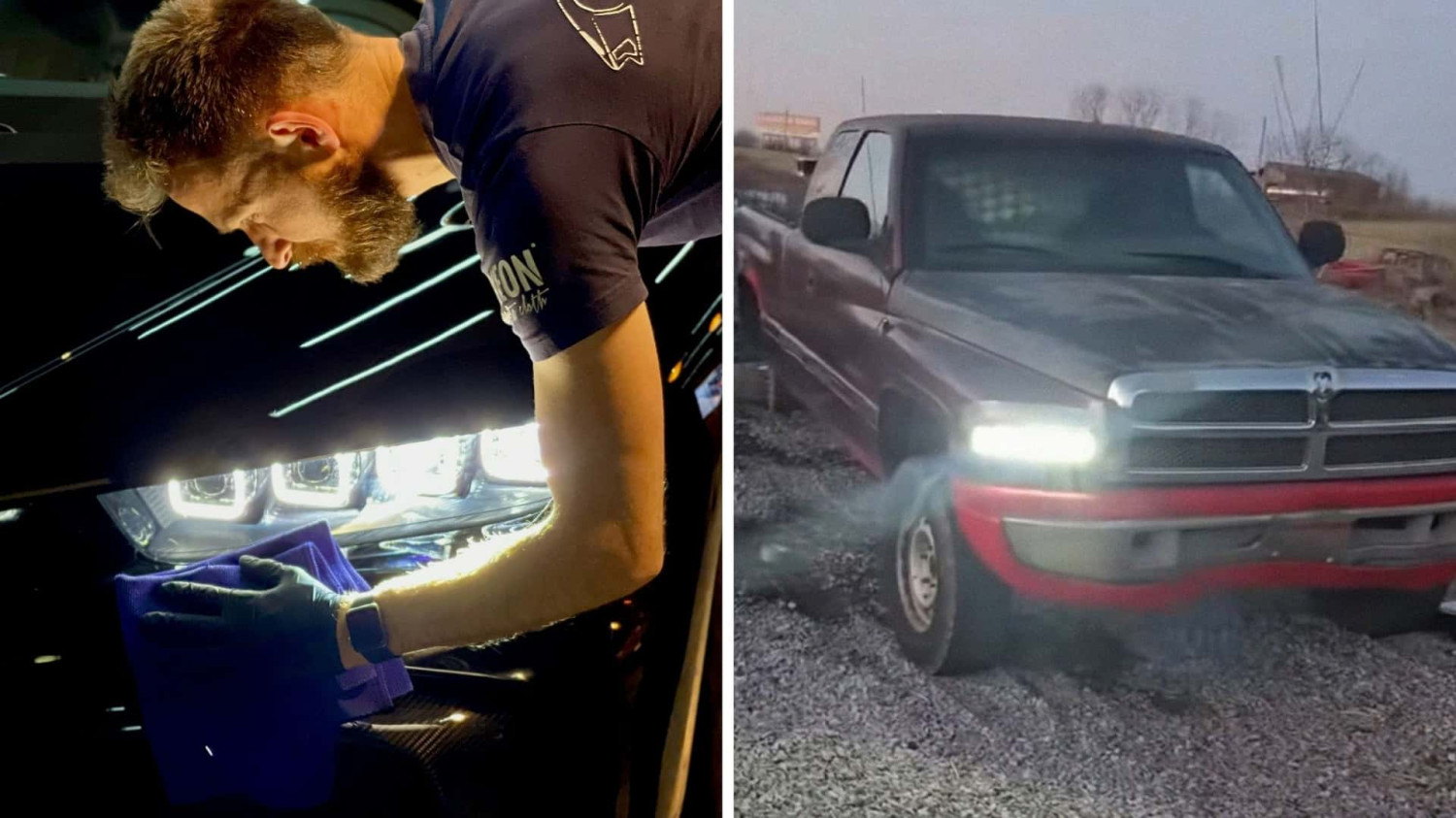
Somewhere on the backroads of Lexington, Kentucky, there’s a Dodge Ram driving around with what looks like a row of checkout-counter LED lights taped to its headlight opening, each one with its own flip-on switch that floods the area in front of it with powerful illumination. The truck's owner marvels at the modification being "brighter than factory." Facebook inhabitants, meanwhile, called it a lot of other things. The viral Facebook Reel from Dodge mechanic Joshua Lee Cox takes a fairly aggressive approach to repairing a burned-out headlight on a well-used Ram truck. The difference in brightness is tough to miss once all five switches on the LED lamps are flipped on, providing Cox with no small amount of glee. "You go to Harbor Freight, buddy, and you just go ahead and just click them on," he said in the clip that’s received more than 10,000 likes. "Brighter than factory, baby!" The name check of hardware headquarters Harbor Freight instead of a parts shop like AutoZone or O'Reilly is an immediate tip-off that we're not dealing with automotive-rated lamps. Instead, they appear to be the kind of small, battery-powered work lights typically used in garages, toolboxes, or under-hood jobs. Harbor Freight LED Lights DIY: A Dim-Witted Idea It's tough to tell in the video whether he's wired them in or simply taped them into place and turned them on manually. It's a gimmicky fix that feels fun in the moment, but it immediately set off waves of arguing in the comments section about modern headlights, common sense, and whether this Dodge was a clever stopgap or a moving hazard. Some viewers immediately questioned how Cox planned to dim the lights for oncoming traffic. "Let’s see you dim them for incoming drivers to avoid a ticket," one commenter wrote. Others argue that blinding brightness has already become the norm. "With as bright as these LEDs are on vehicles now, I’m sure he’s fine," another replied. A second wave of commenters questioned whether Cox's Harbor Freight setup would actually work as a headlight. "Those lights aren’t made for distance—you won’t be able to see [anything]," one critic wrote. Another agreed and added that you might see something, "but by then, it’s too late to stop." Others were less charitable, calling it "The illusion of light" and suggesting he just buy a standard bulb. There were also plenty of smarty-pants who were quick to point out that most of the small work lights Cox used aren't exactly known for their longevity, with one joking, "Too bad the batteries are only good for about three miles." Then, there was the question of logistics. "Could you imagine asking someone to turn your headlights on? ‘Hey bro, could you hop out and flip my lights on?’" Trying to be helpful and address the question of legality, one commenter offered, "I know a guy that’d slap an inspection sticker on it." Shedding Light On LED Bulbs In reality, the Harbor Freight lights are doing a very different job than a proper headlight ever would. And in some ways, they are about as effective for automotive illumination as a sledgehammer is for planting a tree. LED lights are designed to throw a wide, close-range flood of light across the workbench or an engine bay, not to project a controlled beam down a dark road. What Cox has actually built here is less a headlight replacement and more a rolling workbench light bar. The Harbor Freight-style COB LED he's using is great for seeing what you're doing under a hood or in a garage, but it's very wrong for carving a clean path down a dark road. Proper headlights are engineered around beam patterns, cut-offs, and focus, and are designed to put light far downrange while keeping it out of oncoming drivers' eyes. LED work lights do the opposite: they're wide, unfocused, and blunt. That difference truly matters, since the reflector and lens shape control where the light goes, creating a low-beam cutoff that keeps glare in check and a high-beam pattern that reaches out when the road is empty. A bare LED work light just throws light everywhere it can. Up close, it may look impressively bright, but at driving speed, it's far less useful, annoying, and potentially dangerous to anyone coming the other way. There's also the legal question. Headlights are regulated equipment for a reason, and this setup clearly isn't what any inspection manual had in mind. As a stopgap to get a truck home in an emergency, it's in a familiar space for anyone who's ever kept an older vehicle running on equal parts stubbornness and ingenuity. That’s really the point of the whole clip, since we're not looking at a major modification or a how-to that anyone should try to copy. It's a fun little bit of internet theater and a reminder of what happens when a truck still has to run even when the right part isn't handy. If there's a hardware store nearby, it's possible to shed a little light on the road ahead, even if it's not the way the car folks from Detroit would have preferred. Motor1 reached out to the creator via direct message and commented on the clip. We’ll update this if they respond. We want your opinion! What would you like to see on Motor1.com? Take our 3 minute survey. - The Motor1.com Team



















 +29 others