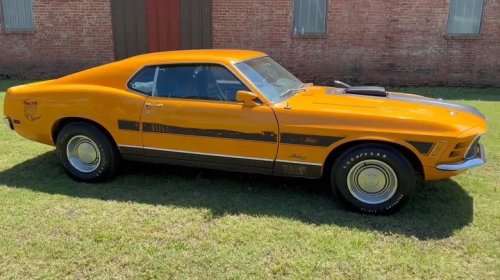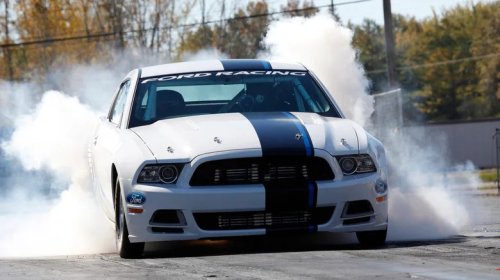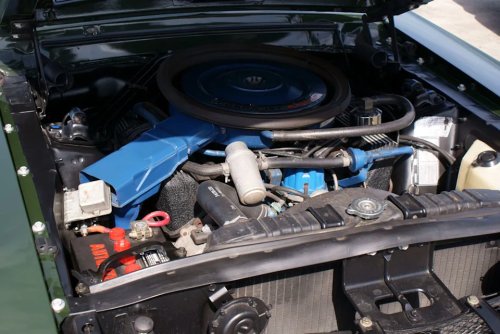
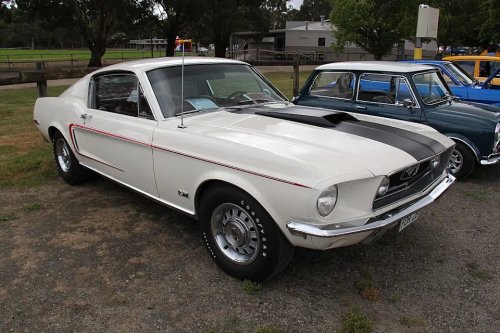
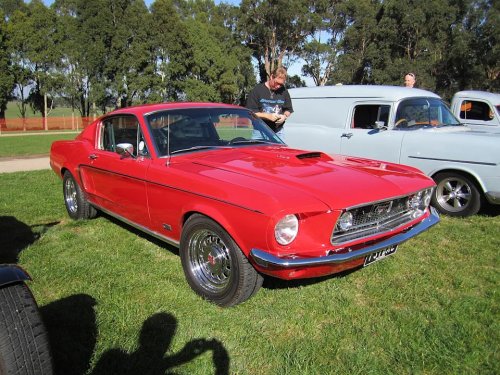
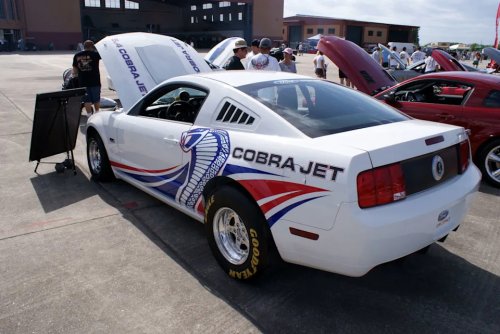
















In late December 1967, Ford's Dearborn plant built 50 identical Mustang fastbacks: Wimbledon White paint, black vinyl interiors, no radio, no heater, and a big-block 428 under a functional hood scoop. They weren't for sale in the usual sense. They were going drag racing, and seven weeks later one of them won the biggest Super Stock title in the country. Today collectors call them the Mustang Cobra Jet Lightweights, or simply the "135 cars." They exist because a Rhode Island Ford dealer got tired of losing stoplight races.A dealer's hot rodThe Cobra Jet didn't start in Ford's engineering department. It started at Tasca Ford in East Providence, Rhode Island, where dealer Bob Tasca Sr. was tired of watching the 390-powered Mustang lose stoplight battles to Chevrolets and Mopars.In 1967, Tasca's team, led by mechanic Bill Gilbert, built a Mustang they called the KR-8 ("King of the Road"). They started with a 428 Police Interceptor short-block, then added 427-sourced cylinder heads, a custom C-Stock camshaft arranged through Ford's "Poppa" Sullivan, a 427 oil pump and distributor, an aluminum intake, and a single 735-cfm Holley. On street tires the KR-8 ran low 13s at around 105 mph, according to Hagerty.When Hot Rod magazine covered the car, readers flooded Ford with requests for the same setup. Dearborn listened. The combination became the factory 428 Cobra Jet, conservatively rated at 335 horsepower.The 428 Cobra Jet, here in a 1968 Shelby GT500KR. Ford's 335-hp rating was widely seen as low. Photo: Valder137 via Wikimedia Commons, CC BY 2.0Fifty white MustangsBefore the public could order a Cobra Jet, Ford built a batch of race cars to prove it. Per the 428 Cobra Jet Registry and Sports Car Market, Dearborn assembled 50 fastbacks at the very end of 1967, all with sequential serial numbers in the 8F02R135xxx range. That "135" sequence gave the cars their nickname.What made them "lightweights":The first 20 cars skipped seam sealer and sound deadener entirely; the remaining 30 used standard body construction.Every car was built radio-delete and heater-delete, and the spec sheet also deleted the export brace.All wore Wimbledon White with black vinyl interiors, with no factory stripes.Ram Air induction fed the engine through a fiberglass hood scoop.Running gear included a 9-inch rear end with Daytona pinion support, 31-spline axles, Traction-Lok, Competition Handling suspension, and power front disc brakes.The cars were aimed at NHRA Super Stock/E, where the 428's conservative horsepower rating and the car's weight put it in a favorable class. Cars with automatic transmissions ran in the "A" (automatic) version of each class.The Ram Air scoop and Wimbledon White paint marked the factory drag cars. Pictured: a 1968 428 Cobra Jet street fastback. Photo: Sicnag via Wikimedia Commons, CC BY 2.0Race prep in Long BeachSix of the cars were shipped to Holman-Moody-Stroppe in Long Beach, California, for race preparation ahead of the NHRA Winternationals in Pomona. The Registry lists 427-style connecting rods, forged pistons at 11.0:1 compression, headers, and Detroit Locker rear ends, with Super Stock cars getting aluminum intakes and solid-lifter cams. Mustang Specs adds 4.89:1 gearing, a roll bar, Goodyear slicks, and a battery relocated to the trunk.Pomona, February 1968Ford sent the six Mustangs to the 1968 Winternationals with some of the best Ford drivers of the era:Al Joniec, SS/E, Rice-Holman FordHubert Platt, SS/E (Paul Harvey Ford) and C/SA (Tasca Ford)Jerry Harvey, SS/E, Paul Harvey FordDon Nicholson, SS/EA, Dick Brannan FordGas Ronda, SS/EA, Russ Davis FordFour of the six Ford Cobra Jets reached their class finals. Nicholson spun a bearing in the first round, and Ronda lost close races to Dick Landy. Joniec beat Platt in an all-Cobra Jet SS/E class final, then took the overall Super Stock Eliminator title by beating Dave Wren's Mopar. Elapsed times reported for his runs vary by source: Sports Car Market lists a 12.12 at 109.48 mph in the class final, while Ford's own retelling cites an 11.49 at over 120 mph.Either way, Ford got the headline it built those cars for: a brand-new engine winning a national event before anyone could order one.From the strip to the showroomProduction 428 Cobra Jet Mustangs started in April 1968. Demand was immediate: Sports Car Market reports that Tasca Ford alone sold 47 in the first month. The Cobra Jet went on to power Mustangs, Torinos, and Cougars through 1970, and the 1968 Shelby GT500KR borrowed the "King of the Road" name Tasca had coined.A Candyapple Red 1968 Cobra Jet fastback. Showroom cars came in any color; the race cars were all white. Photo: Sicnag via Wikimedia Commons, CC BY 2.0What they're worth todayMost 135 cars were raced hard, which is exactly why the survivors bring real money now. One sold for $143,100 at Mecum's Indianapolis auction in May 2013, per Sports Car Market. Another, a former Ford marketing car later sold to engine builder Dave Lyall for $1 under a factory race-car agreement, was offered at Mecum Chicago with its window sticker copy and Ford memos. Classic.com puts the current market benchmark around $128,000, with a modified example selling for $125,000 on Bring a Trailer in October 2025.The name returnsFor the 40th anniversary of Joniec's win, Ford Racing revived the badge with the 2008 FR500CJ Cobra Jet, a turnkey, non-street-legal drag Mustang with a supercharged 5.4-liter V8. Prototype #1 sold for $375,000 at Barrett-Jackson Scottsdale in 2009. In keeping with the original, Ford built the cars in batches of 50, with further runs in 2010, 2012, 2013, 2014, and 2016, according to Ford Performance.The 2008 Cobra Jet revived the name as a factory drag car for NHRA Stock and Super Stock. Photo: Valder137 via Wikimedia Commons, CC BY 2.0For the 50th anniversary in 2018, Ford built 68 cars in Race Red and Oxford White, capable of low-8-second passes, Hagerty reported. Then the Cobra Jet went electric: Ford says the Cobra Jet 1400 prototype ran 8.128 seconds at 171.97 mph in 2021, the Super Cobra Jet 1800 hit 7.623 at 182.16 mph in 2024, and the 2026 Cobra Jet 2200 recorded a 6.76 at 222 mph.A dealer's grudge, still paying offPlenty of factory race cars exist to promote something already in the catalog. This one put a new engine in the catalog. It took a Rhode Island dealer sick of losing at stoplights, a flood of requests from Hot Rod readers, and one white fastback with no heater beating everyone at Pomona. Nearly six decades later, Ford is still using the name for its quickest Mustangs. See more Ford Mustang stories on Backfire News.Original 135 car with a raced-hard past, or a modern factory Cobra Jet that runs in the 6s: which one goes in your garage?SourcesHow a Ford dealer created the 428 Cobra Jet — HagertyThe Introduction of the 428 Cobra Jet — 428 Cobra Jet Registry428 CJ Mustangs at the 1968 NHRA Winternationals — 428 Cobra Jet Registry1968 Ford Mustang Cobra Jet Lightweight — Sports Car Market1968 NHRA Mustang GT Cobra Jet (135 Series) — Mustang SpecsFord Mustang Cobra Jet Lightweight market — Classic.comMustang Cobra Jet Lightweight heading to auction — autoevolutionFord Mustang FR500 — WikipediaFord celebrates Cobra Jet's 50th anniversary — HagertyCobra Jet — Ford Performance PartsFrom Dearborn to the Drag Strip — Ford⚡ Read the full article on Backfire News