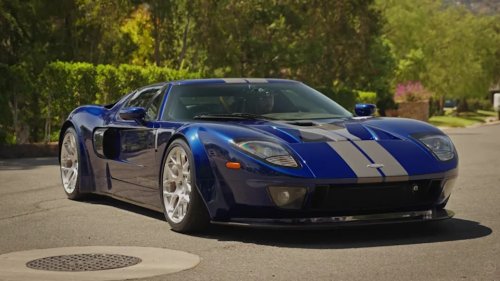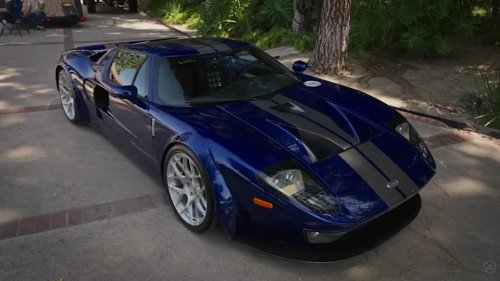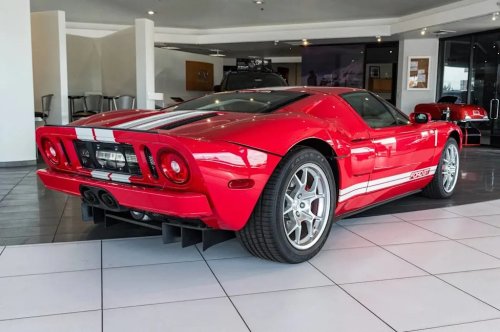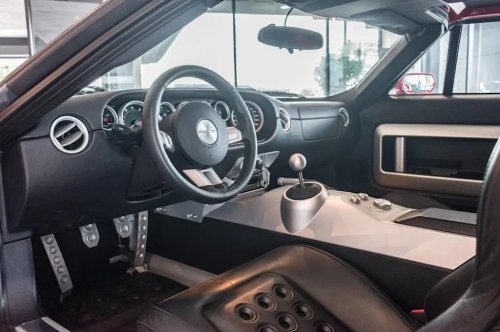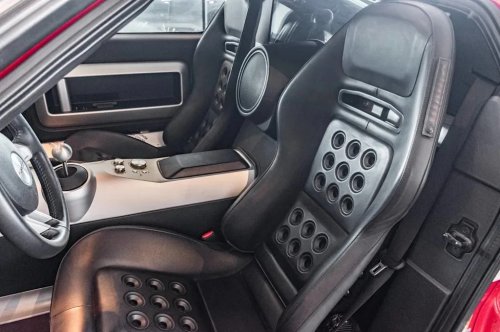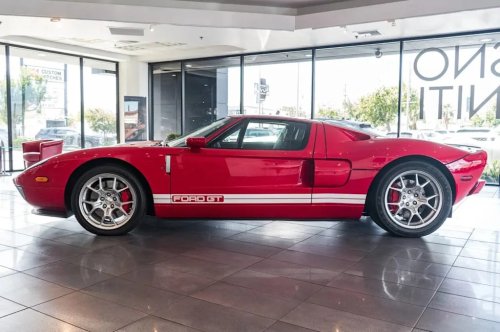



















Most collector cars are bought. A very few are chosen. The distinction sounds like semantics until you look at the two cars headlining Richmond Auctions' inaugural Fall Spectacular at the Savoy Automobile Museum in Cartersville, Georgia, on October 16–17. One is a hand-built custom that had to survive a panel of judges at the Detroit Autorama before it earned its reputation. The other is a factory supercar whose original owners had to survive Ford's own selection process before they were allowed to buy it.Dave Kindig's TwelveAir, winner of the 2024 Ridler Award, and a 2021 Ford GT Liquid Carbon Edition, one of just 30 built, come from opposite ends of the automotive world. What they share is more important than what separates them: each was vetted before it ever reached the open market. That is the real story of this sale, and it says a good deal about where serious collector money is heading.The Ridler Is Not a Trophy. It's a Filter.For readers who live closer to Pebble Beach than to Detroit, the Don Ridler Memorial Award deserves a proper introduction. Presented at the Detroit Autorama since 1964, it is the custom-car world's most demanding honor, and its rules shape the cars that compete for it. An entry must make its public debut at Autorama. Before a single judge sees it, the builder has already committed years of work to a car that cannot be tested in front of an audience. From the field, judges name the "Great 8" finalists, and from those eight, one winner.That rule explains why TwelveAir spent four and a half years hidden in a dedicated, locked room inside the Kindig-It Design shop in Salt Lake City. It also explains why its eventual win, chronicled in the eight-episode series Bitchin' Rides: Road to the Ridler, carried such weight. A Ridler car isn't judged on reputation. It is judged on the day, against the best work that every serious builder has been holding back.What TwelveAir Actually IsThe lot is catalogued as a 1953 Corvette, but that description undersells it. Commissioned by Dave and Tracey Maxwell, TwelveAir is a scratch-built automobile inspired by the fastback Corvair concept that General Motors showed on its Motorama circuit in the Corvette's earliest years, a design that never reached production. According to the Richmond Auctions catalogue, it uses no original Corvette body panels. The body is a hand-formed aluminum monocoque, finished in Modern Classikk Infrared with satin-bronze accents, over a Sienna leather cockpit that mixes traditional craftsmanship with extensive 3D-printed components, a custom aluminum steering wheel and a gauge cluster inlaid with white gold and diamonds.Then there is the engine, which gives the car its name. Australia's Race Cast Engineering built a bespoke, all-aluminum 9.2-liter (564-cubic-inch) V12 based on GM's LS architecture, with a block cast from 3D-printed sand molds and an intake that Kindig-It designed as sculpture rather than plumbing. Output is north of 600 horsepower, delivered through a seven-speed automatic sourced from a 2017 Corvette, with Wilwood brakes and custom EVOD monolug wheels.In other words, this is not a restomod in the conventional sense. It is a coachbuilt car in the oldest meaning of the term: a one-off body over bespoke mechanicals, built to a client's commission by a named house. The Ridler was the headline, but the car went on to collect more than 20 major honors, including ISCA Grand Champion, the Chicago Legends Cup, Goodguys' Most Bitchin' award and SEMA recognition.Why Builder Provenance Is Becoming Blue-ChipThe collector market has always understood the value of a coachbuilder's name on a prewar chassis. A Figoni et Falaschi body or a Saoutchik commission is valued not merely as bodywork but as authorship. The custom world is now arriving at the same conclusion about its own masters, and Dave Kindig, through Kindig-It Design and a decade of television exposure, has become one of its most recognizable signatures. We have seen that recognition play out on the block before, as when a custom 1958 Corvette Kindig-It roadster drew national attention ahead of Mecum Kissimmee.TwelveAir is one of four Kindig-built vehicles in the Richmond sale, which gives collectors an unusual chance to compare the shop's work side by side. But the Ridler car sits in a category of its own. Recent Ridler winners rarely change hands publicly, and a car with a documented build, a televised development story, a named commissioning couple and a full trophy record is about as well-provenanced as a modern custom can be. That documentation will matter for decades. Collectors rarely pay for craftsmanship alone. They pay for craftsmanship that can be proved.The Ford GT Liquid Carbon: Rarity With a GatekeeperIf TwelveAir was chosen by judges, the Liquid Carbon Ford GT was chosen by its maker. The second-generation GT was never a car you could simply order. Ford ran an application process from the outset, favoring buyers with a history with the brand and a stated intention to drive and keep the car. The Liquid Carbon Edition narrowed that circle further: according to Richmond Auctions, Ford selected each of the original 30 buyers itself rather than offering the model through any traditional sales channel.Ford revealed the Liquid Carbon at the 2020 Chicago Auto Show alongside a broader update to the GT, including an increase to 660 horsepower from the 3.5-liter twin-turbocharged EcoBoost V6, revised cooling and a standard Akrapovič titanium exhaust. The defining feature, however, is the body. The Liquid Carbon has no paint at all. Its carbon-fiber panels are finished only in clearcoat, with matching carbon wheels, and the weave becomes the livery.The 2021 Ford GT Liquid Carbon Edition is one of just 30 built, each sold to a buyer selected by Ford. Photo courtesy of Richmond AuctionsThat decision is why the Liquid Carbon matters more than its production number alone suggests. Paint forgives. Exposed carbon does not. Every panel must be laid up so the weave aligns visually across seams, and there is nowhere to hide a flaw. It is the automotive equivalent of a watchmaker leaving the movement exposed. For a collector, it also means the car's condition is uniquely legible: the clearcoat, the weave alignment and the absence of repair are exactly what a buyer should inspect, and exactly what a well-kept example can demonstrate.Set against the full second-generation GT run, which ended with the last cars built in 2022, 30 examples is a tiny fraction. Combine that with Ford's hand-picked ownership and the car becomes something closer to a commissioned object than a limited edition. Seeing one offered publicly, rather than traded quietly between insiders, is the notable opportunity here.Why Richmond, and Why the SavoyThe venue is part of the argument. The Savoy Automobile Museum, which opened in December 2021 on a roughly 37-acre campus and is operated by the nonprofit Georgia Museums, Inc., has quickly become one of the Southeast's most serious automotive institutions. Hosting a sale inside a museum frames the cars the way collectors ought to think about them: as artifacts with histories, not inventory.The connection runs deeper for Richmond Auctions co-owner Mike McCandless, son of NHRA drag racer Herb McCandless Sr., whose private McCandless Collection contributed four Chrysler letter cars to Savoy's 2026 exhibition The Mighty 300. "I grew up around drag racing because of my dad, Herb, so the cars came first for me," McCandless said. He admits he once dismissed vintage signage, until the stories behind the dealerships and brands changed his mind about how much history they add to the cars.That perspective is Richmond's distinguishing trait. Founded by collectors Jordan Richmond and McCandless, the house built its reputation in advertising memorabilia, automobilia and petroliana, including a world-record sale of a 1929 MusGo Gasoline porcelain sign for more than $1.5 million, and has surpassed $100 million in gross auction sales in under four years. Its first major automobile auction, the 2025 Tony Townley Collection sale, generated more than $25 million with a 99.8% sell-through rate, a sale that produced results such as the unrestored 1969 Dodge Charger Daytona that sold for $605,000. A sell-through rate that high signals a house that consigns realistically and attracts genuine bidders, two qualities that matter more to a seller of a car like TwelveAir than any headline estimate.Beyond the HeadlinersTwelveAir and the Ford GT lead a catalogue of more than 125 vehicles spanning prewar classics, American muscle, race cars, modern performance machinery and award-winning customs, alongside roughly 400 lots of vintage advertising, automobilia, petroliana and country-store memorabilia. For collectors who think in terms of a complete story, that pairing makes sense. A muscle car is more meaningful next to the dealership sign that once sold it.It also fits a pattern we have been tracking all season. As we noted in our recent collector car market brief, buyers have been paying up for certainty, meaning cars whose quality, history and significance are beyond dispute, while growing selective about everything else. A Ridler winner and a factory-selected, 1-of-30 Ford GT are certainty in two different dialects.What Serious Buyers Should WatchFor TwelveAir, the questions are documentation and serviceability. A bespoke V12 and a hand-formed aluminum body are extraordinary achievements, and a prospective owner should understand how the build is documented, what support exists from Kindig-It and Race Cast Engineering, and how the car is intended to be shown or driven. Those answers will shape its long-term value as much as the trophy itself.For the Ford GT, it comes down to condition, mileage and the integrity of the exposed carbon, along with the car's ownership history from its original Ford-selected buyer forward. Specification matters too: Liquid Carbon cars were configured with a range of stripe, caliper and interior choices, and the original build details are part of each car's identity.The auction begins at 10 a.m. ET on Friday, October 16, and Saturday, October 17, at the Savoy Automobile Museum, 3 Savoy Lane, Cartersville, Georgia. Bidders may participate in person, online, by phone or through the Richmond Auctions app. The full catalogue and bidder registration are available at RichmondAuctions.com.Rarity is easy to manufacture. Selection is not. The two cars at the top of Richmond's first Savoy sale earned their places before a single bid was placed, and that is precisely why collectors should pay attention.⚡ Read the full article on Modern Car CollectorSign up for the Collector Car Market Brief. For the latest news, follow us on Facebook and Instagram.