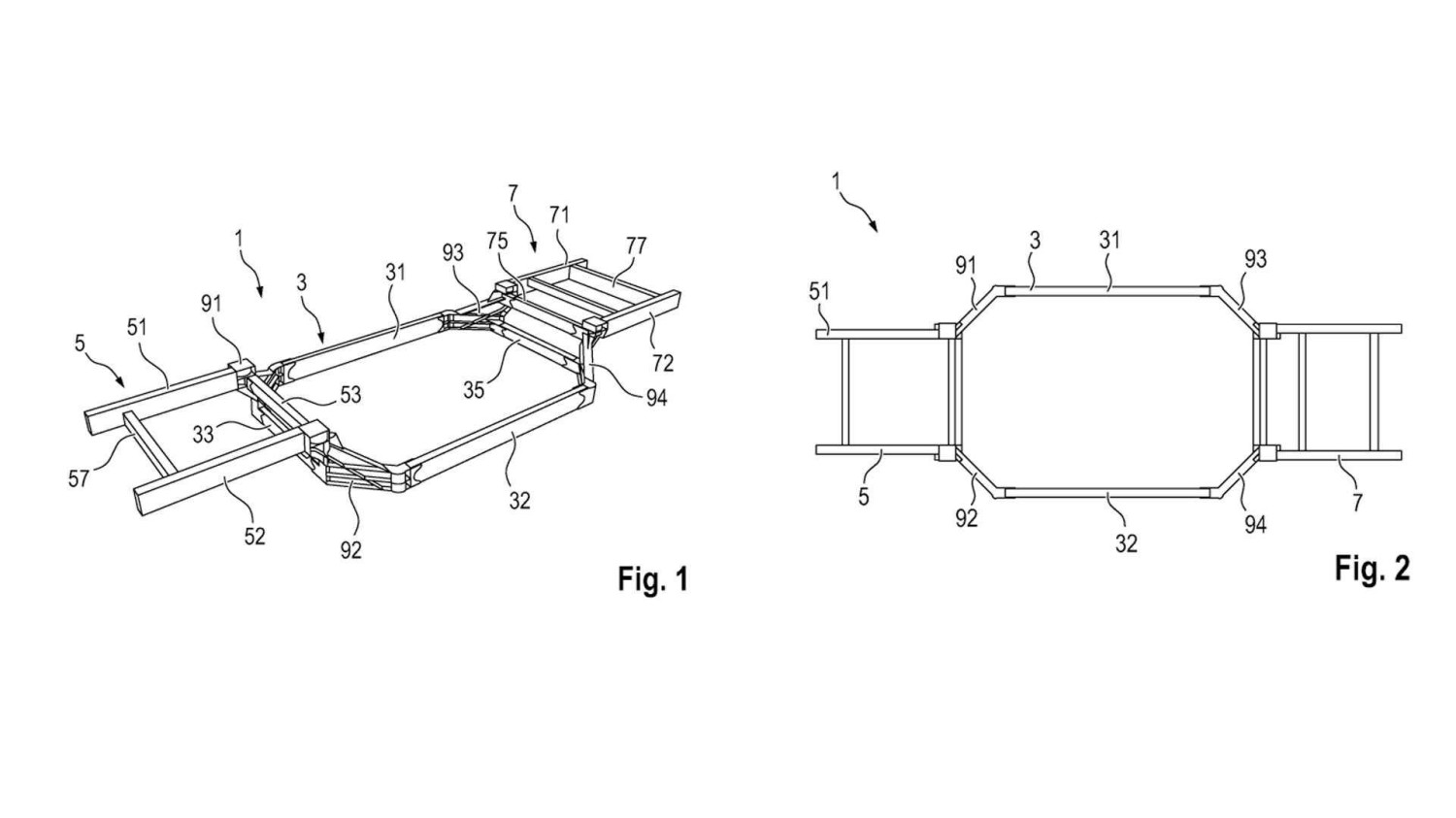
BMW and a conventional full ladder frame? The German car company has been building unibody vehicles since 1960, butwhat about vehicles with a frame? You might be surprised to learn that BMW largely stepped away from such construction, even on vehicles like the X5 and X7. But that could soon change.The CarBuzz researchers have just found a patent that shows BMW is looking into a new frame for future vehicles. It's not just a couple beams either, nor is it a spaceframe like the old M1 had. This looks pretty beefy, possibly something that could underpin a true off-roader, maybe even a G-Class competitor. Or, it could be something to keep future EV batteries well-protected. Whatever its intended use, it looks pretty strong. BMW's New Take On The Old Ladder Frame BMWAdmittedly, this isn't exactly a ladder frame in the way we're used to seeing one. It isn't designed solely to separate the body from the running gear and support an engine, transmission, and axles. Instead, it's about developing electric models more quickly and more cost-effectively.The patent calls this a ladder frame, but it's also referred to as a skateboard chassis. The term was the next big thing about five years ago, and it described an electric vehicle platform that was literally a platform. The motors, battery pack, and suspension came attached to the skateboard, and then a body was dropped on top. GM's Ultium system was one of the most visible examples of the idea, which seems to have fizzled out since then. At least we haven't heard much about it from automakers in a while.Most vehicle frames, at least on the trucks and SUVs that still use them, are made up of small sections that are welded together. The Toyota Tundra's frame, for example, uses dozens of pieces, each of the right thickness for its location. Some others use long extruded square sections instead. BMW's, however, is cast.Casting the frame reduces the number of steps required to manufacture the complete frame. It's still not one piece for the whole vehicle, though. BMW imagines a central section and then front and rear sections. Each connected section would also have mounting points for strengthening and reinforcement through cross members. New Frame Could Make Modular Design Easy BMW The vehicle's battery would drop into the center section. Larger and smaller packs could occupy the same frame space, requiring only slight changes to the pack's mounting points, not the entire frame.Front and rear motors and front and rear suspension components would attach to the front and rear of the center section. This interchangeability could make it easier for BMW to offer rear and AWD models without changing the entire platform.The new idea could also be made longer or shorter in a much simpler manner. Add another section or lengthen the frame rails of the center section, and you have a vehicle that is a different length. Making it wider could be tougher, though, as it would require different castings. Having the body extend farther over the main frame below would be a crash-test nightmare, so it's a non-starter.But strength is also part of this equation. BMW's first ladder frame in decades could be the first sign it is building a real off-roader. This particular design might be a little light to take on the Mercedes G-Class, but it could certainly compete with the smaller electric G-Class. And this could be a starting point for more rugged applications.With electric and gas development coming back together instead of separating further, we thought that the era of the skateboard chassis was over. BMW's patent shows that it might not be. Or at least that automakers aren't afraid to look rearward for future ideas.Patent filings do not guarantee the use of such technology in future vehicles and are often used exclusively as a means of protecting intellectual property. Such a filing cannot be construed as confirmation of production intent.Source: DPMA



















 +47 others











![BMW's new iX4 leaks days ahead of its debut [Images]](https://cdn.topcarnews.net/thumb/id/aHR0cHM6Ly9pMC53cC5jb20vZWxlY3Ry-ZWsuY28vd3AtY29udGVudC91cGxvYWRz-L3NpdGVzLzMvMjAyNi8wNy9CTVctaVg0-LUdULVNVVi0yLmpwZWc_dz0xNTAwJmFt-cDtxdWFsaXR5PTgyJmFtcDtzdHJpcD1h-bGwmYW1wO3NzbD0x/44847916d4631457013dfd46d3f7570e.jpeg?t=20261007&post_id=68433)