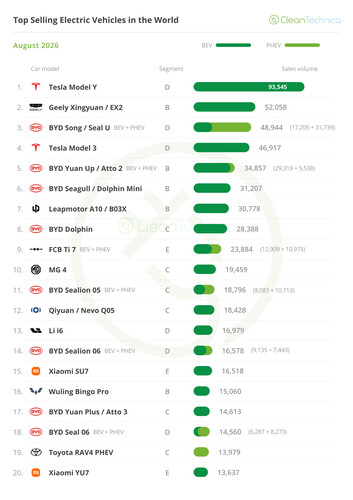
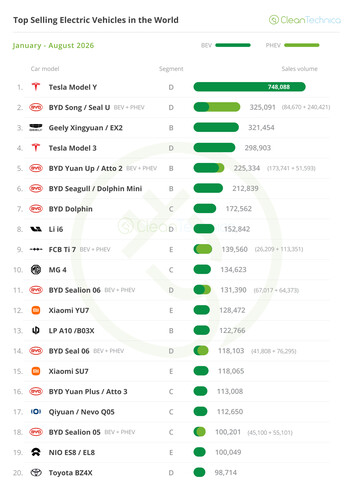
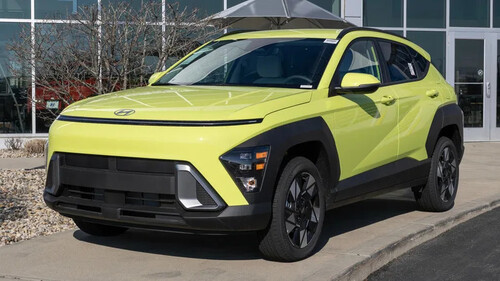
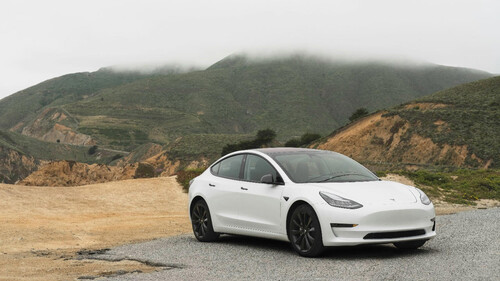
Electric vehicle registrations in the U.S. have dropped down to 4.8 percent of the market in February, according to S&P Global Mobility's US light-vehicle registration data. That’s a big drop from last year, when EV sales peaked at 10.5% of the market in the third quarter just before the Federal tax incentive for EVs ended. EV registrations in Europe, meanwhile, are up, up, up. Sales of fully electric cars in Europe’s main auto markets jumped by almost a third in the first quarter of 2026, as drivers looked for alternatives to combustion engines after the war in Iran caused the highest spike in petrol prices in years, according to Reuters.New battery-electric vehicle (BEV) registrations, a proxy for sales, rose 29.4 percent from a year ago to almost 560,000 in the quarter, and were up 51.3 percent at over 240,000 in March alone in 15 European markets, according to data collected by the trade association E-Mobility Europe and the research firm New Automotive.Overall, in the European Union and Norway, the BEV market share reached a record 24% in Q4 2025, and almost 19% over the full year, according to statistics compiled by Transport & Environment, “Europe’s leading advocates for clean transport and energy.” Quarterly BEV Share Development in the EU and NorwayEurope continues to love EVs.Is it just the cost of gas? The EU has always had much higher prices--and the difference is really about taxes, not core oil or petro cost. Nonetheless, a gallon of regular in the US is $4.04, according to AAA, or $3.98 a gallon according to GasBuddy. Gas in Europe is more than twice that: $8.82 a gallon in France, $8.93 in Switzerland, and $9.35 a gallon in Germany. More important is that European EV sales remain subsidized, as they used to be here in the States, though subsidies vary by country, with over $1,000 in France and more than $10,000 in Greece and Poland. Norway gives strong tax incentives, too, along with free registration. In Paris you can park your EV for free at metered parking spaces. Here we get no help. As a result, new electric vehicle registrations fell 37 percent in February compared to sales a year earlier, pushing EV market share below 5 percent to the previously mentioned 4.8 percent, as the loss of tax incentives continued to ripple across the US light-vehicle market, autonews.com noted, citing the S&P report.So why the disparity?“EV sales in early 2026 have not yet found a new normal, after the rush in third quarter 2025 to get in on incentives," said analyst Stephanie Brinley, associate director for S&P Global Mobility's AutoIntelligence group. "Committed EV intenders bought ahead of plans, and it’ll take time to rebuild momentum with the EV curious. Automakers are pulling back on availability in the meantime, as cost pressures grow faster than consumer adoption and they simply can’t support selling at loss. This does mean that consumers will have fewer choices the rest of this year and beyond. Reduced choice can hamper sales growth, too. Overall, and given the current regulatory and consumer environment, we expect the US market to see EV sales between 12% and 13% in 2030.”Manufacturers selling cars in the US have responded.“In recent weeks, automakers have canceled electric vehicle plans and adjusted electric vehicle offerings in the US as they grapple with tariff costs, slower-than-expected demand and easing US regulations,” Brinley wrote in S&P global’s Autointelligence.Electric vehicles from the Volkswagen plant in Zwickau are waiting for delivery in a factory parking lot.Individual carmakers have taken different approaches to the market changes.“Hyundai and Kia have adjusted EV availability and trim levels, in part based on demand but also a reflection of the 15% US tariff on vehicles imported from South Korea and the increased cost,” Brinley noted. “These changes also follow Kia’s earlier decision to delay the US launch of the EV4. The EV4 is also subject to 15 perecnt tariffs, with production in South Korea and Slovakia.”Hyundai canceled the 2026 model year of the Kona EV because it had too much inventory sitting on dealer lots. Ioniq 6 was stripped down to one model. Volvo dropped the all-electric EX30, while Honda flat-out killed its 0 Series EVs, and the bland-looking Sony Honda Afeela, which might have been overpriced and ugly anyway, got the ax. Toyota is heading the other way. Toyota’s EV registrations rose 77 percent to 3,066 in February as it pushed its only model, the bZ, with average incentives of $12,626 per vehicle, according to Motor Intelligence data quoted in Automotive News.The Hyundai Kona EV at the Brussels Auto SalonThe Tesla Model Y and Model 3 continue to dominate the market, with 317,800 and 172,800 sales in 2025, respectively. Tesla’s top seller registered more than five times more sales than the next-closest competitor, the Chevrolet Equinox EV at 57,945.The upshot of all this? Incentives help, but not everyone approves of incentives. Or the market’s not ready to embrace electric cars. Or people really do need those diesel duallies. Let us know your thoughts in the comments below.