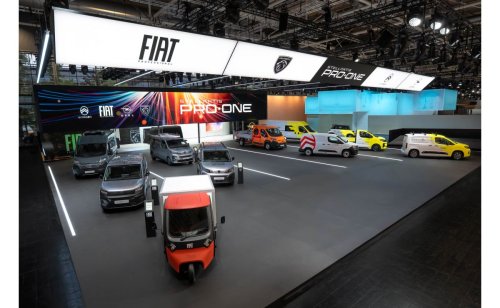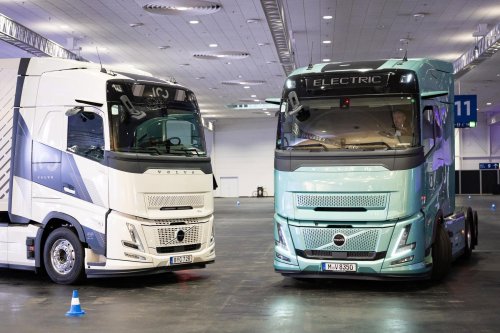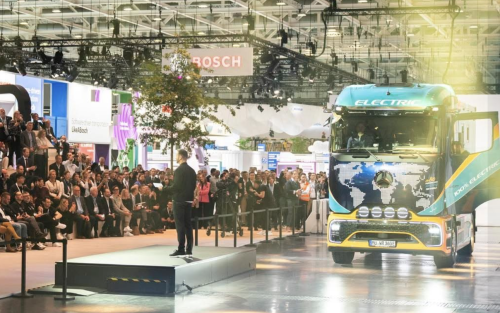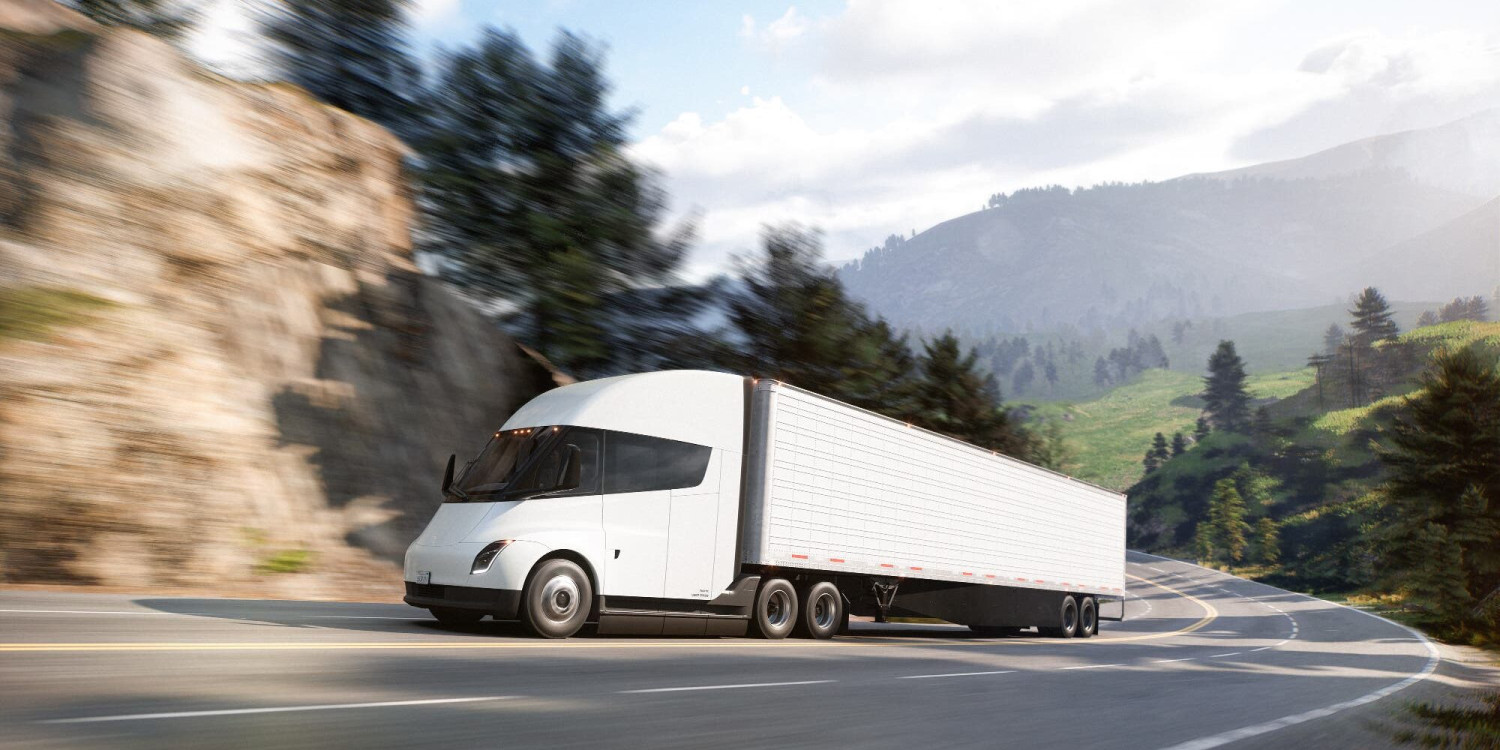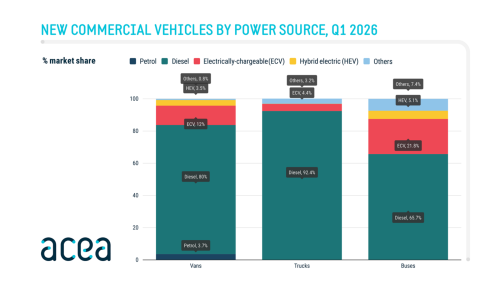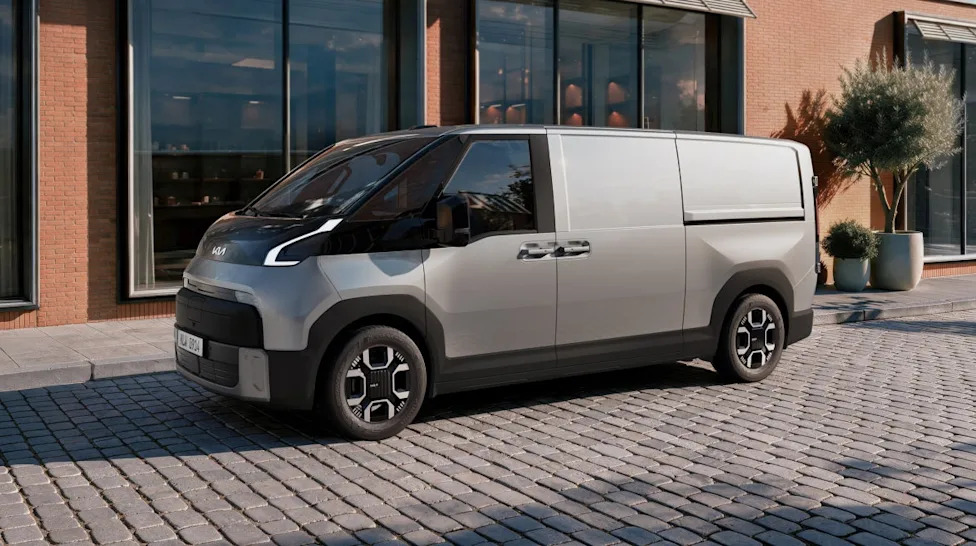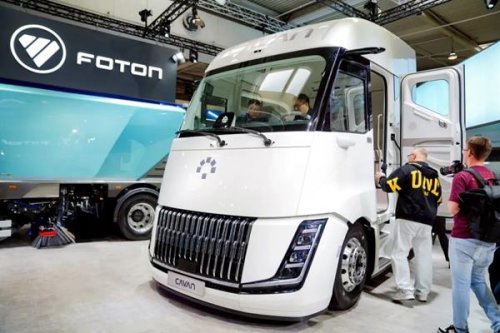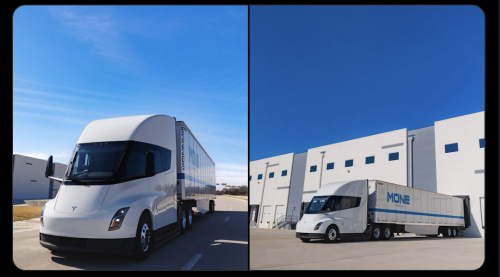
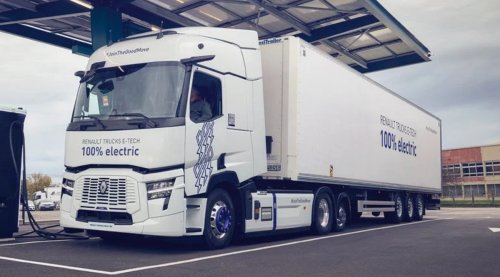
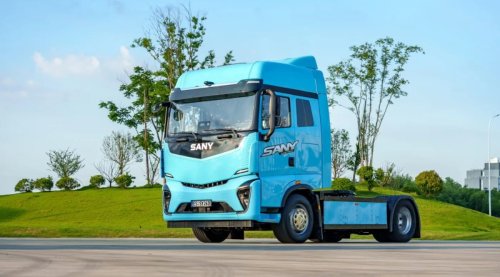
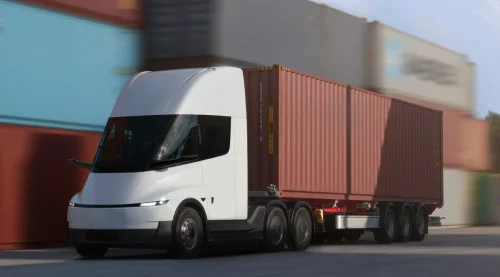
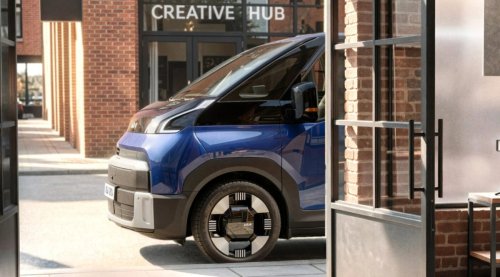
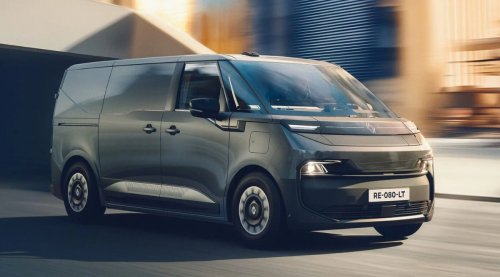



















What’s the latest word on electric commercial vehicles in the US? Pretty much crickets. In fact, most medium and heavy duty truck manufacturers in the US are doing their damnedest to beat back local and state regulations designed to reduce exhaust emissions. That may soon change, as the price of diesel in the US climbed past $6.00 per gallon last week. Things are different in Europe, where the push for more zero emissions commercial trucks is baked into EU regulations and is welcomed by the general public. Starting September 15, 2026, more than 700 exhibitors will pack the halls in Hannover, Germany for this year’s IAA Transportation show. According to Electrive, visitors will see electric trucks on display in three different categories: heavy duty tractors, medium duty work trucks, and the delivery vehicles that are the backbone of many small businesses. Heavy Duty Trucks Credit: Renault Trucks At a pre-show press conference, Hildegard Müller, President of the German Association of the Automotive Industry (VDA), outlined the challenges facing the industry. She invoked the innovative strength of domestic manufacturers and reminded Brussels and Berlin of their political responsibility to enable the ramp-up of alternatively powered commercial vehicles. “The commercial vehicle industry is a powerhouse,” she said. “It, and the many people working in logistics, keep our country running. The IAA Transportation will showcase the dynamism of our industry. It will once again be a showcase of innovations.” Daimler, MAN, Volvo, and Renault will all be present with their latest electric tractors. They will be joined this year by Ford’s Otosan heavy commercial vehicle brand based in Turkey, which is bringing an XXL electric truck to Hannover for the first time. The F-Line E, which Ford presented in Lyon in November 2025, will showcase its first electric 19- and 26-ton vehicles at this year’s show. Credit: Sany There will also be models on display from Chinese manufacturers such as Sany eTrucks, which will present its e263 e-tractor that will be available for sale in Germany beginning next June. Sany is now listing electric three and four axle trucks for the European market on its website. Other Chinese manufacturers at this year’s show will include Sinotruk and SuperPanther, two manufacturers that have already begun producing their E-trucks at Steyr Automotive in Steyr, Austria. Skyworth Auto is set to unveil its heavy duty Skyworth Z9, which will feature Level 4 autonomous driving technology. Other Chinese brands presenting at this year’s IAA Transportation show include FAW Trucks, Dongfeng, Foton, Farizon, Wisdom Motor, and DeepWay. CATL plans to showcase its new battery innovations tailored for commercial vehicles. Tesla Semi Debut Credit: Tesla But the buzz in Hannover won’t be any of those. It will center on Tesla, which has promised to showcase its Semi at the IAA show this year. Tesla is being typically tight lipped about the specs for the Semi. However, what is known suggests they will be virtually the same as those for the Semi Standard Range offered in the US. Any differences are attributable to adaptations designed to comply with European rating systems. The European version will use the same three motors operating on the two rear axles with a total output of up to 800 kW. The Semi is said to be capable of charging at up to 800 kW and operates on 800 volt architecture. It is expected to use the same 548 kWh battery that is standard on US models composed of NCMA battery cells manufactured by Tesla. For the European version, Tesla claims an estimated range of 550 kilometers, while the US version has a range of 523 kilometers. Tesla Germany states energy consumption of 1.0 kWh/km compared with 1.1 kWh/km in the US. This can be explained by the different weight limits and truck speeds in the US and Europe. In the US, the Semi is a Class 8 truck with a maximum gross vehicle weight of up to 36.3 metric tons (80,000 lbs) that is allowed to operate between 88 to 128 km/h. In Europe, the Semi has a GVWR of 40 metric tons and typically operates on highways where its speed is restricted to between 80 or 90 km/h. Standard cargo trailers in the EU have slightly different weights and exterior measurements, which will impact range slightly. Tesla Europe says “the choice of tyres, roof fairing, and semi-trailer configuration has a very significant impact on the projected consumption.” Tesla claims the Semi for Europe will have a curb weight of 9.1 metric tons and an electric power take-off rated at up to 25 kW. When coupled with a standard European cargo trailer, “Tesla would initially enter the European market with a payload optimized truck that sacrifices some range for a higher payload capacity. Range as a headline argument for everyday suitability quickly loses relevance in logistics operations if it comes at too great a cost to payload. For its European debut, Tesla has opted for a version with a smaller battery and, in return, a higher payload,” Electrive reports. Tesla Germany said in an announcement prior to the beginning of this year’s IAA show, “High-performance charging is designed for commercial use: The Semi is engineered to recharge a significant portion of its energy during a short stop at a Tesla Megacharging network station. This keeps the trucks productive and schedules on track. The Tesla Megacharger network comprises ultra-fast charging stations that enable drivers to get back on the road more quickly.” Tesla Germany will primarily market the Semi as a fully electric tractor unit with lower operating costs than conventional trucks. “The Semi was designed from the ground up as an electric truck and is intended to revolutionize freight transport. It is based on Tesla’s expertise in battery technology, electric powertrain, software, and manufacturing to meet the demands of modern logistics,” the company says. Tesla also highlights “remote diagnostics, over-the-air software updates, and reduced maintenance requirements as ways for operators to save time.” Vans, Vans, And More Vans Credit: Kia Ford Pro will introduce the all new battery electric Transit City at the IAA show. The company calls it a “particularly cost efficient” electric van, which starts at €35,990 net in its smallest configuration. It joins the E-Transit Courier, E-Transit Connect, E-Transit Custom, and the large E-Transit. KIA will showcase the PV7, a larger version of the PV5 that was introduced last year. It offers “more space and more possibilities than the PV5 to meet the changing needs of commercial customers across a wider range of business and lifestyle areas.” Kia will reveal the new van in the metal for the first time in Hannover. Stellantis will present is lowest priced electric van ever, the Smart Compact Van which, like the PV7, has not been officially unveiled publicly until now. Volkswagen Commercial Vehicles will present a version of the ID. Buzz that features Level 4 autonomous driving capability. The company says the electric van could deliver goods autonomously in the future, although the recipient would still need to unload them manually. Credit: Renault Trucks Renault will present its latest Trafic E-Tech, which is now built on an 800 volt platform. Charging times of less than 20 minutes for a 15 to 80 percent charge using a DC fast charger will be possible, the company says. Depending on the battery chosen by the customer, the van’s range is up to 450 km. Maxus, a brand of Chinese company SAIC, says its electric van will feature V2L, V2H, and V2G capability. At the IAA show customers, it will demonstrate how the battery in a vehicle can help reduce peak loads in its customers’ buildings , as well as power electric tools for field service technicians. Several other Chinese companies will also showcase their van products at this year’s IAA show. Electric Trucks Are Moving Up For electric vehicle advocates, the takeaway from this year’s IAA Transportation show is that the range of battery electric commercial vehicles available to customers in Europe is extensive and getting larger all the time. At a time when many conventional vehicles are powered by diesel engines, the economic advantages of electric trucks are becoming more compelling as the cost of diesel fuel continues to accelerate due to geopolitical disturbances. For fleet managers, who calculate expenses down to the thousandth of a euro per kilometer, the data increasingly favors battery electric vehicles. That may give the Tesla Semi a significant advantage, if and when it actually becomes available in Europe and is supported by a robust charging network as promised. Others may figure the diesel price spike is a temporary disruption that will pass in time. It is never easy to evict existing technologies from market dominance, but the signs suggest the move toward electric commercial vehicles in Europe has already begun and is rapidly gathering momentum.