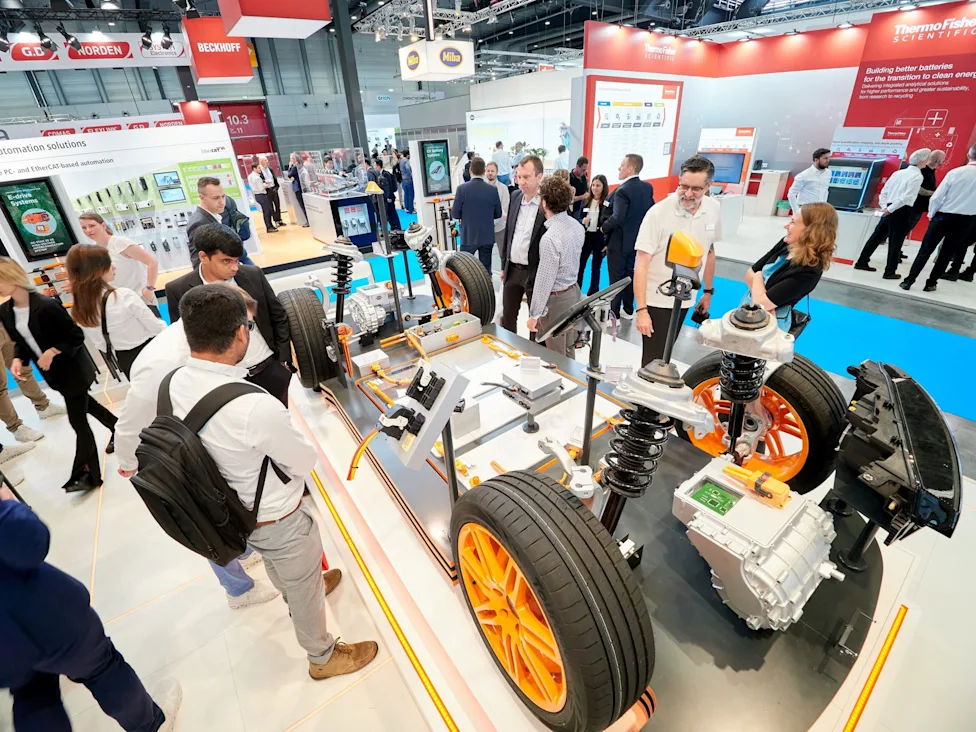
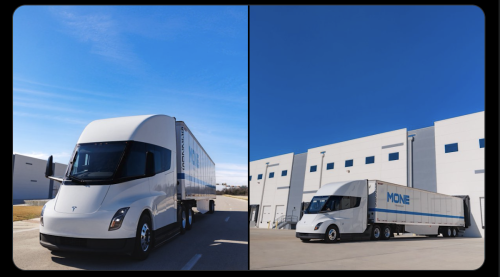
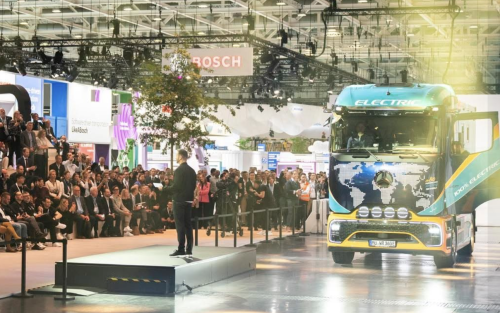
This week, CleanTechnica has been covering news about commercial trucks at the annual IAA Transportation trade show in Hannover, Germany. Our first story focused on the latest battery electric heavy duty tractors being offered by various manufacturers as well as a look at battery powered delivery vans. Overall, our readers took that news as an encouraging sign that electrification of the commercial truck fleet in Europe was gathering momentum. In a time of sky high prices for diesel fuel and crippling heat waves all across Europe this summer, we might expect those vehicles to find a warmer welcome among fleet buyers than in has been the case in the past. Tesla is using this year’s show to feature its Tesla Semi, which has been modified slightly from its US specs to suit European customers. The Standard Range Semi will be able to operate for up to 550 km on a single battery charge and can accept up to 800 kW of charging power. Some readers commented that those specs are fairly ordinary for heavy duty electric trucks in Europe today. This week in Hannover, CATL and Zerova have announced new products that beat those specs by a considerable margin. CATL Techtrans II Battery For Commercial Vehicles CATL says its latest Tectrans II promises ranges of up to 1,000 km and can be charged to 80 percent in 25 minutes using megawatt fast charging. The battery packs are designed so that they can be located anywhere on the chassis of a heavy or medium duty vehicle, including on the roof of buses. In conjunction with Octopus Energy, CATL is also promoting battery swapping solutions for commercial vehicles. The Techtrans’ battery features a gravimetric energy density of 170 Wh/kg — 13 percent higher than the industry average, according to the company. The battery is designed for a service life of 12 years and 1.5 million km with 70 percent capacity retention. In Hannover this week, CATL signed a letter of intent with the DHL Group to develop green freight corridors in Europe that will provide energy storage systems and energy management platforms for DHL’s logistics parks. The companies will focus on battery swapping and ultra-fast charging systems, as well as pilot projects for future electric vehicles. Zhu Lingbo, chief technology officer for the CATL Global Business Unit, told the press at the IAA show, “Commercial vehicle electrification will unfold over more than a decade. With our deep technological expertise and long-term commitment, CATL is ready to be the most reliable partner for customers worldwide and for the global electrification of freight transport.” Zerova 1440 kW Megawatt Charger Credit: Zerova Tesla refers to its 800 kW chargers for its Semi as megawatt chargers, but that isn’t completely accurate, is it? A megawatt by definition is 1000 kW. Zerova is a manufacturer of high power charging equipment. This week, it introduced its latest product: charging equipment for commercial vehicles that can deliver up to 1440 kW of power. That’s almost double what Tesla offers. With its MCS charger, Zerova states it can directly support the clean transportation transition and extend its experience in depot and fleet charging to the megawatt range for trucks and buses. “This launch reflects where the market is heading. Depot operators and logistics fleets across Europe are asking for megawatt-class charging they can deploy today and expand tomorrow, and that’s exactly what our MCS dispenser delivers,” said Brian Huang, Managing Director of Zerova UK. “European fleet operators need charging infrastructure that matches the pace of truck and bus electrification. Our MCS dispenser brings Zerova’s DC charging expertise to the megawatt class, giving operators a fleet satellite charging platform built to grow alongside the MCS standard as it matures across Europe,” said Judy Hung, the director of business operations for the company. The system is designed for both fleet depots and charging parks along long haul transportation routes. Backsliding In High Places The not-so-good news from Europe involves a call by truck manufacturers to roll back the proposed EU exhaust emissions standards for heavy trucks by three years. According to Reuters, the companies claim a lack of charging infrastructure and the high cost of electricity mean zero emissions commercial vehicles do not make business sense for their customers. Under current European Union rules, manufacturers must cut CO2 emissions from new heavy duty vehicles by 43 percent compared to 2025 levels by 2030, 64 percent by 2035, and 90 percent by 2040. Those who fail to comply risk substantial fines. At the present time, only 2.4 percent of new heavy duty vehicles are zero emission, which is far below the level required for the 2030 target, according to the European Automobile Manufacturers’ Association. The CEOs of Europe’s seven leading truck and bus manufacturers — a group that includes DAF Trucks, Daimler Truck, Iveco, and Scania — said that policymakers first need to create conditions to accelerate the roll out of charging stations, speed up grid connections, expand carbon dioxide based road tolls, and reinvest revenue from emissions trading in infrastructure and zero-emission vehicle uptake. That drew a heated response from clean truck advocates such as Rustam Kocher, formerly of Daimler Truck, and Stef Cornelis of Transport & Environment. Together they warn that diluting the standards now will deliver a blow to European jobs and competitiveness and hand competitors — particularly Chinese truck makers — an even bigger advantage than they already enjoy. The current emissions standards are working, the clean truck campaigners contend. European truck makers, on average, achieved the EU’s 2025 CO₂ reduction target of 15 percent one year early. Electric truck registrations in Europe increased by more than 50 percent as the first CO₂ standards took effect, while Daimler Truck tripled its zero-emission share within one reporting period when the targeted reduction was applied. Maintaining the existing 2030 targets could eliminate the sale of about 60,000 new diesel trucks, which, in turn, would avoid exhaust pollution equal to two million cars. In addition, electric trucks could cut European oil imports by 22 percent by 2035, saving businesses about €1,800 a month in fuel costs. The cumulative impact on the European economy would save the EU about €28 billion. European truck makers continued to prioritize shareholder payouts while seeking greater flexibility on their CO₂ obligations, the critics contend. “Europe’s truck makers are market leaders today, but they are failing to invest fast enough to defend that position. Chinese and US manufacturers could take more than a quarter of Europe’s electric truck market by 2030. The CO₂ standards are the main force pushing manufacturers to invest and compete, weakening them would reward inaction,” said Cornelis, in a statement shared with CleanTechnica. “Weakening the standards again would come at a cost Europe cannot afford. Europe has already delivered the policy certainty manufacturers asked for. Now it’s time for them to deliver the trucks. We cannot keep stalling climate action every time that big polluters ask. Manufacturers asked for flexibility and got it. The time for renegotiation is over. It’s time to deliver the electric trucks that businesses, drivers and communities are waiting for,” said Eoin Dubsky, a campaigner for Ekō. A Time For Action The climate advocates make an excellent point. The wolf is at the door. Diesel prices are approaching the equivalent of $10 per gallon thanks to the unremitting foolishness of the US administration. Thousands of people died in Europe this summer due to heat stress brought on by historically high temperatures. Of course, profits are important, but those profits will shrink alarmingly if a solution to the climate crisis is not found. Short term interests will be overwhelmed by long term deterioration of the environment. There will be no do-overs or second chances for humanity. The batteries and charging infrastructure needed to electrify commercial transportation are available. The time for excuses is over. It is time to take decisive action, rather than standing around helplessly, wringing our hands like the characters in Waiting For Godot.





















 +69 others