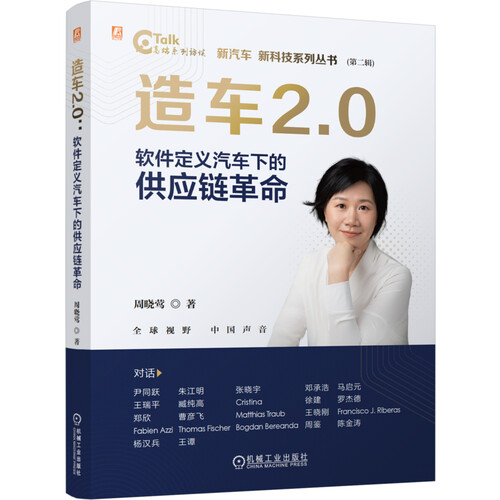
Gasgoo Munich-The automotive industry is entering a new cycle of competition.Not long ago, component suppliers were the unsung heroes behind automakers. Yet in the era of software-defined vehicles, the supply chain’s role is being fundamentally rewritten: shifting from hardware delivery to system integration, from cost centers to value creators, and from passive execution to active definition. The relationship between automakers and suppliers is evolving beyond traditional purchasing and supply toward joint R&D, capability building, and ecosystem collaboration.Against this backdrop, a new book — Building Cars 2.0: The Supply Chain Revolution Under Software-Defined Vehicles — has been officially released. Edited by Zhou Xiaoying, CEO and Editor-in-Chief of Gasgoo, the volume features interviews with renowned experts and executives from the global auto manufacturing and components sectors to explore the industry's ongoing transformation.As the second volume of the "New Auto, New Tech" series, the book focuses on industrial transformation in the era of software-defined vehicles. Centered on the theme of "supply chain revolution," it documents the ongoing shifts through in-depth dialogues with key executives from domestic and international automakers, component suppliers, and technology firms. It also seeks to answer an increasingly critical question:As automobiles evolve from mechanical products into intelligent technology terminals, how will the supply chain be restructured?Chapter 2 | Ecosystem Collaboration: Reshaping the Value of Top-Tier SuppliersIf automakers are the leaders of this transformation, top-tier suppliers are emerging as the key force defining the core capabilities of next-generation vehicles.As software content grows and smart cockpits, autonomous driving, and intelligent chassis become battlegrounds for competition, traditional Tier 1 suppliers are no longer mere hardware manufacturers. They are transforming into integrated software-hardware solution providers, shifting from "executors" that follow blueprints to "definers" and "co-creators" standing shoulder-to-shoulder with automakers.The second chapter, titled "Ecosystem Collaboration: Reshaping the Value of Top-Tier Suppliers," features insights from core managers at leading domestic and international supply chain firms, including Forvia’s Martin Fischer, Horse Powertrain’s Wang Ruiping, Yanfeng’s Zhan Chungao, Antolin’s Cristina, Desay SV’s Xu Jian, and Inteva’s Gerard Roose and Zheng Xin. Through perspectives ranging from the transformation of century-old Tier 1 giants and the rise of Chinese powertrain technology to smart cockpit ecosystems, global innovation networks, software-hardware integration, and holistic innovation, this section highlights the explorations and breakthroughs of suppliers in the Building Cars 2.0 era.Forvia is leveraging its century-old Tier 1 heritage to rethink the logic of the software and ecosystem era. Horse Powertrain declares that Chinese powertrain technology is no longer just "following along" but is actively participating in global technology exports. Yanfeng views the smart cockpit not as a static space, but as a symbiotic, evolving intelligent ecosystem. Antolin is practicing "in China, for the world" two-way innovation through its global network rooted in China. Desay SV demonstrates how technology and organization can self-accelerate using a flywheel of integrated software and hardware innovation. Meanwhile, Inteva adheres to customer-driven, holistic innovation—ensuring that innovation remains anchored to real value amidst fragmented demand and technological diversity.It is evident that the role of top-tier suppliers has shifted from hardware delivery to system integration, from cost centers to value creators—and truly moved from behind the scenes to center stage.As the industry shifts from traditional linear supply chains to networked ecosystem collaboration, what capabilities must suppliers possess? How will the power dynamics between automakers and suppliers evolve? And can the Chinese supply chain seize the initiative in the new round of global division of labor?These authentic voices from the industry frontline form the core observations of this book regarding the "reshaping of supply chain value."From "Chain" to "Network": Chinese Solutions Resonate GloballyThe stories of these six companies outline a clear picture of the automotive supply chain revolution: traditional linear supply relationships are being replaced by networked ecosystem collaboration. In this transformation, China is not only the largest testing ground but is also becoming the birthplace of new paradigms for the global supply chain.Who can translate technological innovation into stable mass-production capabilities? Who can take solutions proven in the Chinese market to the global stage? And who can establish truly sustainable technological and supply chain advantages amidst global competition?Building Cars 2.0: The Supply Chain Revolution Under Software-Defined Vehicles not only documents the present but also seeks to find answers. Starting with the authentic voices from the industry frontline, let us listen to the changes reshaping the automotive sector and gain a renewed understanding of the technology, enterprises, and supply chains of the Building Cars 2.0 era.