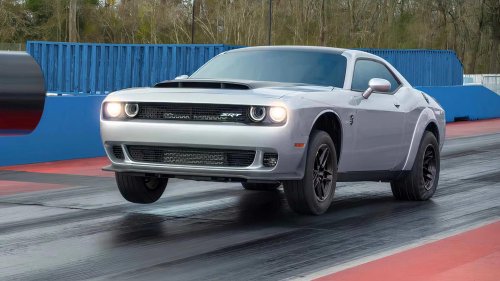
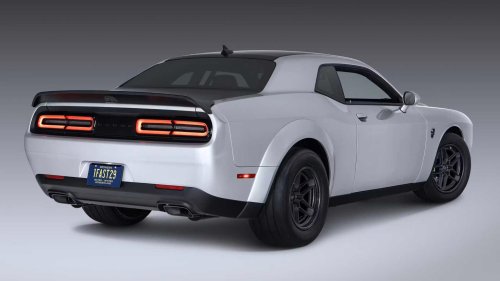
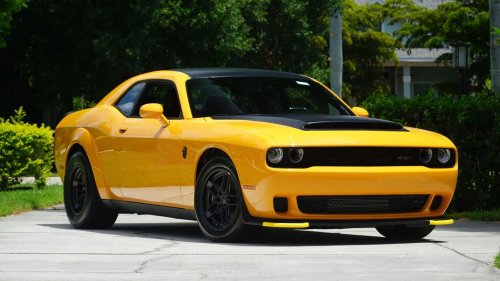
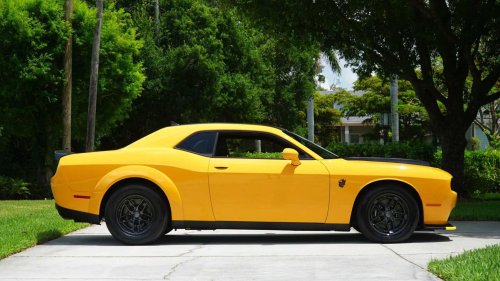
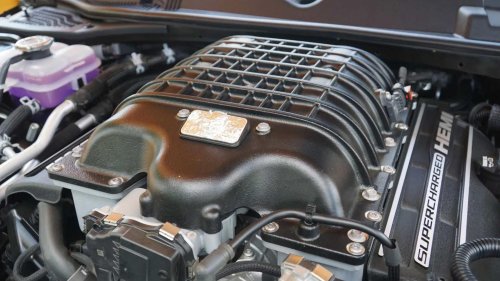
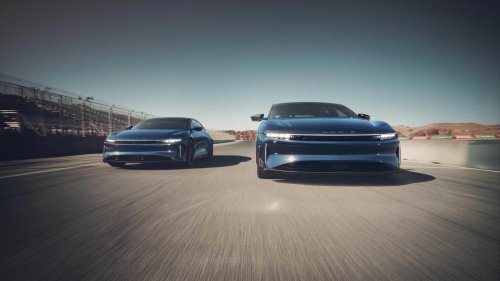



















Detroit carmakers don’t usually chase weird ideas just because they can—that doesn't pay the bills at the end of the month. Mostly, they build cars for commuters and fleets. They also answer to emissions tests, safety rules, and the kind of accountants who can spot a risky horsepower spike from across the room. But every brand keeps a secret shelf of ideas labeled “if we ever get away with it.”Every so often, they do start to push the rules. When that happens, the engineers get bold, and the marketing team stops pretending to be calm. A relatively recent coupe from Dodge proved how far an automaker can push a street car before it starts looking like a dragster that wandered onto public roads. This car feels like a weird experiment that should not have existed. Dodge Built A Street-Legal Science Project Bring a Trailer Honestly, Dodge didn’t even hide its intentions. The mission was simple—take a familiar coupe shape, shove it to the edge of what a factory can sell, and make it run the quarter-mile like a bracket racer. It had to leave hard, repeat the number, and still wear plates on the way home. That meant Dodge had to tune the whole package around launch, traction, and fuel. And this is what it did.The car comes with drag hardware right out of the box, plus software that treats the starting line like the main event. It uses a factory transbrake setup, track-focused modes, and tires chosen for bite instead of lifespan. But the real twist hides in how Dodge let owners unlock the full hit without turning every gas stop into a scavenger hunt.That’s where things get really…experimental. Dodge built a system that can read what’s in the tank and adjust the tune on the fly, because the fuel determines how wild the car gets. Dodge Was Actually Trying To Prove A Point Dodge To a large extent, the Demon 170 exists to show that a factory can build a near-dragster that still meets the basics of a street car. It keeps all systems that matter for legality and daily driving, and the automaker presents it as a purpose-built, street-legal production drag car. Dodge even required owners to sign a waiver that acknowledges the car’s very specific personality.The biggest trick sits in the fuel system. Dodge relied on E85, the ethanol blend that acts like cheap octane and cold coffee for a supercharged V8. The Demon 170 reads ethanol content in real time and adjusts its tune. It can run premium pump gas when it has to and still deliver its full rating when the blend is strong enough. On E10, it still makes 900 horsepower and 810 lb-ft, which is the kind of “backup plan” that makes other cars feel like lawn equipment.Stellantis That ethanol strategy solves a real engineering problem. Massive boost and big cylinder pressure invite knock, and that turns expensive engines into paperweights. Peak cylinder pressure reaches around 2,500 psi—roughly 50% higher than a Hellcat Redeye—so the Demon 170 can’t rely on luck. The car uses sensors, calibration, and fuel chemistry to keep the party going without scattering parts across the highway.The smaller, nerdier details show how Dodge made the trick repeatable. E85 isn’t always “85,” and the ASTM spec allows a wide range of ethanol content depending on season and region. The Demon 170 reads the blend and changes the tune, and Dodge says it makes full power when ethanol content hits 65% or more. That means the owner doesn’t need a chemistry degree, just a decent station and the willingness to smell like corn after every fill-up. The Demon 170 Was The Most Extreme Challenger In History Bring a Trailer But what is the Demon 170 actually? Start with a Challenger SRT, and a person gets a big, comfortable coupe with a long hood and a short list of apologies. The Demon 170 takes the same basic shape and turns every knob until it snaps. The manufacturer upgraded almost everything in and around the 6.2-liter supercharged HEMI short of the camshaft.Dodge fitted the modified 3.0-liter supercharger with a larger snout, a 105 mm throttle body, and a smaller 3.02-inch pulley that raises boost by 40% compared with the Hellcat Redeye Widebody. Then it reinforced the driveline with a hearty 240 mm rear axle setup sitting within a stronger differential housing, because 1,000-plus horsepower treats stock parts like disposable cutlery. Dodge also dropped in a 3.09 rear gear and built new logic into TransBrake 2.0 to help the car leave harder and more consistently.Bring a Trailer The marque then attacked traction like it owed money. The Demon 170 comes with Mickey Thompson ET Street R rear drag radials in 315/50R17 and matching front rubber—all DOT-approved but clearly aimed at prepped surfaces. Dodge calls it the first factory-production car built with staggered drag radials and matching fender flares. It also applies a unique Drag Mode suspension tune to the adaptive dampers, designed to transfer weight and plant the rear tires instead of roasting them. Give People What They Want Bring a TrailerEnthusiasts asked Dodge for one thing from the Challenger for years: make it faster, and make it real. The Demon 170 answers with numbers that were once reserved for dedicated drag cars. Officially, Dodge quotes 1,025 horsepower and 945 lb-ft on E85, plus 0–60 mph in 1.66 seconds, generating up to 2.004 g at launch. Those acceleration figures use rollout, as most headline-grabbing tests do, but the car still has to cover the ground.Drag racing is the Demon’s native language.Dodge worked with the NHRA to certify an 8.91-second pass at 151.17 mph, and that single figure defines the car’s reputation. The NHRA’s newer guidance lets many 2014-and-newer street cars run nine seconds without a cage and parachute, but the Demon 170 runs quicker than that. It misses the cutoff by a hair, which sounds small until you realize that hair measures the difference between “show up and run” and “bring a parachute.” Red Key Madness Bring a Trailer The 2018 Demon used a black key to cap power and a red key to unleash it, just like a Hellcat. Dodge threw that whole routine out for the Demon 170 and delivered the car with red keys exclusively and recommends only using dealer-supplied red keys when programming extras. If someone programs a black key anyway, the engine won’t reduce power, but the car won’t allow Drag Mode.Bring a Trailer Dodge still gives owners a safety blanket for real life. The Demon 170 features five drive modes, including a PIN-protected Valet mode that reduces engine torque for unfamiliar drivers. So yes, the owner can toss the keys to just anyone without also handing over a nine-second time slip. Buying The Demon Is One Thing, Running It Is Different Bring a Trailer On paper, the Demon 170 looked almost reasonable for about five seconds. Dodge listed an MSRP of $96,666 (before destination and fees). However, many dealers treated the car like a lottery ticket with a hood scoop and bumped the prices before delivery.Today, the used market tells a more interesting story than the early hype. Classic.com’s tracking shows a “current market” figure around $151,000. One Demon 170 on Bring a Trailer sold for $134,000 in January 2026, while low-mile cars with the right boxes checked still aim higher. Options matter because carbon-fiber wheels alone cost $11,495 when new.But the purchase price is just the cover charge. Running the car like Dodge intended turns into its own budget line. The Demon 170 ships on DOT-approved drag tires, and Dodge warns they aren’t meant for extended street use, don’t like wet roads, and can crack if someone tries to roll the car in temps below 15°F. Dodge also notes a 149-mph speed rating for highway use on those tires and only “allows” higher speeds in drag applications. If you want to drive it on the street routinely, a new set of tires is a must.Stellantis Track use adds more to the bottom line. Owners who want to run at sanctioned tracks often budget for extra gear. Dodge’s Direct Connection line sells a parachute mounting kit for about $1,329 and a separate release kit for around $899, and that’s before installation or the chute pack itself. The automaker also sells drag-focused add-ons like harness bars and seat-delete pieces. Are There Actual Alternatives? Dodge If the target is “factory-built, warrantied, street-legal drag monster,” the shortlist gets lonely fast. Even Dodge’s own family tree can’t quite match it. The 2018 Demon and the later Challenger Super Stock brought drag-race manners to the showroom, but their claimed quarter-mile numbers sit well above the Demon 170’s certified 8.91-second run.Lucid Motors Most of you are probably going to hate this, but some of the closest straight-line rivals come from the EV world, because electric motors don’t need to spool, build boost, or negotiate with traction control like it’s a hostage situation. Car and Driver tested the Lucid Air Sapphire at 9.1 seconds in the quarter-mile, and MotorTrend has recorded a 9.0-second pass in its own testing. Tesla has long claimed 9.23 seconds for the Model S Plaid, and the aftermarket world has pushed Plaids even quicker with track-focused setups.Gas-powered alternatives tend to trade outright ET for balance. A Shelby GT500, for example, can run around a 10.6-second quarter-mile and a C8 Corvette Z06 can dip to about 10.5 seconds in the right trim. They handle and brake better, and fit in more parking spots. But they definitely won’t make an NHRA official reach for a form letter the moment the car rolls through tech.That doesn't mean the Demon 170 is undefeated. High-powered Corvettes have been closing in on it for some time, and GM has even posted sub-nine numbers on prepped surfaces for certain variants. The 1,250-horsepower ZR1X recently made an 8.6-second run at a public track, dethroning the mighty Mopar. Still, the Demon 170 holds a notable advantage for certain buyers—it isn’t a supercar trying drag racing for fun, it’s a drag car pretending to be a street car. Dodge built it that way on purpose, and it’s just brilliant.