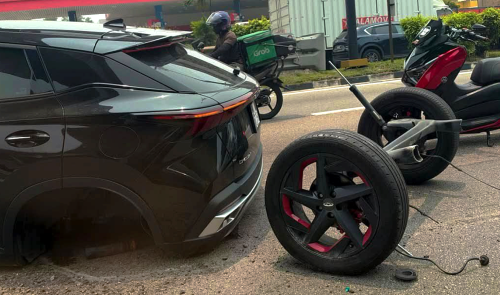
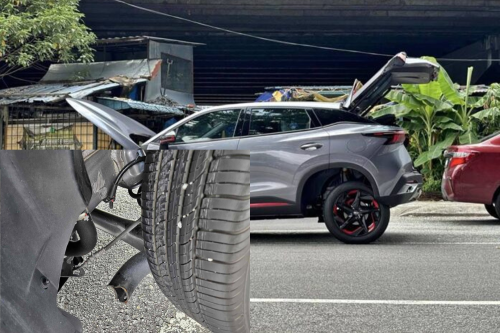
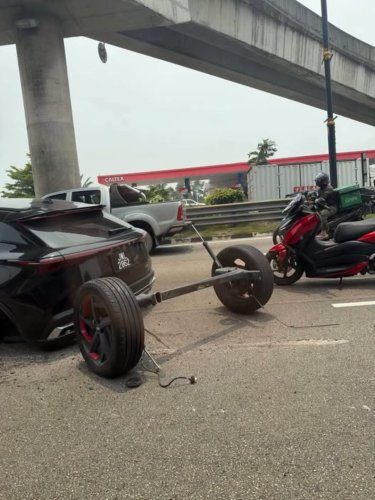
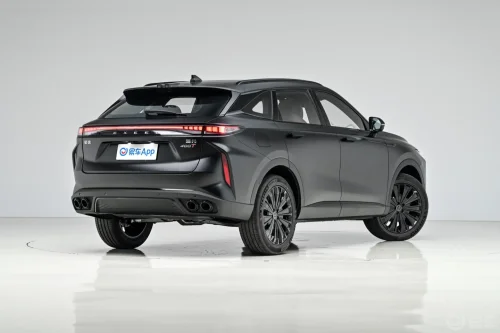
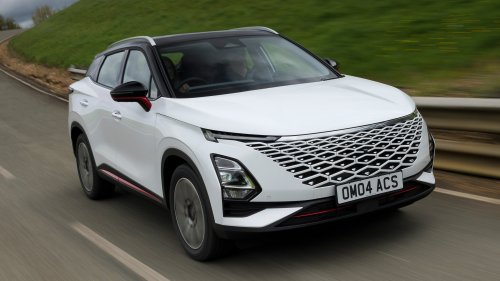
The detached rear suspension assembly, including the transverse torsion beam and both rear wheels, rests behind the Omoda 5. Credit: Panggil Aku Naz A Chery Omoda 5 suffered a complete rear axle detachment in Johor Bahru, Malaysia, in an incident that appears to mirror the structural failure behind a 2024 safety campaign, reports AsiaOne. The incident occurred on October 6 along Jalan Pandan near AEON Mall Tebrau City. On-scene photographs and dashcam footage show a black Omoda 5 (registration JWL 2862) stranded in a traffic lane with its rear suspension assembly, including the transverse torsion beam, trailing arms, shock absorbers, brake lines, and both road wheels, separated from the chassis and resting behind the vehicle. No injuries were reported. Images also show dents on the rear-right passenger door, although it remains unclear whether they relate to the axle separation or an earlier incident. Echoes of the May 2024 recall The earlier case occurred on April 28, 2024, when a Malaysian owner’s Omoda 5 suffered a severed rear axle beam while driving slowly in traffic. That case prompted an investigation by Malaysia’s Road Transport Department (JPJ) and was followed by Chery Auto Malaysia’s precautionary safety campaign covering 600 vehicles. Chery documented the campaign in its May 2024 safety notice. At a technical briefing in May 2024, Chery Auto Malaysia Vice President Lee Wen Hsiang said the root cause was an equipment calibration failure at an overseas component supplier. According to Chery, an automated welding tip had been replaced during maintenance, but improper recalibration resulted in incomplete weld penetration on affected rear axle beams. Chery said 60 Omoda 5 vehicles had received affected components produced on August 15, 2023, while the inspection campaign covered 600 vehicles fitted with rear axles produced between August 14 and 17. The 2024 campaign concerned the Malaysian-market Omoda 5 configuration using a torsion-beam rear suspension. It should not automatically be applied to the electric Omoda E5, which uses a different rear suspension architecture. Inokom Corporation in Kulim, Kedah, assembled the Omoda 5 locally from Completely Knocked Down (CKD) kits. Contemporary Malaysian-market specifications list the 1.5-litre turbocharged model with front-wheel drive, a CVT and torsion-beam rear suspension. A Malaysian Chery Omoda 5 after its rear axle beam reportedly fractured while the vehicle was moving in traffic in April 2024. Credit: Snowbunnie Unresolved questions for Chery The October 6 incident raises questions about whether the vehicle was covered by the 2024 campaign and about its service history. It remains unverified whether JWL 2862 was among the 600 vehicles inspected, whether an authorised service centre cleared it, or whether it was produced outside the affected August 2023 component window. The photographs show the rear suspension assembly separating from the vehicle, but do not establish whether the failure originated at a mounting point, within the transverse beam or at another component interface. Chery Auto Malaysia had not issued a formal technical report or confirmed the vehicle’s production date at the time of publication. The vehicle’s production date, suspension specification, recall history and failure cause will therefore need to be established before any connection to the 2024 weld defect can be confirmed. The rear-right passenger door of the Chery Omoda 5 shows visible dents, although their connection to the axle separation is unconfirmed.