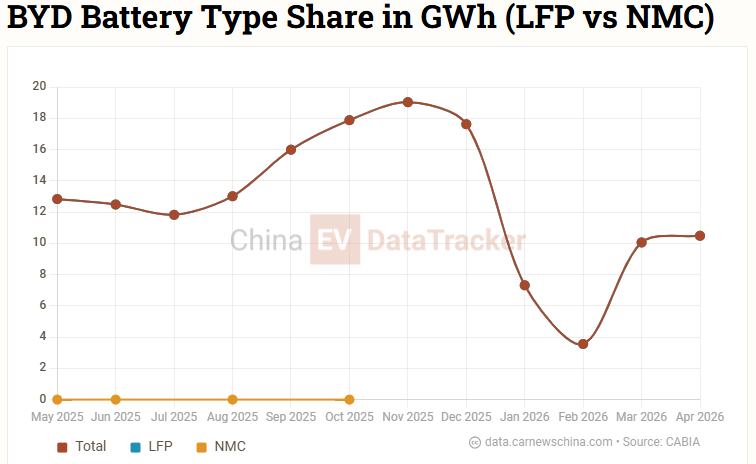



















BYD CTO said battery thermal limits have evolved beyond 70°C. Image enhanced by CNC. Understand China EV’s Market Real-time notifications when critical EV data is released All important data in one place 2,000,000+ data points Become a member A livestream test of BYD’s second-generation Blade Battery recorded a difference between localised temperature measurements and battery management system (BMS) readings during megawatt flash charging, alongside separate technical comments from BYD’s battery CTO regarding thermal design limits in high-temperature operation. The test, conducted under ambient conditions of approximately 25°C, recorded a peak localised external sensor temperature of 76.42°C at the centre-bottom area of the battery cell surface. During the same charging session, vehicle BMS data accessed via OBD reported a maximum pole temperature of 71°C. The difference between the two values reflects variation between localized measurement points and system-level temperature reporting within the battery management architecture. Livestream measurement structure According to the test data, multiple internal sensors within the pack recorded a maximum temperature spread of 6.5°C, ranging from 69.89°C to 76.42°C depending on sensor position. The readings indicate that temperature distribution within the battery pack was not uniform during sustained high-power charging conditions. Different sensor locations captured varying thermal states across the cell structure during the same charging cycle. In lithium iron phosphate (LFP) battery systems such as BYD’s Blade Battery architecture, heat generation during fast charging is typically concentrated near electrode interfaces and current collection paths, while dissipation depends on structural layout and cooling channel efficiency. Difference between BMS and localized measurement points The battery management system monitors pack conditions using distributed sensor inputs placed at selected points inside the battery pack. These readings are used for thermal control, safety management, and charging regulation. Localized external sensors or experimental measurement setups may capture temperature values at specific cell surface locations, which can reflect transient or peak thermal conditions not directly represented in system-level outputs. As a result, differences can appear between peak localized readings and BMS-reported values depending on sensor placement and sampling methodology. CTO technical comments on thermal limits In separate remarks published in a media interview, BYD battery CTO Sun Huajun addressed industry discussions around flash charging and thermal thresholds in next-generation battery systems. He stated that the commonly referenced 70°C level should not be treated as a fixed barrier in modern battery design, noting that thermal management capability has evolved alongside cell structure and electrochemical improvements. Sun also referenced BYD’s Blade Battery architecture, highlighting its structural layout and cooling design as key elements supporting high-power charging operation. He further discussed the company’s development approach combining production validation and long-cycle testing before commercialization. The CTO comments did not reference specific livestream measurements or sensor readings, but instead focused on system-level design principles and charging performance boundaries. Thermal behavior under megawatt charging conditions The recorded temperature range occurred during sustained high-power charging, where heat generation increases with current density across electrode interfaces. Under such conditions, transient temperature differences can form across different regions of the battery pack depending on internal resistance distribution, heat conduction pathways, and cooling system response speed. Even when system-level temperatures remain within operational control limits, localized variations can still occur across different measurement points within the pack. Measurement context and system-level interpretation Battery evaluation under fast-charging conditions typically combines embedded sensor data, thermal modeling, and post-test analysis to assess internal temperature distribution and control response. BMS readings represent system-level monitoring inputs rather than full spatial thermal mapping of all cell regions, which is typically reconstructed through modeling or additional instrumentation in testing environments. BYD’s EV battery installation in China. Credit: China EV DataTracker Industry context BYD’s lithium iron phosphate battery installations reached 10.49 GWh in April 2026, reflecting a 26% year-on-year decline, as the market continues to transition toward higher charging power and energy density requirements, according to China EV DataTracker.