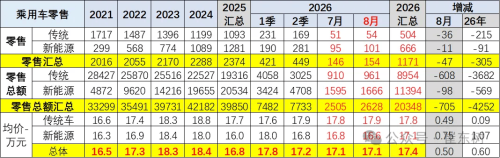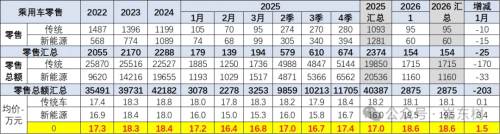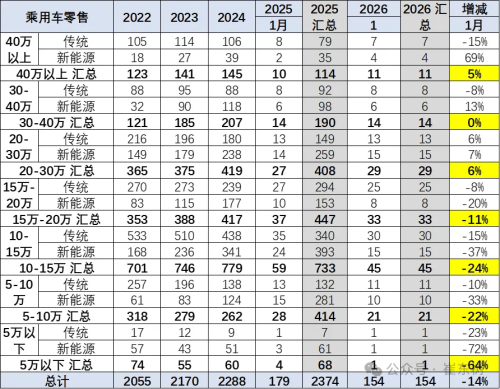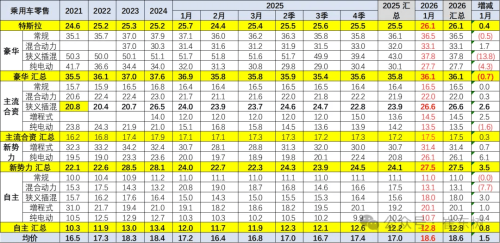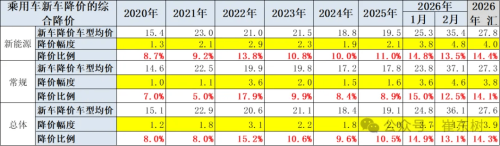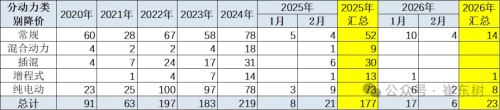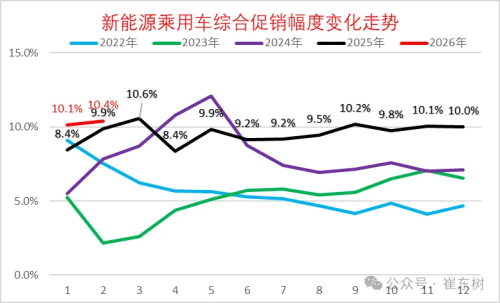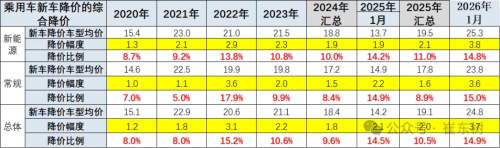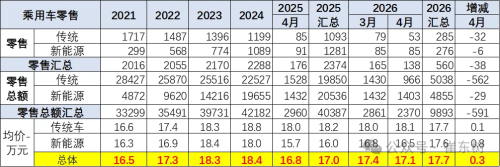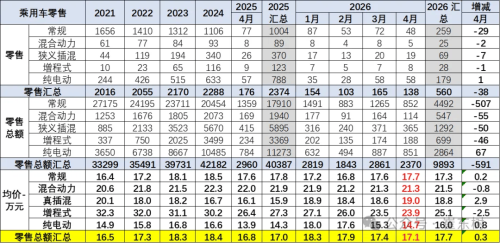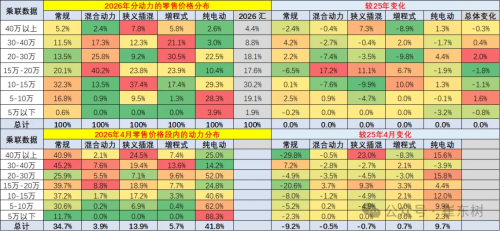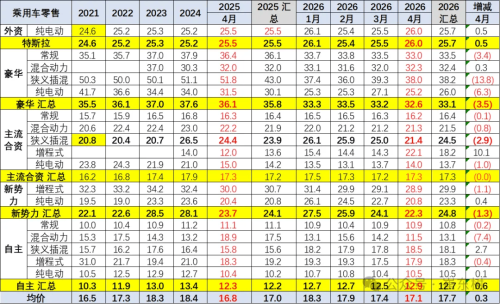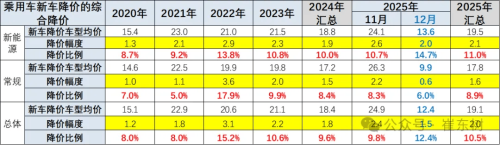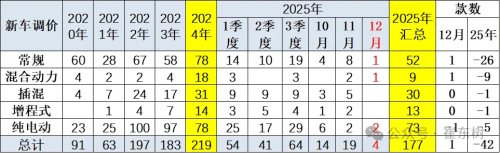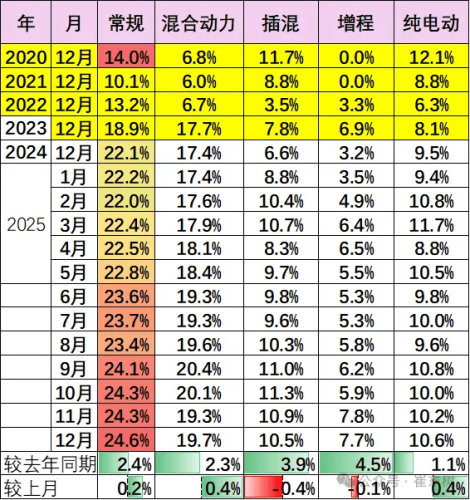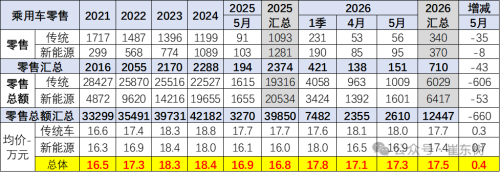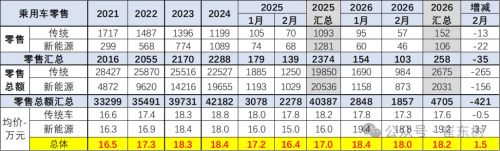
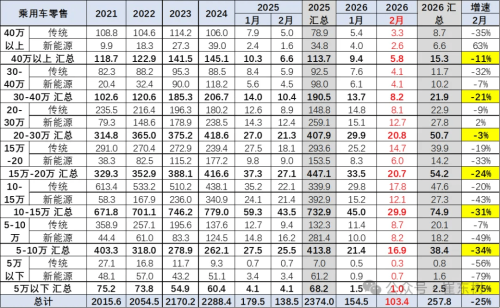
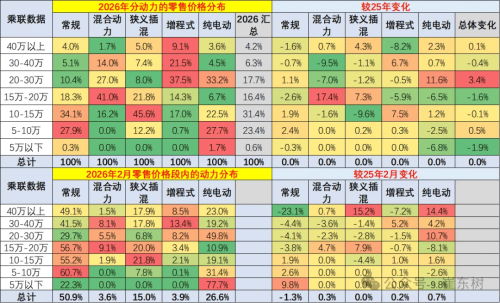
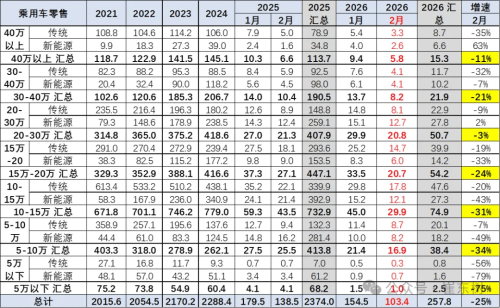



















In Feb, EREVs and HEVs recorded the highest average prices, reaching RMB 261,000 ($37,980) and RMB 211,000 ($30,720) respectively. BEVs had the lowest average price at RMB 171,000 ($24,900). Latest data disclosed by Cui Dongshu, Secretary General of the China Passenger Car Association, show that the average selling price in China’s passenger car market reached RMB 180,000 ($26,210) in February 2026, up RMB 15,000 ($2,180) year-on-year. Overall prices continued to rise, with new energy vehicles recording a more significant increase. Specifically, the average price of new energy passenger vehicles reached RMB 188,000 ($27,260) in February, an increase of RMB 35,000 ($5,100) compared with the same period last year. Annual and monthly sales data for China’s passenger vehicles from 2021 to 2026 Although overall market growth has slowed, the price increase reflects a shift in the consumption structure of the NEV market, with the share of lower-priced models declining and higher-priced vehicles gaining weight. By powertrain type, price differences remain significant. In February, EREVs and HEVs recorded the highest average prices, reaching RMB 261,000 ($37,980) and RMB 211,000 ($30,720) respectively. BEVs had the lowest average price at RMB 171,000 ($24,900). Data from CPCA show that the price structure of the domestic passenger car retail market has been trending upward in recent years. Sales of higher-end NEV models have continued to grow, while lower- and mid-priced vehicles have gradually declined. China’s vehicle sales data across different price segments from 2021 to 2026 Entering 2026, this trend has become more pronounced. The contraction of the low-price segment has accelerated, with sales in the sub-RMB 50,000 ($7,280) price band falling by about 75% year-on-year. In terms of powertrain distribution across price ranges, NEV models are unevenly distributed. In the sub-RMB 100,000 ($14,560) segment, BEVs show the weakest presence, while EREV models are most concentrated in the high-end market. Sales data and price distribution for various price segments in 2026 and February 2026 HEVs are mainly concentrated in the RMB 150,000 ($21,840) to RMB 400,000 ($58,240) range, while PHEVs are largely distributed in the RMB 100,000 ($14,560) to RMB 200,000 ($29,120) band, which represents the mainstream price segment in the current market. In comparison, the price structure of traditional ICE vehicles remains relatively stable, primarily concentrated in the RMB 50,000 ($7,280) to RMB 200,000 ($29,120) range, while still maintaining a certain scale in the segment above RMB 300,000 ($43,680). From a brand perspective, the average price of luxury brand passenger vehicles in February was RMB 344,000 ($50,090), down RMB 14,000 ($2,040) year-on-year. Joint-venture brands recorded an average price of RMB 173,000 ($25,190), up RMB 2,000 ($290). Passenger vehicles broken down by categories and years, including numeric values for each segment from 2021 to 2026 New EV startups recorded an average price of RMB 259,000 ($37,710), up RMB 33,000 ($4,800) year-on-year. Chinese self-owned brands averaged RMB 127,000 ($18,490), representing an increase of RMB 10,000 ($1,460). Overall, Chinese self-owned brands continue to expand their presence in the NEV sector. However, demand for BEVs has weakened somewhat, while the share of PHEV and EREV models is increasing. At the same time, higher-end NEV models are becoming more competitive on price, although the pricing structure of emerging EV brands remains somewhat volatile.