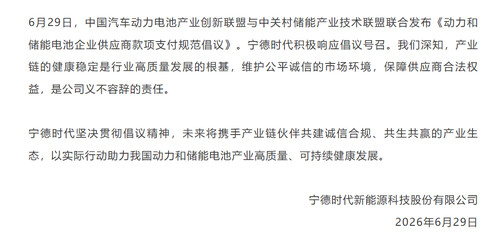
Gasgoo Munich- The crackdown on overdue payments across the automotive supply chain is now reaching the battery sector.On June 29, the China Automotive Battery Innovation Alliance and the China Energy Storage Alliance issued a joint initiative. It is titled "Payment Standardization Initiative for Power and Energy Storage Battery Suppliers." The proposal targets persistent industry ills. These include excessively long payment cycles and delayed acceptance checks. It also addresses the abuse of commercial acceptance bills and the long-term occupation of funds for small and medium-sized suppliers. It sets unified standards covering order signing, goods acceptance, reconciliation, settlement, and payment deadlines.On the day of the release, 11 leading battery makers—including CATL, FinDreams Battery, CALB, EVE Energy, and Sunwoda—pledged to cap payment terms for small and medium suppliers at 60 days.The news drew mixed reactions across the supply chain. While many smaller suppliers breathed a sigh of relief, they also recognize a hard truth: whether the 60-day limit actually lands depends on more than just the battery companies. The lithium battery chain has long operated under a top-down transmission of funds.One industry insider offered an analogy: it's like a rope—if one end is loose, the whole thing can't be pulled taut. Only when every link is tightened does the line straighten out.How Did This Become the Industry Default?The swift response to the initiative suggests the problem has deep roots.Wind data from 2025 annual reports of 31 listed companies in the Shenwan lithium battery sector shows an average accounts payable turnover period. This period stands at 97.3 days. The disparity is stark: the highest figure exceeds 204 days, while the lowest is just 12. This represents a gap of nearly 20-fold.Narrowing the focus to top-tier power battery makers, the trend of stretching payment cycles is more pronounced. Gasgoo data for seven mainstream listed battery companies highlights this trend. While the average receivable cycle was roughly 92 days in 2025, the average payable cycle hit 159 days. This figure climbs even higher when accounting for bill maturity dates.Specifically, companies like CATL and Gotion High-tech saw their accounts payable turnover days stretch beyond 180 in 2025. Yet, CATL's receivable turnover was under 60 days, while Gotion's hovered around 130. Farasis Energy, meanwhile, kept both receivable and payable cycles relatively short, despite failing to turn a profit last year.That raises a question: why are battery companies dragging out payments so universally?Industry analysts argue this can't be simply dismissed as battery makers dumping pressure on their vendors. The deeper cause lies in a top-down fund transmission mechanism. When automakers are slow to pay, battery cash flow tightens, forcing that financial pressure further upstream to material suppliers. In other words, this isn't a choice by any single company. It is how the entire chain operates. This process dictates who gets paid first and who gets paid last.One auto sector researcher put it bluntly: "Battery companies can't collect from others until the automakers pay them." Automakers often hold the strongest bargaining power in the chain. If they move slowly, every link downstream has to slow down. Battery makers are caught in the middle—squeezed by automakers above and material firms below.So, this push to clean up payment terms—extending from automakers to battery makers—isn't two separate events. It's the second half of the same story. If one link in the chain is loose, none of the others can tighten up.Beyond the terms written in contracts, there are plenty of "hidden" ways to stretch payments. Multiple sources indicate that while some contracts fix the payment period, delays in acceptance checks, stalling on reconciliation, and sudden order changes mean actual payment times far exceed what's on paper.Commercial acceptance bills are another channel. Originally a legitimate payment tool, they became a way to defer payments during the industry's rapid expansion. Suppliers deliver goods, wait months for a bill, then wait months more for it to be honored. Need cash urgently? You can discount the bill, but that eats into margins with extra financing costs.Reports suggest commercial bills have long indirectly extended payment cycles in the lithium supply chain. If upstream small suppliers need cash flow and choose to discount these bills, they incur extra financing costs. Combined with the implicit cost of tied-up capital, overall profitability gets eroded. That is precisely why this industry initiative explicitly calls for reducing the use of commercial bills and promoting cash settlements.If commercial bills and similar tactics run rampant, large corporations might weather the storm, but smaller suppliers often cannot. Faced with delayed payments and rising financing costs, these firms are forced to slash spending on R&D and technical upgrades. This sustained tightening of funds eventually ripples through the entire industry, stifling innovation and slowing the pace of technological iteration.An official from the Ministry of Industry and Information Technology (MIIT) noted that imbalanced payment terms hurt small businesses. They also weaken collaborative innovation across the supply chain. This amplifies risks during industry downturns. During the cyclical adjustment of the past two years, many upstream companies had to cut or halt production. This was due to tight cash flows. It directly impacted delivery schedules downstream.Image Source: CATLThe energy storage market faces a similar dynamic. Most small integrators can't meet the direct signing thresholds of battery makers and must source through multi-level agents. This layering drives up procurement costs and creates mismatches in payment cycles and capital occupation.Comparatively, comprehensive costs in energy storage channels are significantly higher than in power battery channels—a gap rooted largely in differences in capital occupation. Commercial and industrial storage projects require heavy upfront investment and feature long payback periods, leading to high financial costs from long-term capital advances and ongoing maintenance. Power batteries are supplied in standardized batches to automakers. They carry basic channel and term costs. However, they lack the pressure of massive, long-term capital advances. This keeps additional channel costs relatively lower.The problem has layered up to the point where it's no longer just about "one company paying slowly." The entire method of capital circulation along the chain needs improvement. By pushing this initiative and securing commitments from 11 leading battery firms, the two alliances aim to fundamentally reshape how capital flows through the entire supply chain.Dong Jing, an analyst at the Gasgoo Automotive Research Institute, believes the initiative's biggest breakthrough is moving payment term constraints from "paper" to "rigid, full-process calibration."On one hand, it clearly defines the start of the payment term as the date of delivery or acceptance, compressing the acceptance window to 7 working days. This plugs the gray area where acceptance checks were used to drag out payments. On the other hand, reducing commercial bills and encouraging cash settlements aims to end the "double occupation" of funds caused by "paper terms plus bill delays," making the 60-day cap a reality.Why Hit the Brakes Now?Shortening payment cycles feels different for different battery companies.Giants like CATL and FinDreams have deep financial reserves. CATL's 2025 annual report shows year-end cash and cash equivalents approaching 300 billion yuan. It reported a net operating cash flow of 133.2 billion yuan. The debt-to-asset ratio stands at 62% and continues to improve.FinDreams benefits from the closed loop of BYD's internal vehicle support, enjoying low receivable turnover days and clear advantages in internal capital coordination. It faces almost no pressure from large capital advances. For these two, shortening payment terms brings pressure, but nothing life-threatening.Second-tier battery makers are less composed. Companies like Gotion, EVE Energy, and CALB generally faced high debt ratios and large interest-bearing debts in 2025. Gotion's debt ratio exceeded 71% last year, with cash on hand insufficient to cover short-term interest-bearing debt. Moreover, second-tier makers typically see receivable turnover days above 80; compressing payment terms will squeeze their cash flow far harder than it will the market leaders.Image Source: WeLion New EnergyDuring the lithium downturn of 2025, several related companies delayed projects due to tight cash chains. In energy storage, Tianyancha data shows that by March 2026, a staggering 63,000 storage companies were listed as abnormal—including deregistered or revoked licenses—within just five years.The funding constraints imposed by payment term governance will accelerate the clearing of backward capacity, pushing orders and capital toward top-tier firms. Yet, voluntarily breaking a years-long model of interest-free capital occupation is no easy task for anyone.During the past phase of high-speed expansion, stretching payment terms and issuing commercial bills en masse were standard low-cost financing tools for battery makers. By occupying upstream funds via ultra-long terms, companies could offset massive cash outlays. These outlays cover raw materials, new production lines, and inventory stockpiling. This was done without taking on extra debt.Now, with payment deadlines strictly compressed and commercial bills restricted, cash outflows are accelerating significantly. Procurement payments that could previously be deferred in installments must be settled within 60 days; payments reliant on bill delays must switch to cash. The crude logic of capital dispatch many companies relied on may no longer suffice.Greater uncertainty lies downstream. The underlying contradiction of capital transmission in the chain hasn't disappeared: OEM payment speeds still dictate the ceiling for battery maker cash inflows. If automakers do not improve their payment rhythm in sync, battery makers face a risk. If they unilaterally shorten terms, they must shoulder the cash flow gap alone. This gap is caused by mismatches on both ends. That is not a burden one company can carry.So why do it? The core reason: supply chain stability matters more than ever.The logic of industry development has shifted. In the early expansion phase, companies competed on capacity scale and unit cost. Today, supply chain collaboration, stable supply, and joint R&D are becoming the core competitive chips. Premium upstream suppliers are no longer just vendors; they are partners in bringing new materials and processes to life.Image Source: CATLRelying on ultra-long payment terms to occupy supplier funds might relieve short-term pressure, but it long-term consumes the upstream's ability to expand and research. Once raw materials enter a shortage cycle, companies with poor payment terms will see their supply priority drop, or even lose capacity allocation.Shortening payment terms is essentially using stable cash cooperation to buy priority supply and customized technical support from upstream. It is a long-term investment in supply chain security.Another change comes from internal management. The old model of ultra-long terms and heavy bill use involved complex coordination with suppliers—reconciliation, bill verification, payment scheduling—which consumed significant human resources. With standardized 7-day acceptance and 60-day cash settlements, payment nodes become uniform, reducing disputes over accounts and bills.Viewed over time, this payment rectification marks a turning point for the power battery industry—shifting from crude scale expansion to refined operations. Future competition won't just be about how fast capacity expands or how low manufacturing costs are. Supply chain governance and the efficiency of capital coordination across the chain will become key differentiators. Adapting to new payment rules is a necessary path for top firms to cement long-term advantages.Payment Terms Change, So Does the GameThe initiative changes payment rules, and with them, the business logic of the entire supply chain.The most direct change is upstream. For material and equipment companies, improved receivable turnover means faster cash return. This reduces the need for short-term financing. It frees resources for R&D, process upgrades, and capacity optimization. One equipment company calculated that shortening the payment cycle by 30 days could save millions in annual financial costs. This money could be funneled directly into developing next-generation equipment.For many "little giant" firms specializing in niche technologies, the benefit isn't just "getting the money back." When companies do not have to rely on constant financing to stay afloat, they can focus on long-term R&D. They become more willing to engage in deep cooperation with downstream partners. As chain-wide collaboration improves, the industry's innovation efficiency rises. The industrialization of new technologies like sodium-ion and solid-state batteries could benefit from this.Image Source: CATLThe energy storage market will also feel the shift. Previously, small integrators couldn't meet battery makers' direct thresholds and relied on multi-level agents, leading to layering of capital advances and price markups. As payment rules standardize and upstream capital occupation drops, the space for middlemen to profit from payment terms and arbitrage narrows.As payment rules standardize, the room for channels to profit from capital occupation and arbitrage shrinks. This doesn't mean intermediaries have no value, but the source of that value must change. Making money from information asymmetry and capital advantages is getting harder; capabilities like solution design, project implementation, installation, and maintenance are becoming increasingly vital.The competitive focus for integrators will shift to "can you deliver the project well?" Companies will change their mindset, spending less energy hunting for goods and comparing prices, and more time studying user needs and optimizing solution designs.From a macro perspective, this is a positive development. In the past, some companies gained advantages through ultra-long payment terms and bill settlements, creating a degree of disorderly competition. As capital rules unify, competition will return to core capabilities: product quality, technical innovation, and customer service.Image Source: BAIC GroupOf course, payment term governance won't produce overnight results. The capital transmission chain between automakers, battery makers, and material firms is long. The operational health and bargaining power of companies at each link vary widely. Implementation will inevitably be uneven.Dong Jing believes that, long-term, a unified payment yardstick will help break the "prisoner's dilemma" of delayed payments. This dilemma has plagued the industry. It will accelerate capital turnover and point toward a healthier virtuous cycle. But short-term friction remains: second- and third-tier battery makers have weaker bargaining power and are easily squeezed by both automakers and upstream suppliers.More importantly, the current initiative is a soft industry constraint. There is a risk that some companies might maintain existing levels of capital occupation. They could do this by adjusting quality deposit ratios or switching to other credit instruments. This would effectively sidestep the payment term limits.This warning highlights the complexity of the issue. Yet change is rippling through the chain. For upstream material suppliers, more standardized settlement mechanisms can directly relieve capital pressure, giving them leeway to invest in R&D and upgrades. For battery companies, it requires a shift from relying on term-based expansion to more refined management of cash flow and supply chain balance. For automakers, it means re-examining the logic of cooperation with suppliers.This adjustment may not immediately reshape the industry landscape, but it is driving a gradual improvement in capital turnover efficiency. The center of gravity for competition will increasingly return to "who does it better." The deeper significance lies in the establishment of a more transparent set of cooperation rules. This lets transactions return to fairness. It also lets competition return to products, technology, and collaborative capability itself.