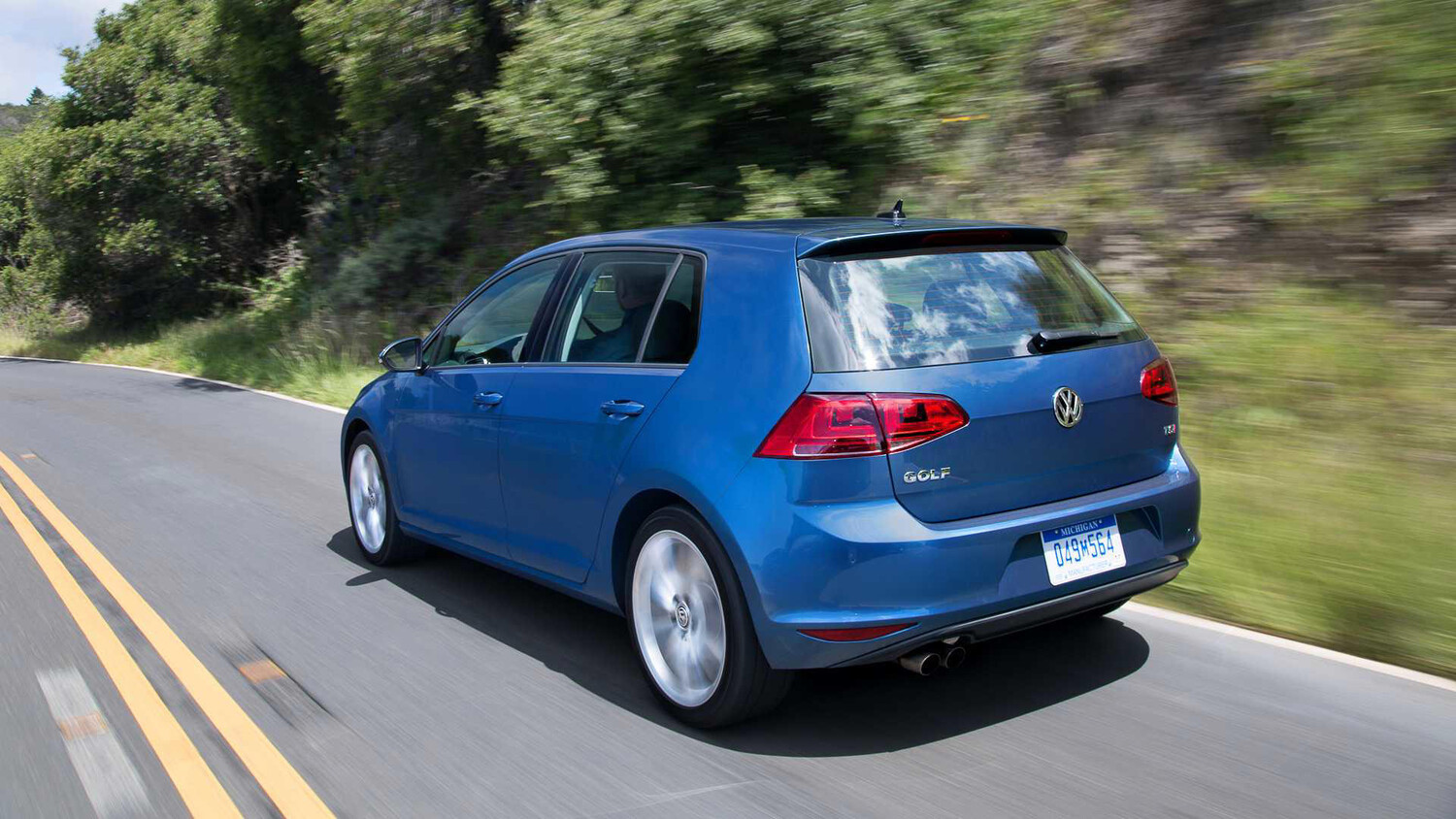
Initially it was the Rabbit, but then it became the Golf and slowly, but surely, this diminutive Volkswagen went on to become a household name in the U.S. VW sold this every-day machine to Americans for the best part of five decades before unceremoniously pulling it from sale after 2021.From that point onward US buyers could only get the GTI hot hatch or the even spicier Golf R versions of the car, marking the end of a significant era. That gives the last Mk7 batch of standard 2015 to 2021 Golfs some clear historical context and VW gave US buyers a surprisingly broad spread of versions to celebrate their farewell. And interestingly, today's prices suggest that you can buy a piece of this VW history for some quite sensible money. The Mk7 Golf Is A Real Bargain Now VolkswagenThe CarBuzz Marketplace suggests the average price of a 2015 Golf Launch Edition car is $10,990, a refreshed 2018 Golf TSI S sits at about $12,670 and a newer 2019 1.4 S shows $16,893.The very last 2021 Golf 1.4 TSI is at just under $15,000 with its usable hatchback body, more premium cabin feel, and the kind of crisp road manners that made the Golf so enticing for decades. And those prices should be even more enticing because the Mk7 was a nicely put-together vehicle and not some stripped-out economy car.The Mk7 came out on the MQB platform as a solid player in the compact hatchback segment and the Launch Edition initially went on sale from $17,995, with S, SE, SEL, and TDI variants available. It featured a roomy cabin with a lot of usable cargo space, a compact exterior, and a notably mature ride. In fact, this Golf was everything that enthusiasts in the market had grown to know and love, but for its own internal reasons, VW decided the Golf was over par. The 2021 model would be the last year for the regular version in the U.S. to close the book on the normal hatchback while VW still allowed the enthusiast versions to stream in.In hindsight, VW's retirement plans give the Mk7 some historical weight that it might not have had otherwise. And the best part for used vehicle buyers is that the market hasn't really priced that historical weight into the picture. The market is still seeing these cars as practical daily drivers, not as some kind of collectible VW. The US Lineup Changed A Lot Between 2015 And 2021 Volkswagen USA Volkswagen couldn't sit still during the Mk7 Golf era and seemed to want to re-shape its U.S. lineup at every opportunity. It started off with a range that was unusually broad at the generation's launch, with various gas or diesel options. The gas motor was a 1.8-liter turbo four while the diesel was a 2.0-liter TDI. The first turned out 170 hp while the diesel, using the new EA288 plant, gave you 150 hp and 236 lb.-ft of torque.In 2016, Volkswagen shuffled the pack a little, with 1.8T models organized around S, SE, and SEL trims and TDI versions around SE and SEL. In 2017, the company added a Wolfsburg Edition above the S trim, which was a value play to help bring more buyers into the ecosystem.In 2018, Volkswagen gave the Golf a fresh new look but pared it down to S and SE trims, both still using the 1.8-liter TSI engine. In 2019, out went the 1.8T and in came the newer 1.4-liter turbo engine that produced 147 hp and 184 lb.-ft of torque. You could still get just S and SE trims, but you could now get drive assistance features like blind spot monitor and rear traffic alert as standard. In 2020, Volkswagen reduced the range to a single well-equipped Golf TSI trim, before repeating that formula for the vehicle's farewell year in America.If you search for Mk7 Golfs, you will likely come across this sometimes-confusing array of options. Early cars seem to offer more choice and engine variety, while later cars represented a tidier lineup with more standardized tech. But in any case, there is a legitimate market spread of used cars to choose from. The Sweet Spot Surrounds The Regular Gas Hatch And Not The Hero Cars Volkswagen There's no doubt that the Mk7 GTI and Golf R are very accomplished cars, but they operate in a very different type of pricing environment altogether. This makes the regular Golf the more interesting game, as it still has much of the same core architecture and polish without all those performance-oriented bells and whistles.Perhaps the very sweetest spot involves the late 2019 to 2021 1.4T cars. Granted, their 147 hp engine is not particularly exciting, but you will get plenty of torque low down in the rev range, and you can certainly enjoy good fuel economy. Tests suggest a 0-60 mph time of 7.6 seconds with a potential 122 mph top speed for the 2019 Golf automatic, which isn't too shabby. Meanwhile, the earlier 1.8T cars have an appeal of their own. They came with 170 hp, so they felt a bit more purposeful than the later 1.4T cars and could be a better all-round daily driver for the enthusiast.All these performance stats are entirely respectable for a mainstream hatchback. They underlined that this car was every inch the composed European-style package that made a Golf so familiar and welcoming for all those decades. And Volkswagen didn't lose sight of the Golf's core identity, as it turned out those different trims, so the trim choice isn't as important for used buyers as it might be with other mainstream compacts. And best of all, the single-trim Golf TSI in the late years was very nicely appointed with standard 16-inch alloy wheels, keyless access, heated front seats, and optional panoramic sunroof, so it felt like a purposeful send-off from the company. The Sportwagen Kept The Practical Golf Idea Alive VolkswagenVolkswagen's Sportwagen idea added some cargo usefulness to the Golf's tidy footprint and European road manners. It wasn't particularly flashy, but it was perhaps a credible SUV alternative if you didn't want something taller, heavier, and boxier in your daily life. Early cars had the 1.8T engine and initially the TDI, but by 2017, Volkswagen offered 4MOTION all-wheel drive on the S trim too. In 2018, you could buy a wagon in S, SE, and SEL trims, and in 2019, the front-wheel-drive Sportwagen got the same 1.4-liter 147 hp engine as the hatchback. The S 4MOTION retained the 1.8T before VW ended the Sportwagen's life after the 2019 model year.CarBuzz Marketplace shows that the average price of a 2018 Golf Sportwagen TSI is $10,777 and the 2019 version is $14,564. 4MOTION versions may be a little higher again, but that's an interesting market proposition for those who want some Golf DNA with more utility. And don't forget that this vehicle also happens to be one of the last genuinely compact wagons due to the encroaching crossover revolution. Buy Carefully And Watch For A Few Known Trouble Spots Volkswagen RepairPal gives the Mk7 Golf a 4 out of 5 rating in reliability and ranks it 25th out of 36 compact cars. Annual average repair costs could be around $630 as well. RepairPal also suggests that shifting trouble in high-mileage automatic transmissions is a commonly reported problem and cooling system and sealing issues may also prove a challenge.It might cost between $850 and $1,100 to replace a Golf water pump and around $650 to $920 to get a new thermostat, while the engine front cover gasket replacement costs roughly $600 to $750. And while those are not ruinous numbers in the broader analysis, they're still significant enough to prompt a proper pre-purchase inspection.Notably, CarComplaints suggests that the 2015 Golf model year was not stellar, with engine issues flagged as the main beef among owners, and the headline problem a timing chain cover oil leak. The outlet also highlights some roof leaks on 2016 cars and a range of Sportwagen issues for the 2017 model year, like coolant sensor failure, water pump or thermostat housing coolant leaks, and sunroof leaks.None of these reports suggest that every Mk7 Golf is going to be a bad buy, but those reports do suggest that you need to be careful when sifting through the candidates. It's best to skip neglected cars and look carefully for any signs of water ingress with panoramic roof vehicles. Also, verify that the cooling system works before checking the transmission behavior carefully. And once you've done all that, try to buy the cleanest and best-kept regular Golf you can find for your budget.Ironically, a standard Mk7 Golf seems to be a car that makes more sense now than it did when new. When it first came out, it was overshadowed by those brasher GTIs and emerging crossovers and, at least at that moment, had no historical significance. But now, these cars could be attractive for those who want a practical hatchback with genuine VW lineage, a relatively mature feel, and a clear place in VW’s American history. And don't forget that this was the last time that Americans teed up a round with a normal Golf, and used versions now cost a lot less than that milestone might suggest.