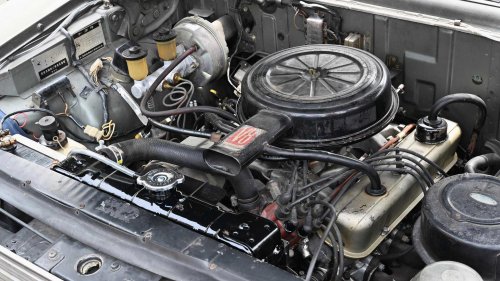





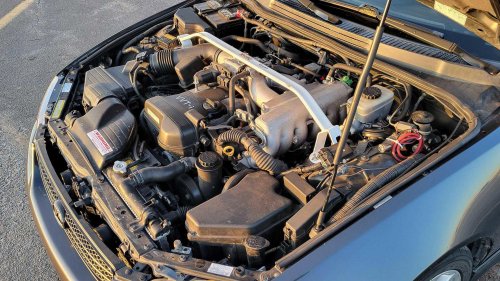



















For decades, Toyota has been synonymous with practicality, durability, and efficiency. Corollas, Camrys, and Land Cruisers have cemented the company’s reputation as the king of reliability. But if you dig a little deeper into Toyota’s archives, you’ll find that the company's past includes some pretty daring experiments that seem almost impossible to reconcile with its present-day identity.One of the strangest examples is a Toyota-built V8 with hemispherical combustion chambers. This wasn’t a muscle car engine meant to dominate drag strips, nor did it define an entire era of American car culture. Instead, it powered a handful of Japanese luxury sedans and quietly faded into obscurity. That’s precisely why it deserves another look today. Toyota’s Short-Lived 3V V8 With Hemi Heads TTTNIS/Wikimedia CommonsThe story begins with the Toyota 3V, a 2.6-liter V8 introduced in the mid 1960s. At just 115 horsepower and around 140 pound feet of torque, it didn’t come close to the fire-breathing numbers of Chrysler’s legendary 426 Hemi. But that wasn’t the point. The 3V was Toyota’s first stab at a hemispherical-head V8, and for its size, it was a refined and technically advanced motor. A Statement Of Intent Kzaral/Wikimedia CommonsWhat set the 3V apart from Toyota’s existing inline sixes was its smoothness and ability to rev cleanly thanks to the chamber design. The hemispherical layout allowed for better airflow and more complete combustion, which translated into improved efficiency and refinement. Toyota didn’t need earth-shaking horsepower; it needed an engine that could quietly elevate its luxury cars above the competition.The 3V was also a statement of intent. Japanese automakers were still seen globally as producers of small cars and utilitarian trucks, not prestige sedans. By creating a V8 with hemispherical chambers, Toyota signaled that it could go beyond its reputation and stand shoulder to shoulder with the engineering feats coming out of Detroit and Stuttgart. Why Toyota Developed The 3V In The First Place ToyotaBy the early 1960s, Toyota had already conquered the domestic small car market with models like the Corona and was exporting to the United States. But breaking into the upper echelons of global markets meant more than offering compact sedans. Toyota wanted a halo product, a car that represented status and sophistication. The solution was to create something bigger, grander, and powered by an engine unlike anything else in the Japanese market.The choice to design a hemispherical chamber V8 was as much about symbolism as performance. In Chrysler's world, hemispherical heads delivered raw muscle. In Toyota’s world, the same principle delivered refinement and prestige. The 3V may have looked tiny compared to American V8s, but within Japan, it was revolutionary. At a time when rival Nissan was still relying on six-cylinder engines, Toyota had vaulted into new territory.Another factor was the Japanese government’s interest in showing off homegrown industry at its best. Luxury sedans powered by advanced V8 engines offered a chance to demonstrate that Japan could build cars for the elite, not just cheap transportation. The 3V became Toyota’s weapon of choice in this quiet status war. The Cars That Carried Toyota’s Hemi ToyotaThe 1964 Toyota Crown Eight was the first to carry the 3V, and it immediately stood out in a market filled with small sedans. The Crown Eight was larger, boxier, and more formal than anything else Toyota sold at the time. Chrome trim, wide bench seating, and a commanding presence gave it an upscale aura that Japanese buyers weren’t used to. The 3V under its hood sealed the deal, providing the smoothness and quietness buyers expected from a luxury sedan. Exclusive Luxury That Gave Toyota New Reach ToyotaWhen Toyota introduced the Century in 1967, the 3V truly found its home. The Toyota Century was designed as Japan’s ultimate executive car, reserved for government officials, business magnates, and the country’s upper class. It was not built in large volumes, but that exclusivity only enhanced its prestige. The 3V gave the Century a level of refinement no inline-six could match. For Toyota, this was more than a powertrain; it was an engineering showcase that elevated the company’s reputation.The Century carried a price tag north of $10,000 by the early 1970s, putting it on par with established luxury rivals from Europe. That was a staggering figure for a Toyota, but it reflected the brand’s ambition. The fact that a Japanese company could command such a price in its domestic market was due in no small part to the 3V’s presence. It represented prestige under the hood, even if its numbers on paper looked modest by American standards. How The Toyota 3V Compared To Chrysler’s Hemi Via: Mecum AuctionsOf course, whenever hemispherical heads are mentioned, Chrysler’s Hemi looms large. The 426 Hemi of the late 1960s became a cultural phenomenon, with 425 horsepower, NASCAR wins, and drag strip domination. Toyota’s 3V, by comparison, was barely a blip on the performance radar. But that’s exactly why it’s fascinating: two companies, oceans apart, chasing the same basic engineering principle for entirely different reasons.In Chrysler’s case, the Hemi was a weapon. In Toyota’s case, it was a statement of refinement. Both relied on the same advantages of hemispherical chambers: better breathing, larger valves, and cleaner combustion. But while Chrysler engineered massive ports and carburetors to feed its beast, Toyota shrunk the concept down to fit a modest 2.6-liter V8. That contrast makes the 3V one of the most curious offshoots of Toyota’s history.It’s also worth noting how invisible Toyota’s effort was compared to Chrysler’s. The American Hemi was marketed aggressively and immortalized by muscle car culture. Toyota’s version was quietly tucked into a few luxury sedans, sold in small numbers, and never exported widely. The result is that one became legendary, and the other sadly became forgotten. The Legacy And Why You Never Hear About It AutoForeverThe 3V’s limited production is the main reason it faded into obscurity. Toyota built the engine only for the Crown Eight and early Centurys, and once newer V engines with simpler head designs arrived in the 1970s, the 3V disappeared. Unlike Chrysler, which made the Hemi a brand in itself, Toyota never promoted its hemispherical head V8. It was just another part of its lineup, and soon it was gone.Today, cars powered by the 3V are incredibly rare. Most remained in Japan, where collectors guard them closely. A Toyota Century with its original 3V can fetch upwards of $30,000, especially if the car retains paperwork and original equipment. These cars are more often seen in museums than on the road, and even diehard Toyota fans sometimes have no idea their favorite brand once built a Hemi.For historians, that obscurity is part of the appeal. The 3V represents an alternate path Toyota could have taken, one where the company leaned harder into experimental V8s instead of settling into its reputation for bulletproof four-cylinders and later hybrids. The fact that the 3V exists at all shows Toyota’s willingness to take risks during its formative years. Why The Toyota Hemi Matters Today via Bring A TrailerThe Toyota 3V may not have changed the global car landscape, but it highlights an important chapter in the brand’s evolution. It was a pretty unique step for a company still finding its footing in international markets. Without experiments like the 3V, Toyota might never have developed the confidence to build engines like the 1JZ and 2JZ, or the smooth V12s that powered later Centurys. It laid a foundation of ambition that carried through decades of innovation. The Stepping Stone To Better Builds Via: Cars and BidsIt also sparks one of the great what-ifs of automotive history. Imagine Toyota taking the Hemi concept further, building a bigger displacement V8, and exporting it to the United States in the late 1960s. The muscle car wars might have had an unexpected Japanese participant. That alternate history never materialized, but the thought underscores just how unusual and intriguing the 3V really was.For modern Toyota fans, the 3V is a reminder that the company’s past is richer than it seems. It wasn’t all about Corollas and Hilux pickups. Hidden in its history are stories of brave engineering moves, like a hemispherical-head V8 that quietly carried the hopes of Japan’s automotive ambitions. The forgotten Toyota Hemi proves that even the most conservative automaker once dabbled in rather outlandish ideas. And to be frank, who'd want to live in a world without 2JZs?Source: Toyota, NHRA