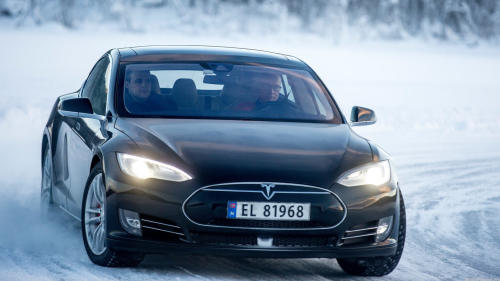
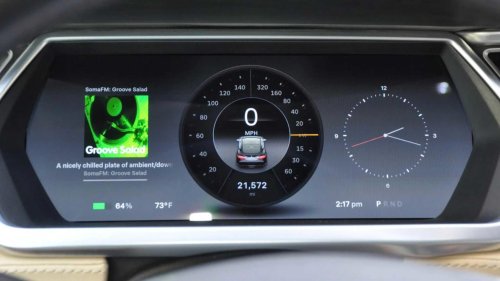
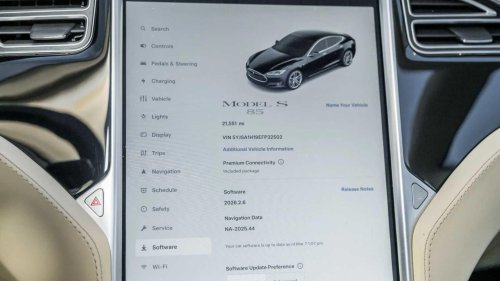
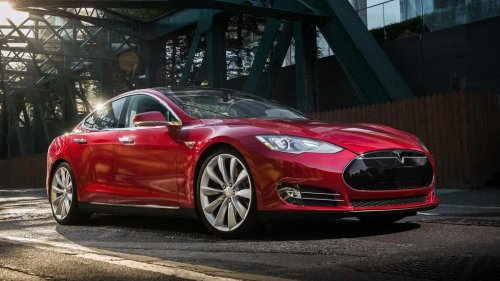
Electric vehicle advocates may turn to an old Tesla Model S as proof of concept to show that EV batteries can indeed last forever. Others may not be so sure and think that any 12-year-old luxury EV could be just one software update away from financial ruin. But for those who are on the fence, a 2014 Model S is an intriguing proposition.It’s certainly not a Tesla statement anymore, and it is a used luxury car suffering from real depreciation that comes with a very specific risk profile. But while the original 85 kWh rear-drive car may have started out at $79,900 new, you can now pick up some 2014 examples in the mid-teens, depending on their trim, mileage, and condition. And this means that the story is no longer about the car's significant place in history, but about whether its numbers can still work for a second or third owner. The Model S And The Used Car Question TeslaWhen the Model S first came out, it was futurism personified, with that giant central screen, huge torque capability, over-the-air updates, and genuine long-range for the skeptics. Today, the 2014 Model S85 still looks like a large premium fastback and not some kind of decades-old relic and, in its base form, is still capable enough for most consumers. But now that it has aged out of its original protection, it definitely starts to pose some interesting questions for used car buyers.To start with, the Model S is a lot more than just a used EV talking point. Instead, it's now in the same type of conversation as an old S-Class or 7 Series in terms of its broad proposition. This means that the purchase price is only the ice-breaker, and the real question lies in what kind of liability you open yourself up to if you jump. You know that you might have to deal with air suspension, electronics, or transmission failure if you're getting a 12-year-old German luxury sedan, but with this 12-year-old Model S, the defining variable is that high-voltage battery. It's not guaranteed to fail by any means, but its condition will have a lot to say in determining the car's real range and ongoing value.Prospective buyers will need to start looking at the Model S as less of a former status symbol and start to calculate what it represents today. Tesla can provide some historical range figures as a baseline and long-running owner data is also available, while current asking prices suggest that the market is already discounting the vehicle in real world terms. A Smart Buy But Only If The Battery Checks Out Tesla A 2014 Tesla Model S could be a brilliant used-car buy today, if the battery's health is good. If it can still keep the car in the high 80% range-retention zone, that's fine, but if that's not the case, its value may start to unravel fast. Bear in mind that the original Model S 85 had a 265-mile EPA rating and then look at your used car candidate. If it shows something like 225 to 235 miles at a full charge under normal calibration, then that's broadly around 85% to 89% of its original rated range.The actual real-world usable range may be a little under what it says on the dash, but you're still looking at a decent proposition, especially if you intend to use your Tesla as a home-charged daily driver, rather than a long-distance hauler. This type of range capability could turn a 2014 Model S into a viable used car buy, and you'll be getting a large, quick, and premium EV that can do about 230 miles on a full charge, which is surely a lot of car for compact sedan money.Having said that, the opposite is also true. If the seller can't give you credible battery health evidence or if the displayed full charge rating is now below the 200-mile range, then it's probably best to move on to something else. It's not enough to think that you can own a Tesla cheaply and somehow enjoy what it represents, because at the end of the day, the battery condition represents most of the story. Values Are Finally Low Enough To Make The Model S Tempting The 2014 Tesla Model S is an intriguing proposition today, as many market listings and valuation guides place standard cars in the mid-teens. The CarBuzz Marketplace shows an average of $14,990, depending on mileage, trim, condition, and battery health. The nicest of examples are still commanding near double that figure, with low mileage to boot, although poor examples which might be suffering from high miles and reduced battery health are available for even less. And at prices like this, the Model S could be a distressed luxury bargain, so long as the battery numbers support the asking price. Existing Battery Data Is Better Than You'd Expect Bring a Trailer Some Model S degradation datasets suggest that many of these batteries suffer from an early drop in capability and then settle into a much flatter curve. So, they may lose about 5% in the first 50,000 miles but only around 1% of additional loss for every 30,000 miles thereafter. Certainly, that doesn't apply to every single battery pack, but it does suggest that the average pattern is less catastrophic than many used EV skeptics might state. And in one analysis of more than 22,700 EVs in 2025 (covering 21 models), Geotab found that battery aging tends to be gradual, with that steep early decline and then a settling out stage.When assessing a 12-year-old Model S, you should also consider how it's lived its life. In one example, an owner may have kept it in the garage and mostly charged at home while rarely allowing the battery to sit at 100% for long periods. But in another, a less than careful owner may have subjected the car to years of heat soaking with lots of supercharging along the way. Tesla suggests lower daily charge limits if possible and that owners should avoid spending long periods near to either 0% or 100%, with home charging preferred if possible.The data seems to show that batteries will certainly degrade, but may do so in measurable, predictable, and often manageable ways. And that represents a much more useful conclusion for someone with a rational outset. Look closely at what the dashboard suggests in terms of range when the battery has full charge, and you can quite quickly make a shrewd decision. The Real Risk Is Not Mythology But Exposure Bring a Trailer It's important to be aware of Tesla's original warranty position. With its early 85 kWh Model S cars, buyers would get an eight-year battery warranty with unlimited mileage, but the company wouldn't cover gradual energy or power loss over time. Today, that situation is different as a new Model S now comes with eight years or 150,000 miles of use with a minimum of 70% retention.Degradation does change the ownership math, because once you get outside the original battery drive unit coverage window, every percentage point of retained health is an ownership problem and not the company's. And when you consider that the battery pack is the car's defining asset, that can be important. So, it only makes sense to grill the seller carefully to find out everything that you need to know about the battery.Once you're happy with the battery's story, turn your attention to other old luxury car realities. Some of these Teslas did have electronic issues and there are reports of owners needing to replace the central touchscreen. Model S vehicles with the 8 GB eMMC could suffer from a loss of function and a blank center display, while on others, exterior door handles were a known weak spot as well.Look closely at the vehicle's history. You may have heard of instances where cars ran for more than 200,000 miles on the original battery without any major issues, but not every Model S will age that way. The Best Old Model S Cars Can Still Make Sense Tesla A used Tesla Model S could make perfect sense if you buy it for the life that it can realistically live now. And this means that it could be an excellent proposition if you're looking at a second car, a suburban family shuttle, or something for your everyday commute. After all, it comes with a very spacious cabin, and it’s still quick enough to feel quite special today, while some owners have been quick to point out that the car's total cost of ownership is favorably strong.Not every cheap Model S is a steal, and the car's documentation is very important. But if you can verify a strong indicated range, and observe a sensible charging history, then you may well be able to buy one of these cars at the right number and not fret about that ticking battery-operated clock.



















 +47 others