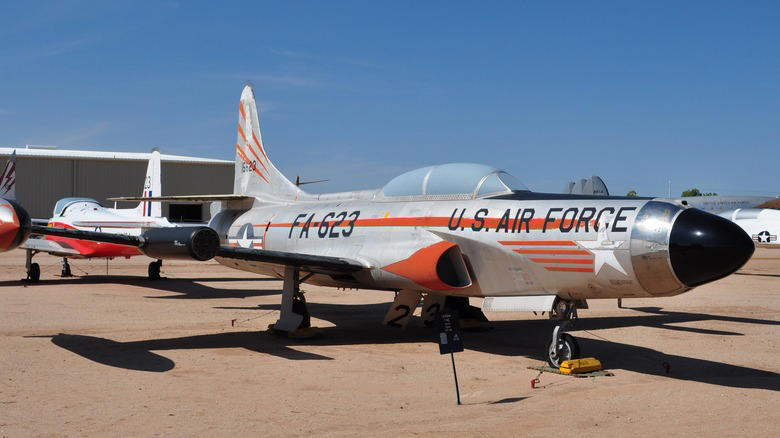
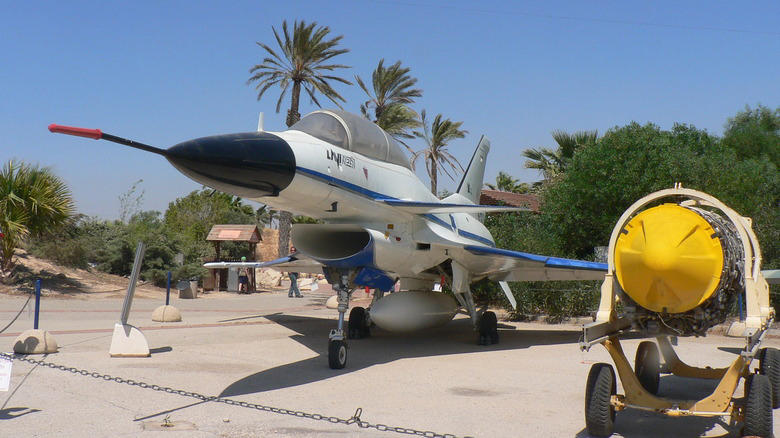



















Lockheed F-94C Starfire (1950)In 1948, the U.S. Air Force grew concerned about the threat posed by the Soviet Union's new long-range bombers. It issued a request for an interceptor that could use radar to find and kill enemy bombers. Lockheed answered the call with the F-94 Starfire, which first flew in 1949. The F-94 was developed from the T-33A Shooting Star trainer jet, which was itself a derivative of the F-80 Shooting Star, the Air Force's first operational jet, whose development began during World War II. Therefore, the Starfire had DNA going back to the very beginning of the Jet Age.The F-94 series included A, B, and C variants. The F-94C model first flew in 1950. It was such a marked improvement over previous planes in the Starfire series that it was practically an all-new plane. Fundamental to that transformation was an increase in power, courtesy of a single Pratt & Whitney J48-P-5 or J48-P-5A with an afterburner. With 8,750 pounds of thrust, it propelled the F-94C to a maximum speed of 640 mph with a cruising speed of 476 mph. Its range was 1,275 miles, and its ceiling was almost 52,000 feet. The new jet had the speed and range for its mission as an all-weather interceptor.This jet used three pods of Folding Fin Air Rockets, one in the nose and two on the wings, rather than guns to attack enemy aircraft. Of the 855 F-94s built, only one was lost in combat. The F-94C scored several air-to-air victories in the Korean War. The last one was retired in 1960, a relatively short lifespan due to the fast-evolving technology of jet fighters in that era.IAI Lavi (1986)The Israeli Air Force has traditionally been one of the country's biggest military strengths, but it has long relied on imported fighter jets to accomplish its mission. This is an obvious liability for any air force, and it became a critical issue when France embargoed Israel in the 1960s, cutting off an order of new Mirage jets. The Israelis responded by initiating their own fighter jet development program. Israel launched the program with an unlicensed Mirage knockoff called the Kfir, which demonstrated its ability to build aircraft. Next up was an entirely indigenously designed, clean-sheet-of-paper fighter called the Lavi, meaning "Young Lion."Although the Lavi was originally intended to be a fairly simple jet, it evolved into a sophisticated delta-wing fighter with steerable canards, carbon fiber structure, and advanced digital avionics. Flight tests began in 1986, and the program received advanced technology from American defense contractors. Among these technologies was the Pratt & Whitney PW1120 turbofan engine. This engine had been developed specifically for this project and generated 20,600 pounds of thrust. Lavi prototypes achieved Mach 1.85.However, the project faced opposition both within the U.S. and even from the Israeli Air Force leadership, who felt the money could be better spent importing the F-16C. The Lavi was ultimately canceled in 1987. Though abandoned after building just three prototypes, the project significantly boosted Israel's aerospace industry capabilities. Some Lavi-developed components became successful exports, such as the Elta EL/M-2032 pulse-doppler radar. The Israeli aerospace industry has also proven its prowess by modifying American aircraft to its own needs, such as the F-15I Raa'am and the F-35I Adir.