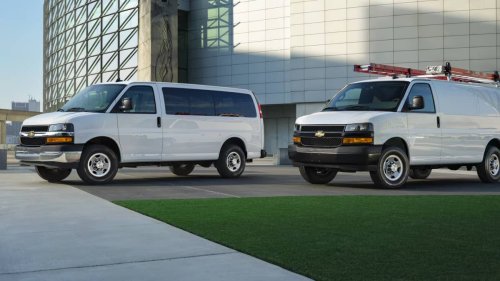
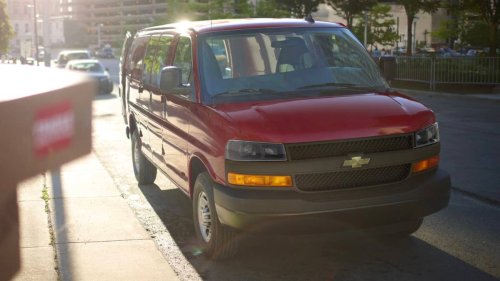
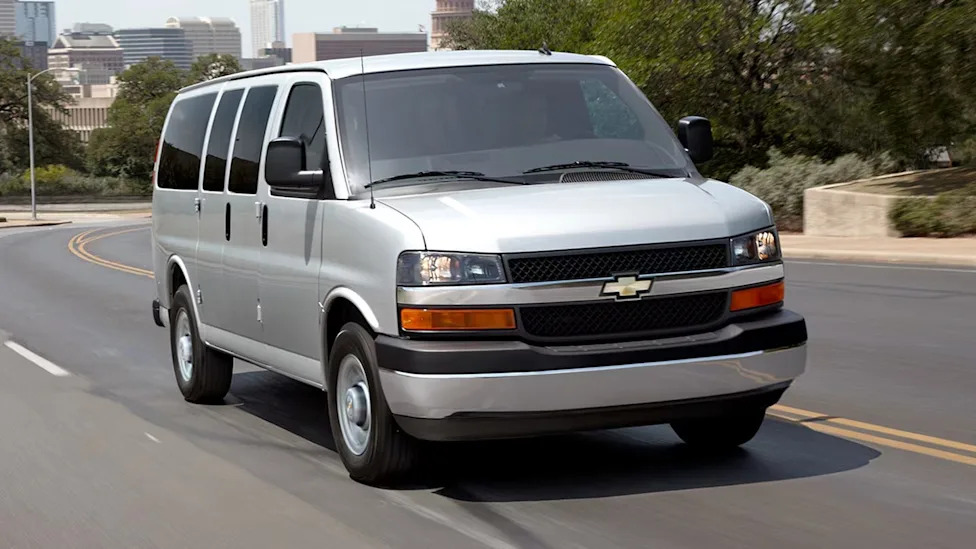
2027 Chevrolet ExpressMotorTrendStrong towing capacityProven commercial platformFlexible upfit optionsVery dated designNo high-roof optionLimited safety techThe Chevrolet Express has survived by staying stubbornly true to its mission. Sold in cargo, passenger, and cutaway configurations, it has endured for decades by focusing on straightforward capability, fleet-friendly durability, and upfit versatility, rather than chasing the latest van trends. This year's model carries over from 2026 unchanged.AdvertisementAdvertisementSimilarly geared competitors include the Ford Transit, Ram ProMaster, and Mercedes-Benz Sprinter.What We ThinkThe Express isn't trying to be modern, and by now that almost feels like part of its identity. This is still the same basic full-size van formula Chevy has sold for decades: rear-wheel drive, simple controls, V-6 or V-8 power, and cargo, passenger, or cab-and-chassis configurations built for commercial work.That old-school approach gives the Express a few real advantages. It offers strong payload ratings, excellent towing capability, and the kind of straightforward mechanical layout fleet operators and upfitters understand well. For buyers who just need a durable van to haul people, cargo, tools, or specialized equipment, the Express still makes sense.The problem is that nearly every major rival feels newer, smarter, and more flexible. Vans like the Ford Transit, Ram ProMaster, and Mercedes-Benz Sprinter offer more modern cabins, better available safety tech, more cargo-space configurations, and available high-roof bodies.AdvertisementAdvertisementThe Express is still useful, but unless maximum towing capacity, V-8 power, or fleet familiarity are top priorities, most shoppers should compare it carefully against newer alternatives.Top-Ranked Competitors:Ford TransitRam ProMasterMercedes-Benz SprinterPerformanceThe 2027 Express keeps the same powertrain lineup as last year, with rear-wheel drive as the only available configuration. The standard engine remains the 4.3-liter V-6, rated at 276 horsepower and 298 lb-ft of torque, while the available 6.6-liter V-8 continues to offer a much stronger 401 hp and 464 lb-ft.Both engines pair with an eight-speed automatic transmission equipped with tow/haul mode and grade-braking functions. Those features help tailor shift behavior when towing or carrying heavy loads and add more control on downhill grades.AdvertisementAdvertisementAs with past Express models, official EPA fuel-economy ratings likely will not be published because full-size vans in this class are exempt from those reporting requirements. Even so, shoppers should expect real-world fuel economy in the teens with either engine.Towing Capacity and PayloadThe Express continues to come in 2500 and 3500 duty ratings, giving buyers a choice between strong capability and maximum work-truck muscle. The 2500 can haul roughly 3,280 pounds of payload, while the 3500 adds about another 1,000 pounds when properly configured. Choosing the extended-wheelbase body trims payload capacity by a few hundred pounds.The Express Cutaway takes capability a step further. Sold as a cab-and-chassis platform for commercial upfits, it offers a much higher maximum payload rating of up to 8,920 pounds.Towing remains one of the Express van's clearest strengths. When equipped with the available V-8, the 2027 Express is expected to tow up to 10,000 pounds, putting it ahead of newer full-size van rivals such as the Ford Transit and Ram ProMaster, which typically top out several thousand pounds lower.Safety FeaturesEvery 2027 van comes with standard Hill Start Assist, a tire pressure monitoring system, and StabiliTrak, the Express' traction assistance and vehicle stability enhancement system. Other tech is optional and includes:AdvertisementAdvertisementRear parking sensorsBlind-spot monitoringLane keeping alertsForward collision alertsCargo Space and Interior RoomThe 2027 Express comes in two wheelbase lengths, a 135-inch regular-wheelbase model and a longer 155-inch extended-wheelbase version. It also offers two basic interior setups: cargo models with an empty, work-ready cabin and Passenger models with factory-installed seating.In Passenger form, the regular-wheelbase Express seats up to 12 people across four rows, while the extended-wheelbase version increases capacity to 15 passengers with a fifth row. Cargo models provide 239.4 cubic feet of space with the regular wheelbase and 283.6 cubic feet with the extended wheelbase.Those numbers easily beat most consumer vehicles, but the Express is still limited by its traditional low-roof body. Newer commercial vans such as the Ford Transit and Ram ProMaster offer high-roof configurations with substantially more total cargo volume.TechnologyInfotainmentAs expected, the 2027 Chevrolet Express keeps its tech offerings fairly basic. Every model comes with a 7.0-inch touchscreen, a traditional gauge cluster, and Bluetooth audio streaming, though Apple CarPlay and Android Auto are not available. The Express also includes 120-volt and 12-volt power outlets.Sound SystemEvery 2027 Express Cargo and Cutaway van comes with two speakers, one in each of the front doors. Express Passenger vans come with four speakers.Available UpgradesChevrolet also offers a handful of practical upgrades aimed at commercial and fleet buyers. Depending on configuration, the 2027 Express can be equipped with keyless entry, remote start, cruise control, rear air conditioning, a chrome appearance package, and a sliding passenger-side door.AdvertisementAdvertisementThe Cargo van is also available with Ambulance and Hotel Shuttle packages, while the Express Cutaway can be ordered with School Bus and Shuttle Bus packages for specialized upfit needs.ValueThe 2027 Express stays one of the more affordable ways into a full-size commercial van, even with an expected small price increase over the identical 2026 model. Its closest competitors include the mechanically related GMC Savana, along with more modern alternatives such as the Ford Transit, Ram ProMaster, and Mercedes-Benz Sprinter.Value is where the Express still has a case to make. Its payload ratings are solid, its V-8 towing capacity is among the strongest in the class, and its straightforward design can appeal to fleets that prioritize durability, easy serviceability, and familiar upfit options over the latest features.Still, the Express feels dated almost everywhere else. Most rivals offer newer cabin designs, more body-height choices, better standard safety technology, and, in some cases, electric powertrain options. Even if the Chevy undercuts some competitors on price, the gap may not be large enough to offset what shoppers give up in refinement, efficiency, tech, and configuration flexibility.AdvertisementAdvertisementFor buyers who need a simple, proven work van with strong towing capability, the Express can still be a sensible value play. For most others, spending more on a newer rival will probably be worth it.



















 +2 others