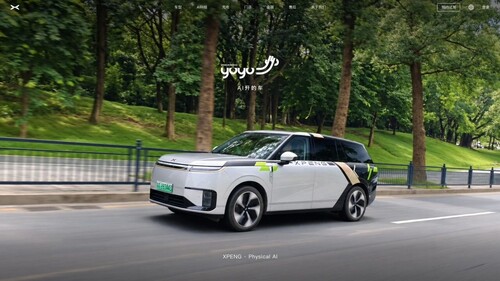
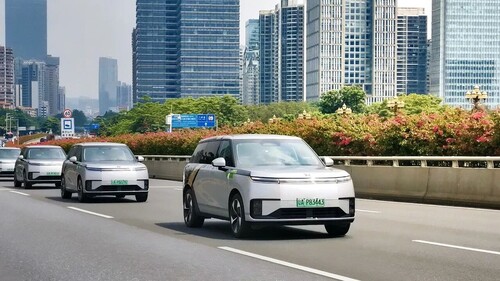
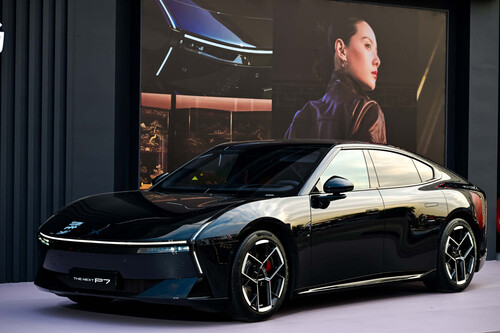
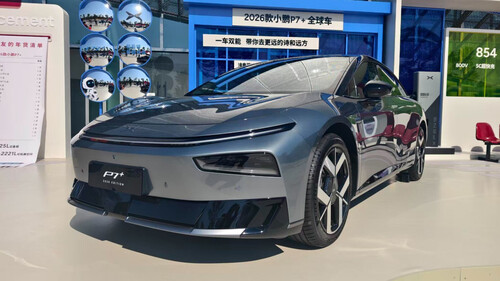
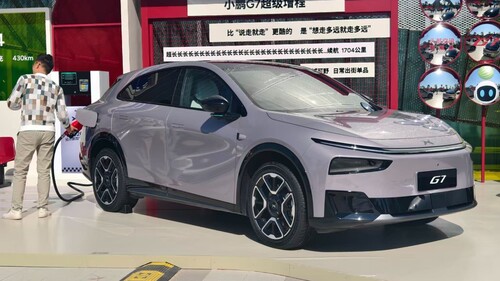
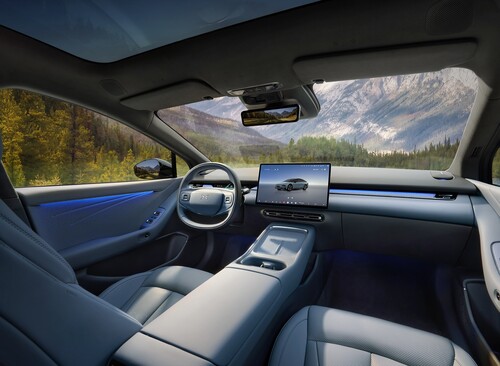
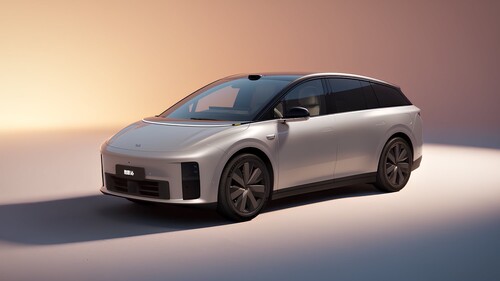
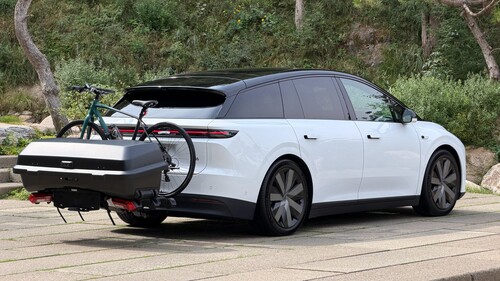
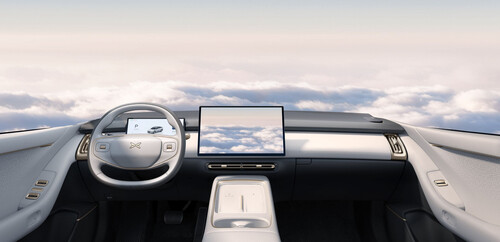
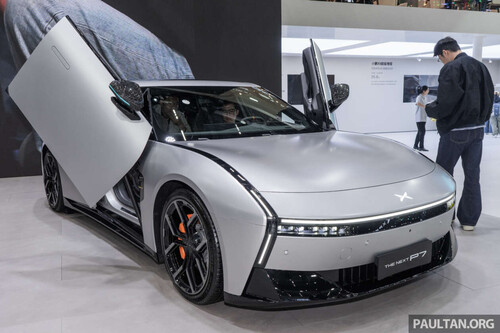
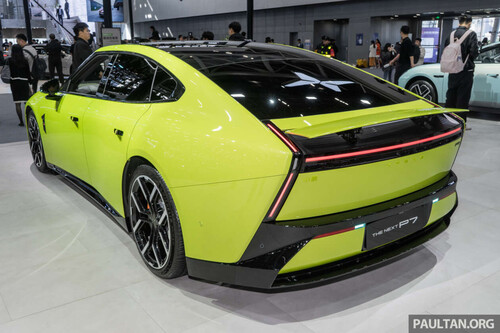
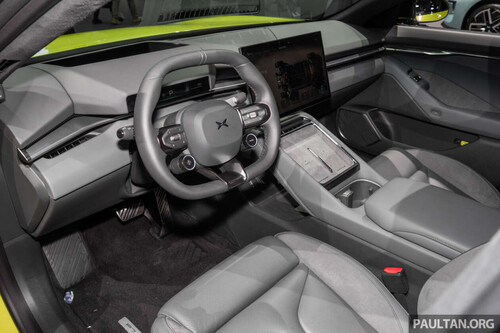
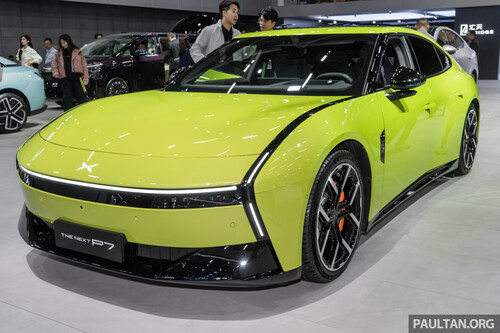
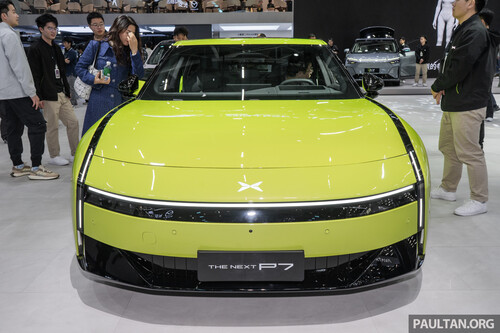
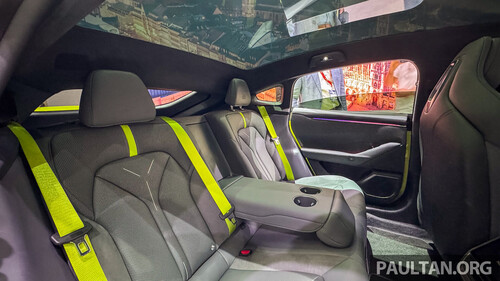
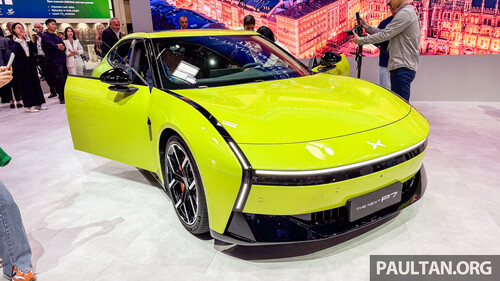
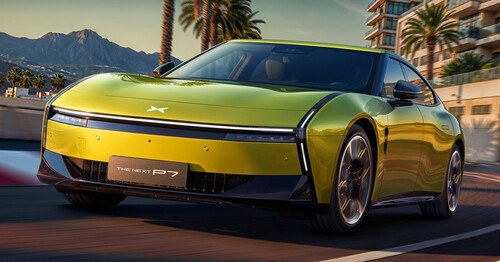
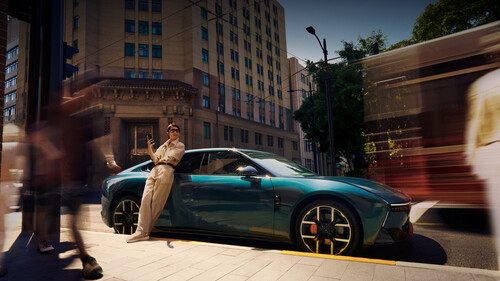
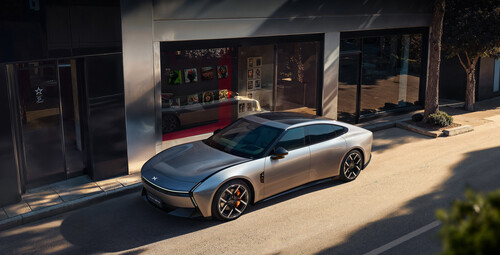
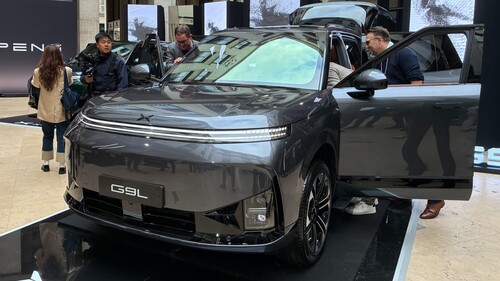
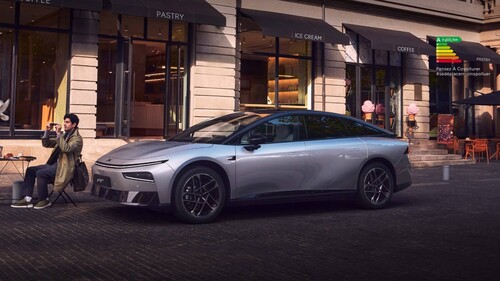
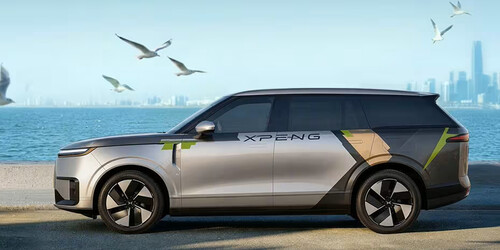
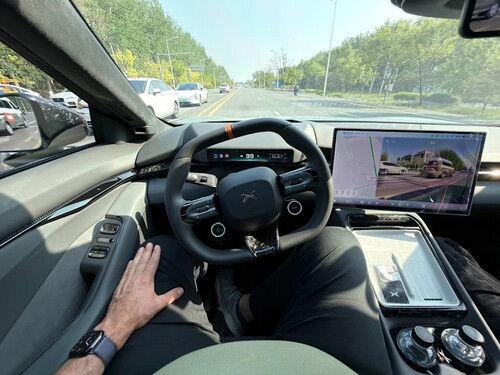
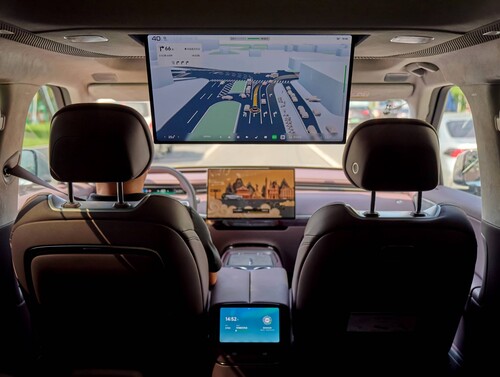
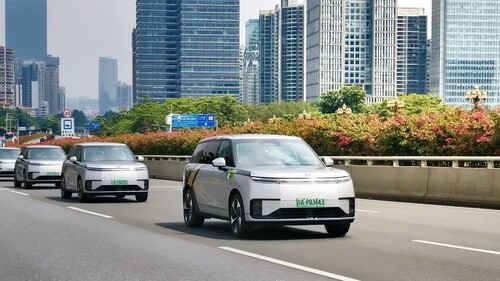
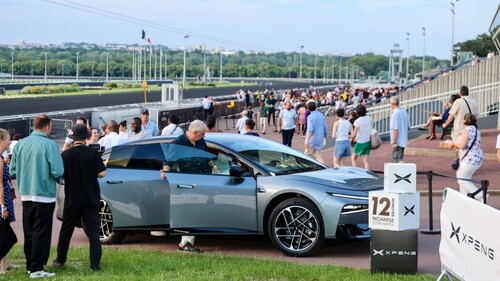
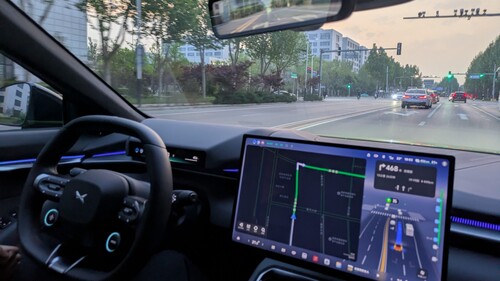
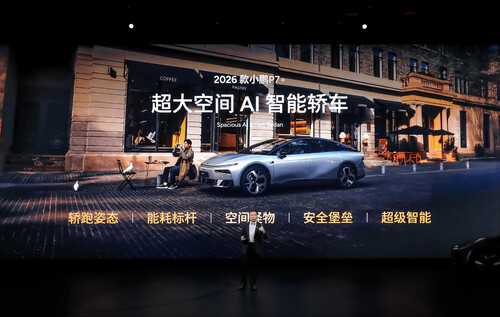
The latest Xpeng P7 was on display at this year’s Auto China (also known as Auto Beijing) following its refresh in March this year. This comes less than a year after the second-generation went on sale in China in August last year. Priced between 203,800 and 301,800 yuan (about RM118k and RM175k), the P7 comes in four variants, including the 702 Max, 820 Max, 750 4WD Max and 750 4WD Wing Ultra. There’s also a longer version of the P7 called the P7+ that is intended for both China and overseas markets, but we’ll get to that later. In terms of size, the P7 is quite a large car, measuring in at 5,017 mm long and with a wheelbase of 3,008 mm. At just 1,427 mm tall and 1,970 mm wide, the sedan sports a sleek, aerodynamic profile that is complemented by flush door handles, a sloping roofline, muscular shoulders and an active rear wing. All ’750’ variants come with soft-close doors, with the ‘4WD Wing Ultra’ being the only one that gets front gullwing doors. As for the interior, the P7 is just as minimalistic as most Xpeng models. Ahead of the driver is an 8.8-inch digital instrument cluster and sporty steering wheel, while the infotainment display measures 15.6 inches – the latter is able to pivot and tilt for directed visibility. Other displays include an 87-inch head-up display and a nine-inch streaming rear-view mirror, while rear passengers have an eight-inch control panel aft of the front centre console. No shortage of luxuries either, with the powered front seats offering heating, ventilation and massage functions, while the rear seats are heated. Cooled wireless phone charging pads at the front offer up to 50 watts of power each, and there is also in-car karaoke, a fragrance system, a panoramic glass roof and a whole host of connected features. A comprehensive ADAS suite also comes standard on the P7, powered by a single Turing AI chip developed by Xpeng that draws information from a bevy of onboard sensors. As an option, buyers can also upgrade to two Turing AI chips for double the computing power at 1,500 TOPS, which enables more advanced self-driving functions. There’s also an option for a third chip for 2,250 TOPS and even more vision language action (VLA) capabilities aimed at achieving Level 4 autonomous driving. Built on an 800-volt architecture, the P7 in its base 702 Max form gets a 74.9-kWh lithium iron phosphate (LFP) battery that is good for up to 702 km following the CLTC standard. This variant features a rear electric motor rated at 367 PS (362 hp or 270 kW) and 465 Nm of torque for a 0-100 km/h time of 5.8 seconds. The 820 Max keeps the same motor but upgrades to a 92.2-kWh nickel manganese cobalt (NMC) battery for up to 820 km and a slightly quicker century sprint time of 5.4 seconds. The next step up is the 750 AWD Max, which also uses the NMC battery but adds another electric motor at the front for all-wheel drive. Total system output rises to 594 PS (586 hp or 437 kW) and 695 Nm as a result, further reducing the 0-100 km/h time to 3.7 seconds. The 750 4WD Wing Ultra is identical to the normal-doored variant, and all versions of the P7 will max out at 230 km/h. Xpeng says the P7’s batteries support 5C charging, with a 10-80% state of charge requiring around 12 minutes (LFP) or 11.3 minutes (NMC). Xpeng announced last year that the P7+ will be sold in 36 countries, and we’re expecting Malaysia to be one of them because our colleagues at paultan.org/BM found out that the P7 will be shown at the upcoming Kuala Lumpur International Mobility Show (KLIMS) in June, albeit in left-hand drive guise – likely as an early preview. Considering the brand did not state the P7 will go overseas, we’re assuming the P7+ is the model coming our way, pending Xpeng Malaysia’s confirmation. So, what’s the deal with the P7+? Well, it is meant to be a larger and cheaper version of the P7i, which itself was a refresh of the first-generation P7. It sounds confusing but just remember that the P7 has gone on to be a higher-tier offering in its second generation, while the P7+ sits just below it. Unlike the P7, the P7+ is offered as both a fully electric vehicle (EV) and a range-extended EV (REEV). The former is priced from 186,800 to 198,800 yuan (RM108k to RM115k) and comes in 615 Max and 725 Max variants. Both come with LFP batteries for up to 615 km or 725 km of range, and support 5C charging with a 10-80% state of charge needing around 12 minutes. Meanwhile, the REEV variants – introduced later in China in October 2025 – are the 1,550 Max Tech and 1,550 Max Flagship, both sharing the same 49.2-kWh LFP battery for up to 430 km of EV-only range. The range extender is a 1.5 litre turbocharged inline-four petrol engine rated at 116 PS (114 hp or 85 kW) that enables a combined hybrid range of up to 1,550 km. All P7+ variants are based around an 800-volt system and rear-wheel drive, with an electric motor serving up 245 PS (241 hp or 180 kW) and 450 Nm. The top speed across the board is 200 km/h, while the 0-100 km/h time is 6.9 seconds for all except the 725 Max EV that needs 5.9 seconds. In keeping with its positioning, the P7+ misses out on some of the luxuries of the P7 such as the three-axis infotainment touchscreen and fancy gullwing doors. Buyers are also limited to a maximum of two Turing AI chips, although the available ADAS functions are pretty comprehensive as they are. Comparing dimensions, the P7+ measures 5,071 mm long, 1,937 mm wide, 1,512 mm tall and has a wheelbase spanning 3,000 mm. That makes it 54 mm longer than the P7, while also being 33 mm narrower, 85 mm shorter (height-wise) and its wheelbase is down by eight mm. Looking to sell your car? Sell it with Carro. Compare prices between different insurer providers to save the most on your car insurance renewal compared to other competing services. Many payment method supported and you can pay with instalment using Atome, Grab PayLater or Shopee SPayLater. Use the promo code 'PAULTAN' when you checkout for 10% discount!