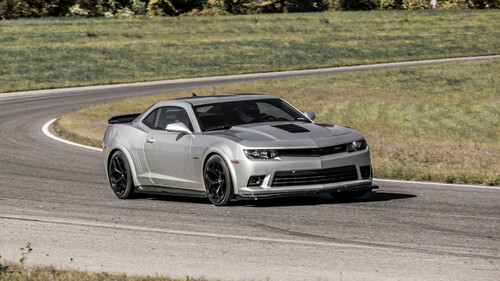
When Chevrolet resurrected the Z/28 nameplate for the 2014 Camaro, the intention was little less than the ultimate track-ready Camaro configuration from the factory. Built to pursue lap times over quarter-mile figures, the resulting car featured nearly 200 unique parts to set it apart from the Camaro SS, with every detail focused on getting drivers around their favorite circuit as quickly as possible.The Camaro Z/28 would only go on to sell for two model years, earn the coveted title of Motor Trend's Best Driver's Car in 2014, and achieve greatness along the way. Today, this limited-time affair is still fetching big bucks in the secondhand market, reinforcing its reputation as one of the ultimate attainable driver's cars. Below, we get up to speed on the latest Camaro Z/28, look at the impressive hardware and tuning that made it tick, and see how much you should expect to pay for your own used copy today. Up To Speed On The Modern Chevrolet Camaro Z/28 ChevroletThe latest Z/28 was officially debuted at the 2013 New York Auto Show, with the nameplate returning once again to a Camaro designed to dominate on the road course. With the Camaro SS as the mainstream performance model and the ZL-1 as the supercharged performance dominator, there was space in the lineup for a lighter, less complex version built for lightning-quick responses to driver inputs.It was available only as a coupe and featured extensive aerodynamic tweaks to generate downforce and reduce weight. Power came from a simple, lightweight small-block LS7 V8. Initial pricing was around $75,000, and only 1,801 were built in total for model years 2014 and 2015. This Was A High-Tech Track Star With Stunning Hardware ChevroletUnder the hood, the 7.0-liter V8 engine delivered 505 horsepower in a thrilling, high-revving surge. When the LS7 launched in the 2006 Chevy Corvette Z06, it made 505 hp and 470 pound-feet of torque. In the 2014 Camaro Z/28, the powerplant had 505 hp and 481 lb-ft. At the time, it was the most powerful naturally aspirated engine GM had ever built for a production car.The LS7 in the Z/28 had titanium connecting rods, reducing their weight by about 30 percent versus conventional pieces. The intake valves were also lightweight and made of highly durable titanium. Add in the inherently lightweight and compact pushrod valvetrain, and the result was an enormous engine with a lightweight reciprocating mass that loved to spin fast and made all the right sound effects.This was Chevrolet's last big-displacement V8 before downsizing. Originally designed for the Corvette Z06 in conjunction with Corvette Racing, the LS7 V8 could spin to 7,100 revs, meaning the optimal point in the rev range was always within striking distance when drivers kept the engine on a rolling boil. The Tremec TR-6060 transmission had specialized gear ratios and a unique shifter for the application.A helical-gear rear differential constantly adjusts torque bias to help drivers power out of corners earlier and harder. Specifically, traditional limited-slip differentials are biased towards straight-line traction. However, the helical-style LSD used in the Z/28 had coupling forces and responses tuned to handle corner entry, mid-corner, and corner-exit situations differently. The rear differential was also liquid-cooled, just like the transmission fluid and engine oil.TrueCar The brakes were built to take some serious heat, too. All models shipped with carbon ceramic discs, designed to tackle extreme driving for extended periods, with a consistent, confidence-inspiring pedal feel and reduced rotating mass. If you're a used shopper, take note that replacing carbon ceramic pads and rotors can be extraordinarily expensive. Drivers Absolutely Loved This Machine ChevroletA Nürburgring lap time of 7:37.40 in less-than-ideal conditions meant the Z/28 was faster than both the Ferrari 458 and Lexus LFA. The Z/28's suspension system was largely to thank for the quick time, due to a slew of upgrades. Used shoppers take note: front springs were 85 percent stiffer than the Camaro SS you might be used to, with bushing stiffness increased by anywhere from 25 to 400 percent throughout the rest of the suspension. Exotic spool-valve dampers provided the ultimate in predictable, consistent control during severe use, replacing the adaptive magnetic suspension system from other models. All said, expect a completely different Camaro driving experience than what you're used to.ChevroletThe tech all added up to significant lap-time advantages over other hot Camaro variants and key competitors. For an apples-to-apples comparison, GM benchmarking data from 2014 provides the lap times above, based on testing at the Milford Road Course.Mass reduction was extensive. In addition to the lightweight engine and brakes, there was thinner glass and less sound deadening. Air conditioning was an option, rather than being standard, to save more weight. The engineers even stripped out unused wiring from the Z/28's wiring harness. They even hollowed out the bow-tie emblem on the front grille, which not only saved a little weight but also increased airflow to the radiator by 3 cubic meters per minute, according to the SAE.From the driver's seat, the result was a potent performer with the authentic looks, sounds, and feel of a track-honed weapon. Drivers who loved the feel and sound of a naturally aspirated V8 and preferred to stick with proven tech at a track day found the Z/28's recipe for pure performance to be particularly enticing. Here's What You'll Pay Today, And What To Know Before You Do ChevroletToday, according to information from Hagerty, shoppers looking for a secondhand Z/28 in good condition should set aside at least $53,000. However, units in excellent condition or with extremely low miles can cost plenty more. If you've got a budget of around $60,000, you should be able to do nicely with a secondhand Camaro Z/28, provided you shop with patience.Remember, production of this specific Camaro variation was extremely limited, and some drivers may find it too extreme and noisy for regular use. However, if you regularly partake in some road course racing, this might be the best Camaro you can buy. If you're more concerned with fast drag-strip passes and highly accessible power at low revs, an SS or ZL-1 is likely a better alternative.Chevrolet To prevent pricey surprises, assume that any used Z/28 you're considering needs a new clutch, new tires, and new brakes until you have confirmation to the contrary. Note the production date of the tires on the unit you're considering, too: by now, Z/28 models on original rubber are at least 11 years old, meaning a fresh set of tires is highly advised, even if the originals aren't worn badly. Do not underestimate the importance of running an appropriate, quality tire in this application, for maximum enjoyment and safety.Finally, don't be afraid of a used Z/28 that's seen a lot of racetrack use because that's what they were designed for. Regular weekend lap-day participants are some of the most meticulous owners out there when it comes to over-maintaining their rides for the sake of longevity. If in doubt, have a qualified GM technician check out the model you're considering before you buy.