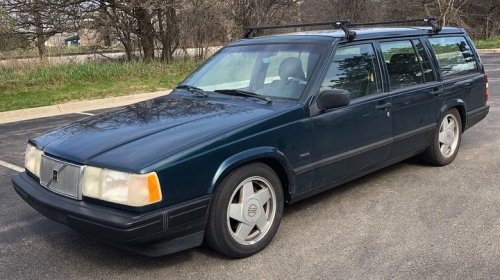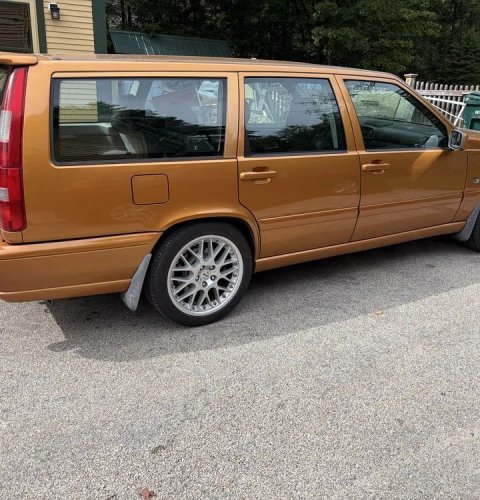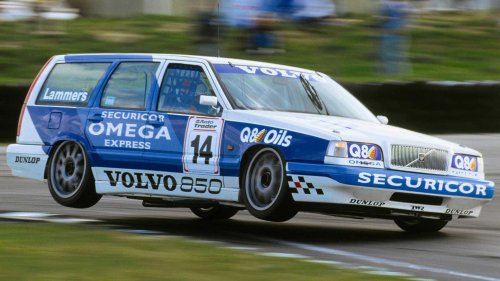
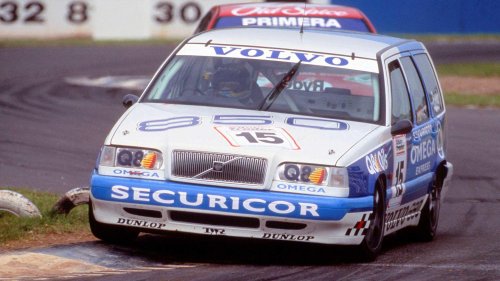
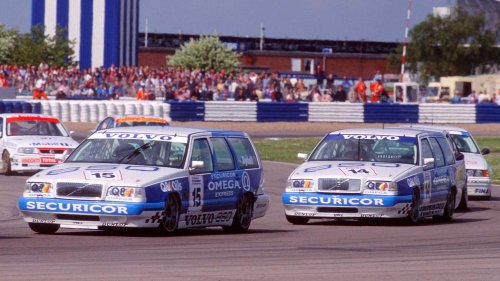
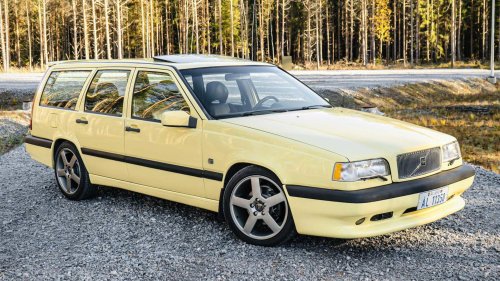
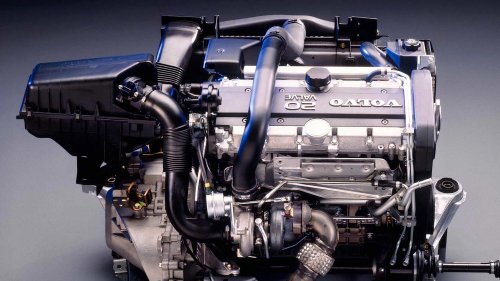
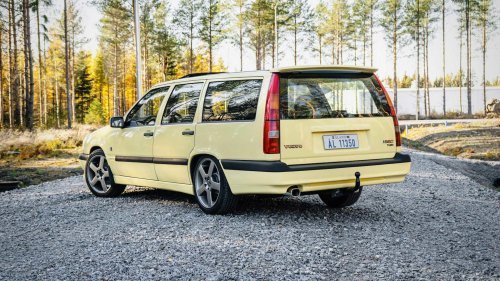
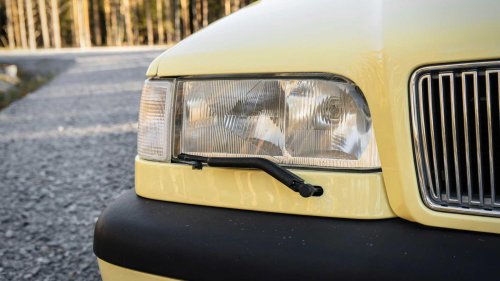
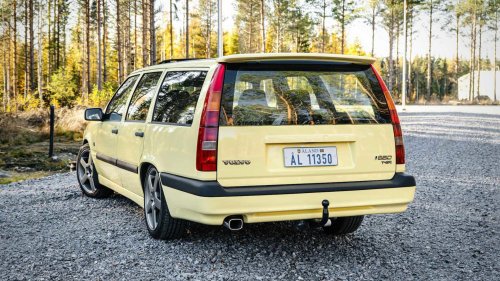
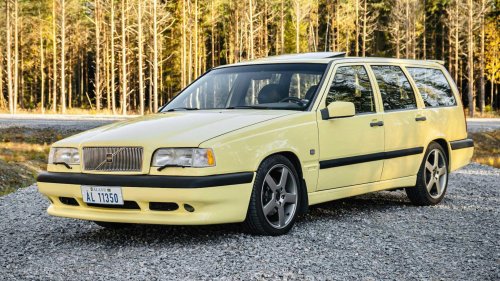



















In April 1994, a Volvo station wagon rolled onto a British racing circuit leaving the entire paddock amused. Rival drivers called it "the bread van." Volvo's own crew stuffed a toy dog in the back for a parade lap, leaning into the joke before the green flag even dropped.The wagon's long roofline generated more downforce than any sedan on the grid that day, and the Swedish crew from Tom Walkinshaw Racing knew exactly what they had built. It didn't win races. It didn't need to.What that season proved — to Volvo, to the press, and eventually to collectors — is that a fast wagon could be something people genuinely wanted. But the craziest part? The road-going monster that answered the public's demand had actually debuted a month before the race car ever hit the track, rolled out at the Geneva Motor Show in a color that was only ever supposed to exist once, resulting in one of the coolest Volvos ever made. The Year Volvo Brought A Bread Van To A Race Via: VolvoTo understand why the yellow wagon at that stoplight exists at all, you have to go back to April 1994 and a racetrack in southern England called Thruxton.Volvo had decided to re-enter motorsport as part of an internal initiative called "Back on Track." The plan was to campaign a car in the British Touring Car Championship (BTCC), one of the most competitive and well-attended series in the world at the time. Volvo enlisted Tom Walkinshaw Racing (TWR) — better known then for Group C endurance racing — to run the works program on a three-year contract, with development work commissioned through Swedish performance specialists Steffansson Automotive.The choice of body style wasn't entirely intentional. When Steffansson went to collect a body shell to build the prototype, only wagon variants were left. Volvo's board saw the accident as an opportunity — a chance to break the stereotype of the brand as a carmaker for sensible, middle-aged drivers.Via: Volvo What rolled onto the Thruxton grid that April stunned the paddock. Rival teams had been pointing and laughing since the news broke, calling it "the bread van." To lean into the media hype, driver Rickard Rydell and the Volvo crew playfully stuffed a large plush dog in the back during a parade lap.The ridicule was understandable, but the science behind it was real. The wagon's long roofline actually produced more downforce than the saloon equivalent would have — though that advantage disappeared at slow, technical corners, where the heavy front-mounted engine caused significant understeer. The TWR-built car ran a naturally aspirated 2.0-liter five-cylinder engine making around 290 hp, putting it on par with the rest of the BTCC field.Via: Volvo By the end of the season at Donington Park in September 1994, Volvo had defied expectations by finishing a respectable 8th overall in the Manufacturers' Championship. Their best single-race result was a 5th-place finish at Brands Hatch. On paper, it wasn't a championship trophy, but in practice, Rydell later reflected that the car had generated more press coverage than any other team on the grid.The wagon's one season was its last. For 1995, rule changes allowed a rear spoiler — but only within the roofline — which stripped away the wagon's natural downforce advantage and made the saloon the logical choice. The sedan went on to win six races in 1995 and Rickard Rydell finished third in the championship that year, repeating the result in 1996, before Volvo ultimately claimed the BTCC title in 1998.The wagon never won a race. But it had already done something more important—it cemented the idea, inside and outside Volvo, that a fast wagon was a brilliant idea. How Volvo Built A Cream Yellow Sleeper In Nine Months Via: Collecting Cars The racing project and the production car were developed in parallel. Just a month before the race car's debut at Thruxton, Volvo gave the world a taste of what a factory performance wagon could look like.The answer arrived at the March 1994 Geneva Motor Show. Volvo rolled out the 850 T-5R wagon in a paint job that stopped people in their tracks — a bright, pale yellow that seemed to dare onlookers to take it seriously. The initial global production run was set at just 2,500 units, but the first cars sold out so fast that Volvo felt compelled to run a second batch, then a third.The color was created specifically for the T-5R by Volvo's in-house color designer, Ingvar Malander, as part of a project that had just nine months and a budget of 15 million Swedish Kronor to work with. Cream Yellow was the only color available for that initial 2,500-unit run. When demand pushed Volvo to expand production, Stone Black and Dark Olive Pearl were added to the palette.VolvoThe engine is where this story gets important — and where it's easy to get wrong. The T-5R did not use the same setup as the standard 850 T-5. The T-5R's B5234T5 engine was fitted with a Bosch 628 ECU (629 in European markets) that added approximately 1.5 psi of additional boost pressure, producing 18 extra horsepower over the standard 850 T-5's 222 hp and bringing the total to 240 hp with 243 lb-ft of torque.Porsche helped tune the B5234T5, and one of their contributions was an overboost feature: above 5,100 rpm, the ECU allowed an additional 1.4 psi of boost — totaling 10.9 psi — available for up to 30 seconds. That's not a footnote—that's the difference between a quick wagon and a genuinely fast one.Via: Collecting Cars Alongside the engine upgrades, the T-5R received 17-inch gray Titan alloy wheels, a deep front air dam, a rear spoiler, and unique upholstery to separate it visually from the standard 850 Turbo. It looked purposeful without looking loud.Only 49 Cream Yellow wagons were imported to the United States, alongside 364 Cream Yellow sedans. The color carried Volvo paint code 607 and was exclusive to the T-5R for the 1995 model year. Total T-5R production across all three colors — Cream Yellow, Stone Black, and Olive Green Metallic — reached 6,964 units worldwide. Fast Enough To Make BMW And Mercedes Uncomfortable Via: Collecting Cars A Volvo wagon at a stoplight doesn't read as a threat. That was the point, and in 1995 it was also quietly, measurably true.The T-5R's 240 hp and 243 lb-ft of torque put it on paper parity with the North American-specification E36 BMW M3. Car and Driver recorded a 0–60 mph time of 6.7 seconds and a top speed of 149 mph. The M3 was a sports car. The T-5R was carrying grocery capacity in the back.In period pricing, the T-5R sedan listed at $36,350 and the wagon at $38,056 — roughly $5,000 more than a standard 850 Turbo, but with most optional equipment bundled in as standard. Compared to an M3, that gap looked even wider.Via: Collecting CarsWhat the period press did agree on was this: the T-5R felt more like a fast cruiser than a head-to-head M3 rival, but the E36 M3 was never offered as a wagon—which gave the Volvo a performance category entirely to itself. No BMW could haul a labrador and a weekend's worth of camping gear while doing it in 6.7 seconds. From Used Car To Cult Classic – The 850 T-5R Market Today Via: Collecting Cars For a long time, the 850 T-5R lived in an awkward middle ground — too old to be a modern, used car, not quite established enough to be a serious collectible automobile. But that is changing.A 1995 Cream Yellow 850 T-5R sedan with 106,000 miles recently sold on Bring a Trailer for $24,517. Hagerty flagged the result as significant, noting that the previous high-water mark for a T-5R sedan on BaT was $15,000 back in 2021. That's a meaningful jump in four years for a car that was once considered just a used Volvo.Hagerty observed that T-5Rs appear to be leaving "just a used car" territory behind, with wagons, low-mileage examples, and well-documented cars consistently outperforming sedans at auction. Cream Yellow wagons in original condition are trading around $20,000, with lower-mileage manual examples—which were never sold new in the US—commanding more.Auction data from Classic.com puts the average sale price for a T-5R Wagon at approximately at $26,395, and $12,474 for the automatic with the lowest recorded sale at around $3,800 in March 2025. The spread between a tired example and a clean one is wide, which means condition and documentation matter more than almost anything else right now.Via: Collecting Cars The broader collector market is in the middle of a 1990s performance rediscovery, and the T-5R fits that moment precisely—rare production numbers, a genuine motorsport connection, and a color that makes it impossible to confuse with anything else.That pale yellow wagon at the stoplight is still there, if you know where to look. It was never supposed to exist in the numbers it did, built in a color that was only meant for one run of 2,500 cars.What it represents is a Swedish carmaker that went racing with a station wagon, embarrassed a paddock full of professional racing teams, and quietly built one of the most surprising performance cars of its decade in the process. The collectors who figured that out early are sitting on something. The ones who haven't—the clock is running, and so is the T-5R.Sources: Volvo, Car and Driver, MOT Auto Technik, Hagerty, Classic