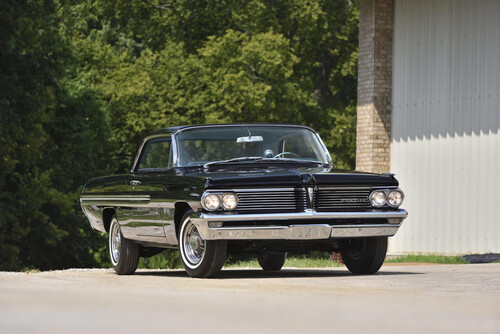
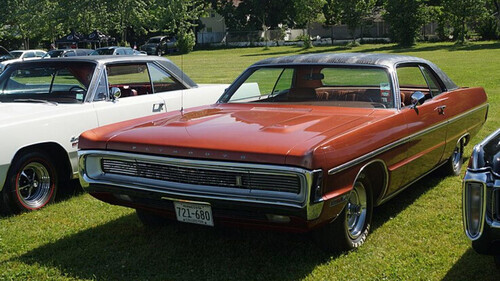
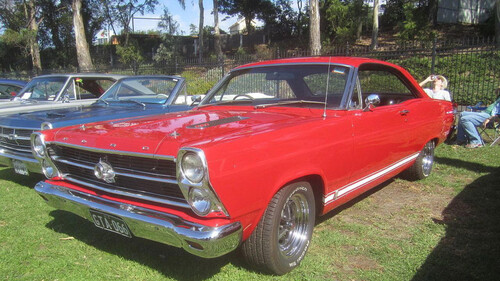
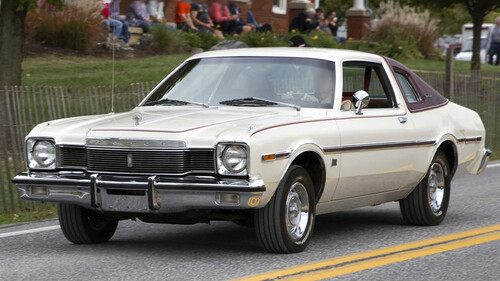
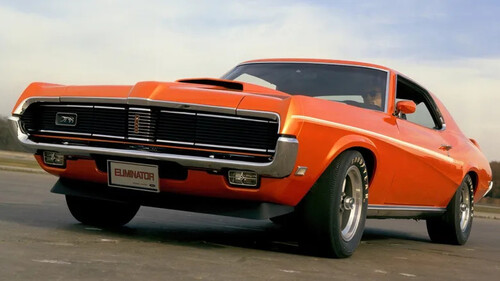
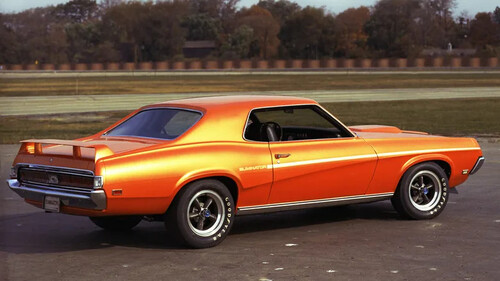
1960 Dodge PolaraThe Dodge Polara was launched to the public in 1960 and was instantly a recognizable car, with its truncated tailfins, massive front grill, chrome-plated everything, and one-piece unibody construction — a real innovation for the time. The Polara was designed to mimic an airplane, hence the fins, frills, and cockpit-inspired dashboard, which also happened to house an in-dash record player that could work with a maximum of 14 records at a time, translating to roughly two hours of playback. The tail lights on the Mark I Polara are really statement pieces that look like the back of a jet engine, keeping in line with the whole airplane theme that the car follows, and there are four of them in total. Two of the tail light units are tinted red, located right behind the tailfins, and the other two, located on either side of the rear bumper, are clear units. When launched, the Mark 1 Polara was available in five main variants: a convertible, a pillared sedan, a two-door hardtop coupe, and a four-door hardtop sedan. In addition, it came with a grand total of 20 different body styles as well as two different wheelbase lengths. Power for the first-generation 1960 Dodge Polara came from a 383 cubic-inch (6,276 cc) Ram-Fire V8 that produced 325 hp and 420 lb-ft of torque, paired to a manual three-speed transmission. It was the typical American dream car: decently high horsepower, RWD only, and striking good looks — what more could anyone want?1948 Tucker 48The man who made this rolling work of art, Preston Tucker, started his journey at Cadillac Engineering, not as a glamorous engineer, but as a lowly office boy. Later in his career, he would also work on the manufacturing line at Ford, and eventually, he would make a name for himself in Automotive sales, where he would become regional management at Pierce-Arrow, around the time when he would team up with another engineer to make the four-wheel-drive Indy 500 race cars for Ford — from 1935 onwards. Around that time, the Second World War began to loom, so Tucker decided to make a car that could be used as a scout vehicle, and almost closed a deal with the Netherlands — but the Germans overran the country. It would be produced after the war ended, in 1948, and production would last only a year, with the prototype getting all independent suspension, disk brakes on every wheel, and a gargantuan 9,652 cc six-cylinder engine, though the production variant got a more tame 166 hp, 372 lb-ft 5,473 cc engine. The design was truly resplendent, with particular focus given to the back, complete with chrome grill and mini-fin tail lights, which, even in the flamboyant design theme of the time, looked like something out of a sci-fi movie. Unfortunately, only 51 units of this super cool car were made before the company declared bankruptcy, and today, a Tucker 48 won't leave you much change from $2 million.1967 Mercury CougarThe 1967 Mercury Cougar is what we'd like to introduce you to next, featuring one of the coolest tail light designs of any car, ever. The tail lights are two massive units from the 1956-generation Ford Thunderbirds, each more than a foot long, covered with what we can only describe as prison bars from top to bottom, evenly spaced. A likely benefit of this design was probably impact protection; absolutely nothing was reaching the lens of the lights, which, when illuminated, undoubtedly had a very unique glow pattern. Speaking of design, anyone with an interest in cars will immediately notice that the car looks oddly familiar — and that's because it is based on the Ford Mustang. In terms of engines, customers were offered a 4,735 cc engine that produced either 200 hp or 225 hp, paired with a three-speed manual transmission; However, a four-speed automatic transmission was also available. When new, the base MSRP for the Cougar was just $2,851 ($28,081.40 today), making it only slightly more expensive than the Ford Mustang which it was a derivative of, though a more luxurious version, called the XR7, had a base MSRP of $3,081, which is $30,346.82 today. The 1967 Cougar also just happened to be the most successful car ever made by Mercury, having sold over 150,890 units, and actually beat the Ford Thunderbird, Caddy Eldorado, and Chevy Corvette to win the Car of the Year award from Motor Trend.2000 BMW Z8One of the few European cars on our list is this, the BMW Z8, made by BMW between 1998 and 2003. The particular edition we'd like to draw your attention to is the one made in 2000, called the Millennium Edition Roadster, which, even today, looks like a car from the future. It was a "retro-modern" design, probably symbolic of the turn of the century. To that end, several parts of the car were unique and standout-ish at the time, and one of these parts were the slit tail lights — and were the only neon lights ever fitted to a BMW from the factory. The units themselves were very thin, and the actual brake lights were only about half the height of the entire assembly, and located in the bottom half of the housing. The top half of the unit consisted of a very long turn indicator light, which, if it were on cars today, would certainly be made into a sequential indicator. However, you'd probably finish your turn before one light sequence was completed. The ones on the Z8 were quite long. Power came from the E39's 4.9-liter V8, making 400 hp and lb-ft of torque sent through a six-speed gearbox. There's not much more to be said about the Z8; It debuted in 1997, launched in 1999, and was used by James Bond in "The World Is Not Enough" — if it's good enough for Bond, it's good enough for the rest of us.