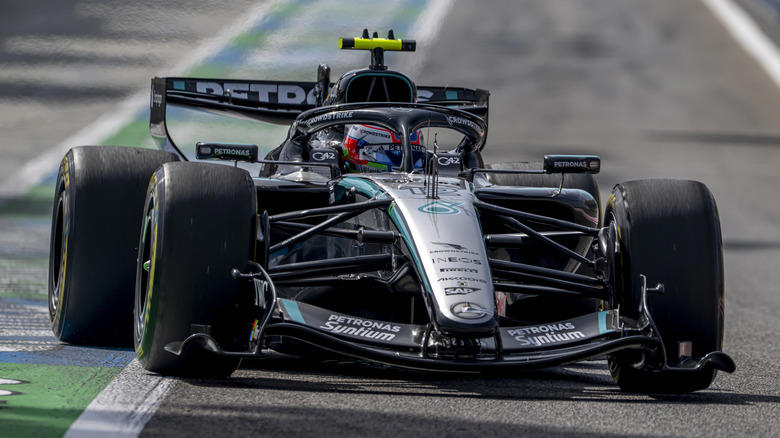
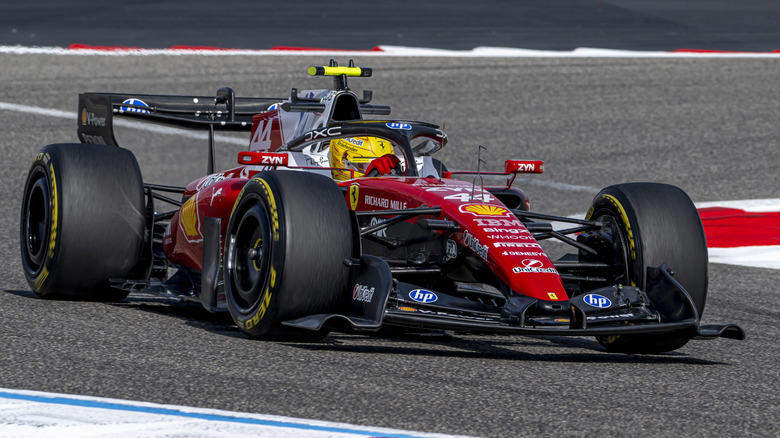
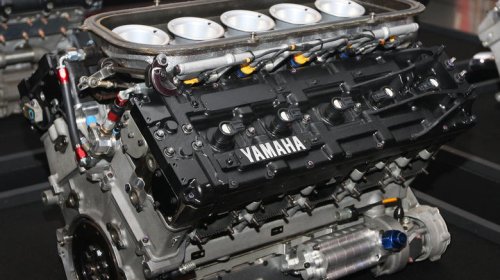
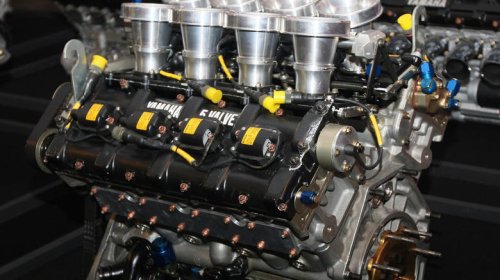
Mercedes driver Kimi Antonelli during 2026 F1 winter testingComparing a Formula 1 engine to that of a run-of-the-mill Camry is like comparing the SR-71 to a Cessna. One's tailored for mass-market appeal while the other is about precision at any cost, and both have their own set of rules to follow. That said, it's not uncommon to see F1 tech trickling down to the mainstream, but thermal efficiency is still something that Formula 1 has a clear lead over high-volume cars. On average, most production cars have a thermal efficiency of about 30%, which pales in comparison to the over 50% efficiency achieved by F1 power units. These engines achieve such levels of efficiency because of pre-chamber ignition, high compression ratios, and the MGU-H (Motor Generator Unit-Heat).Keep in mind that F1 power units don't get to enjoy variable-valve-timing or variable-valve-lift. Also, F1 engines are limited to just one injector per cylinder, which is different from the port and direct injection combo you'd find in Maserati's Nettuno V6 and other production engines. And mainstream manufacturers are catching up; Toyota and Hyundai have reported 41% thermal efficiency, with Nissan pushing it to 42% not too long ago. Dongfeng, a rather unassuming Chinese automaker, is perhaps the biggest leader here, achieving a peak thermal efficiency of just over 48%. Of course, though, these engines don't come close to the 15,000 rpm screamer that you'd find in Formula 1. Breaking things downFerrari F1 driver Lewis Hamilton during 2026 winter testingIn pre-chamber ignition, which Honda pioneered before F1, the primary combustion chamber runs a lean mixture, while a much richer mixture is ignited within a pre-chamber that sits above. The flame exits through small holes designed into the pre-chamber, which then ignites the lean mixture inside the main chamber. This bit of engineering allows the engine to run leaner mixtures without the risk of detonation.Next comes the concept of compression ratios, and we already know that higher compression ratios unlock better engine efficiency. But the actual ratios are a bit of a secret across teams, leaving their true numbers a mystery. That said, current F1 rules dictate a 16:1 limit (older regs allowed up to 18:1), and Jason from Engineering Explained assumes engineers are fully — or at least partially — making use of this number. While this sort of compression ratio isn't too far from many diesel engines, it's practically unheard of in gas-powered blocks (if we exclude the aforementioned Dongfeng's 1.5L turbo-four — which is reportedly running 15.5:1 compression — and Mazda's Skyactiv engines).The MGU-H is basically a motor that runs off the turbocharger. Its ingenuity lies in the ability to either charge the battery or send power to an additional motor that's connected to the crankshaft. Traditional turbo engines relied on a wastegate to prevent overboost, but in F1, the MGU-H harvests energy from the excess exhaust gases, contributing to the system's overall efficiency. Of course, this innovation doesn't come without an absurdly high price. F1 engines cost far more than your average Honda, and many of the components are not there to last 200,000 miles. It's a different league altogether, with a different set of rules. Want more like this? Join the Jalopnik newsletter to get the latest auto news sent straight to your inbox, and add us as a preferred search source on Google.