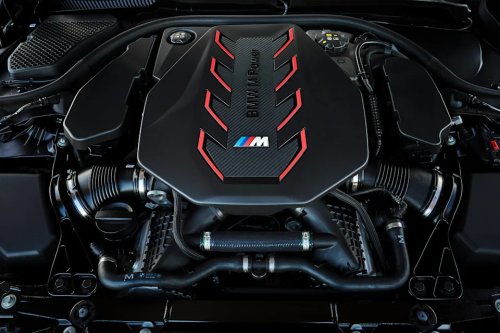
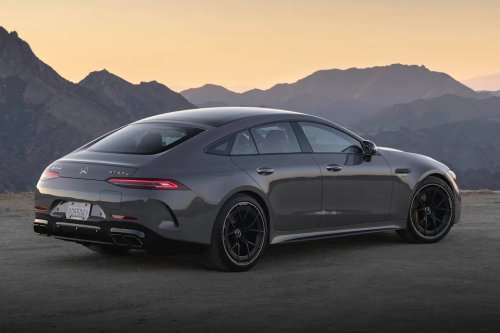
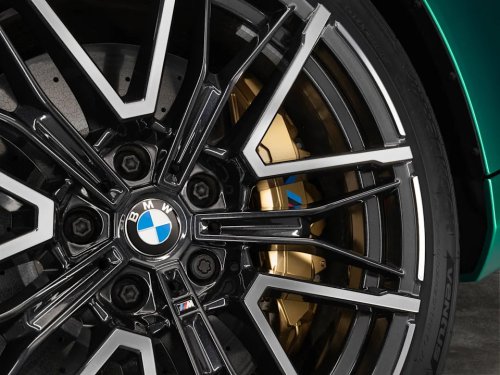
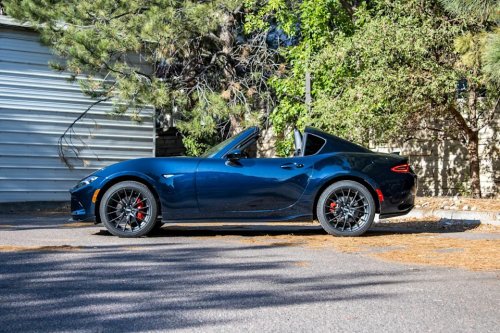























Pull That WeightIn the not-so-distant past, there was a time when the recipe for building a fast car was relatively simple. Legends like Caroll Shelby and Colin Chapman had it down to a formula; you'd take a small body, put a powerful engine in it and remove anything that isn't absolutely necessary. Give it good tires, a notchy manual gearbox, and enough suspension to keep the thing pointed in the right direction. The result was often spectacular, but for some, it made for an uncomfortable, noisy, cramped, and occasionally terrifying experience.Today's performance cars have become something very different from the machines of yesteryear. A modern sports sedan can have more than 600 horsepower, all-wheel drive, adaptive suspension, carbon-ceramic brakes, heated and ventilated seats, a dozen cameras, massive infotainment screens, sophisticated driver-assistance systems, and enough electronic hardware to make a 1990s computer lab jealous. And then there's the battery. Whether it's a mild hybrid, plug-in hybrid, or full EV, electrification has added another significant source of mass to modern performance cars.The result is an unavoidable trend of performance cars getting heavy; really heavy. In the U.S.-spec form, the latest BMW M5 tips the scales at well over 5,000 pounds. Its rival, the latest Mercedes-AMG GT 63 S E Performance is also similarly porky. Even relatively compact performance cars that once emphasized lightness can now tip the scales at weights that would have seemed absurd a generation ago. But the reasons are more complicated than simply saying that automakers have forgotten how to build lightweight cars. Modern performance cars are heavier because we're asking them to do considerably more.Mercedes-BenzSafety Comes FirstThe easiest place to start is also one of the least glamorous: safety. A modern car has to protect its passengers from all kinds of crash scenarios. That requires stronger passenger compartments, crumple zones, airbags, sensors, cameras, radar systems, and increasingly sophisticated restraints. None of this is particularly visible from the driver's seat, but the hardware is there. Modern vehicles also have to account for pedestrians, cyclists, and a wide range of regulatory tests. The result is a car more sophisticated and substantially heavier than cars from decades ago.While enthusiasts often complain that modern cars feel bloated compared with their predecessors, safety is still a major priority by all types of buyers. Today, buyers get advanced safety equipment that simply didn't exist in the past. They include airbags, an essential piece of safety equipment in today's cars. Modern cars can contain multiple airbags positioned around the cabin, including front, side, curtain knee, as well as specialized systems to protect different occupants. In addition, seatbelt pretensioners, load limiters, occupant sensors, crash sensors, have to work around all of those systems to protect people from the outside world.Every individual component might be relatively small, but collectively, they aren't. The same is true of electronic safety equipment. A modern performance car isn't merely watching the road through the driver's eyes. It may be monitoring wheel speeds, steering angle, yaw rate, acceleration, brake pressure, vehicle position, surrounding traffic, and countless other variables. That hardware adds weight. So does the structure required to mount and protect it.BMWMore Power Requires More StuffThen there is the engine itself. Modern internal-combustion engines are significantly more complicated than their predecessors. Today, most performance cars are powered by direct-injection turbocharged engines, which require sophisticated equipment in order to function. A modern performance engine isn't simply trying to put down horsepower, it also has to meet increasingly stringent emissions requirements across different regions worldwide, which requires additional hardware that can get heavy.The irony is that many of these technologies simultaneously allow manufacturers to extract considerably more power from smaller engines. A modern turbocharged four-cylinder can produce as much that would have required a much larger naturally aspirated V6 or V8 engine in the past. The technology required to meet emissions isn't necessarily making cars slower, it's just doing so while adding complexity. Turbochargers themselves illustrate the trade-off. Forced induction allows manufacturers to produce more power from smaller displacement, but they require more stuff. Under the hood, Turbos need intercoolers and plumbing for additional cooling, as well as more sophisticated engine management and stronger internal components in some instances.But if a car produces twice as much power as its predecessor, almost everything helping it put power to pavement will need to cope. The brakes have to stop it, the tires have to transmit the power and the transmission has to survive the torque. The power has to go to driveshafts and differentials to get to the wheels and the suspension has to control the additional performance. None of these solutions are always lightweight; more power requires stronger components and they add weight. More weight requires more power, and the chase for performance becomes a hamster wheel.Few technologies demonstrate this better than all-wheel drive (AWD), where it can offer an enormous advantage for performance cars. All-wheel-drive can distribute torque between the axles, improve launches, increase traction in poor conditions, and allow engineers to deploy power that would overwhelm a rear-drive setup. However, these systems require additional hardware like another differential, a transfer case and other structural requirements. This stuff is heavy, but modern performance cars increasingly rely on AWD because it allows manufacturers to make enormous power accessible to a broader range of drivers. A 700-hp rear-wheel-drive car can be intimidating, but a 700-hp AWD car can feel like a rocket.As a result, tires have also become enormous. If you look at the wheels on a modern performance car compared with a sports car from the 1980s or '90s, you'd find that not only are twenty-inch wheels very common, but some cars use staggered setups with enormous rear tires. More power requires more grip, and today's modern performance tires are engineering marvels, capable of producing levels of lateral and longitudinal grip that older tires could never reach. Bigger wheels require bigger brakes and big brakes require larger tires, which require stronger suspension components.A modern performance car also needs brakes capable of repeatedly stopping a very heavy vehicle traveling at very high speeds., Increasingly, high-end performance cars have been shipping with carbon-ceramic brakes, which are extremely capable and can reduce unsprung weight compared with some conventional setups. But they're also expensive, and even when manufacturers use lightweight materials, modern brake systems can be physically enormous.MercedesThe Luxury CarThere's another reason modern performance cars are heavy that has little to do with performance: they're actually luxury cars. For example, the new 717-horsepower BMW M5 isn't just a fast sedan, but as a BMW, it is also expected to be reflective of the premium image the BMW badge brings. Not only does it have to bring racecar-levels of performance, it also has to be quiet on the highway, comfortable in traffic, loaded with technology, and luxurious enough to justify its six-figure price tag.Specifically, the $123,300 M5 features a whole smattering of equipment and creature comforts that make it seem more like a luxury limo than a spine-bending supercar. These include power-adjustable seats, as well as a massive curved display that houses an advanced infotainment system paired with an 18-speaker Bowers & Wilkins audio system. In addition, a $1,850 Executive package adds heated front and rear seats, front ventilated seats, an interior camera, a power rear sunshade and rear side window shades, a 3D, 360-degree camera for parking and an illuminated front grille.None of those features individually adds an outrageous amount of weight, but collectively, they transform the vehicle. If you compare a stripped-down sports car with a modern performance luxury sedan and you're essentially comparing two completely different philosophies. One is designed around minimum mass, while the other is designed around maximum capability.However, this is where things get interesting. Weight is generally considered the enemy of performance, but modern performance engineering has become extremely good at managing it. For instance, the big, high-voltage battery powering the M5's plug-in hybrid architecture is mounted underneath its floor for better weight distribution and to lower the vehicle's center of gravity. In addition, its advanced M xDrive all-wheel-drive system is paired with an electronically controlled M Sport limited-slip differential in the rear to deliver intelligent torque vectoring across its wheels for different traction situations.BMWAre Cars Actually Too Heavy?All of this modern technology makes for an otherwise heavy car feel surprisingly quick and agile. It may not have the delicacy of a lightweight sports car, but it can do things that lightweight cars simply can't do; especially in terms of straight line power and speed. However, none of this means lightweight cars are obsolete. Actually, it is quite the opposite. The continued existence of cars like the Mazda MX-5, Toyota GR86, and Porsche 718 demonstrates that there is still an audience for lightweight performance. A lightweight car doesn't need 600 horsepower.It can provide excitement at lower speeds, can communicate more directly and requires less tire, brake, and suspension hardware. Most of all, it can be entertaining without putting so much pressure on the driver. That's an important distinction in the modern performance landscape. These days, there are essentially two paths to speed: you can make the car light, or you can make the car incredibly powerful and technologically sophisticated. Increasingly, manufacturers are choosing the second. If one were to ask if today's modern performance cars are far too heavy, it'd be a much more complicated question.If the driver is looking for maximum acceleration, all-weather capability, luxury, safety, and everyday usability, the weight of a modern performance car is understandable. But if the objective is driver engagement, simplicity, and agility, it becomes harder to defend. The problem isn't simply that modern cars weigh more, it's that consumers increasingly expect their performance cars to be everything at once; even things that don't seem to make sense at all. Consumers want an EV that can travel hundreds of miles and recharge quickly, or a sports car that can be used as a daily commuter. Luxury cars that can tackle a racetrack, and SUVs that can accelerate like a supercar. Those requirements have consequences.Chase BierenkovenThe Real Weight ProblemAt the same time, the automotive industry's weight problem is ultimately a problem of expectations. We're asking cars to do more than ever, but thanks to our demands, today's cars are safer, faster and come with a whole host of modern tech and creature comfort and equipment that rivals more prestigious luxury cars. Whether it be efficiency or electrification, each solution comes with engineering costs, whether it be straight up money, a final product that is technologically complex, or one that is ungodly heavy. The fascinating thing is that automotive engineers continue to find ways around the problem. Lightweight aluminum, carbon fiber, high-strength steel, magnesium, advanced composites, smaller engines, integrated electric motors, and smarter software all help offset the mass added elsewhere.But physics remains stubborn. If you want a 700-hp luxury car with all-wheel drive, a hybrid system, massive brakes, huge tires, 20-plus-inch wheels, a giant battery, and enough safety equipment to protect its occupants in a serious crash, you're going to end up with a heavy vehicle. The question for the next generation of performance cars isn't simply how to make them faster. It's whether automakers can figure out what we can stop adding. Because the ultimate performance upgrade may not be another 100 horsepower. It might be losing 500 pounds.