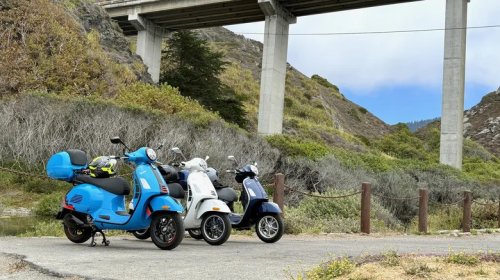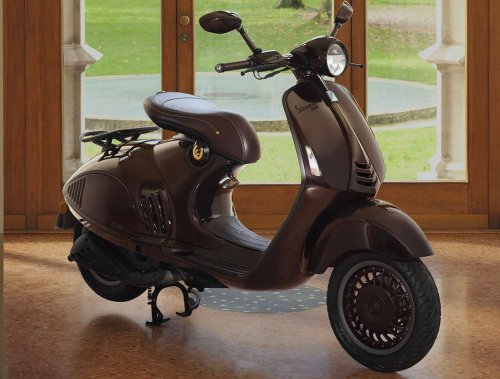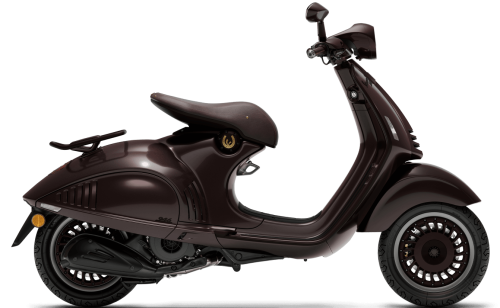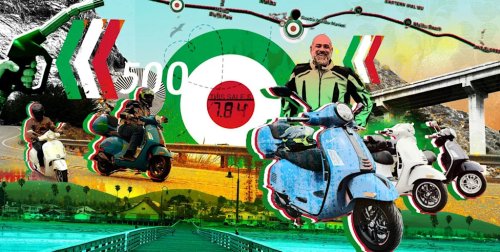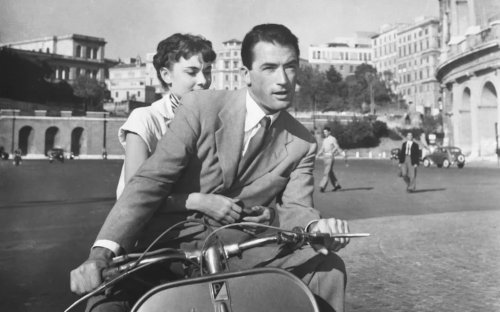
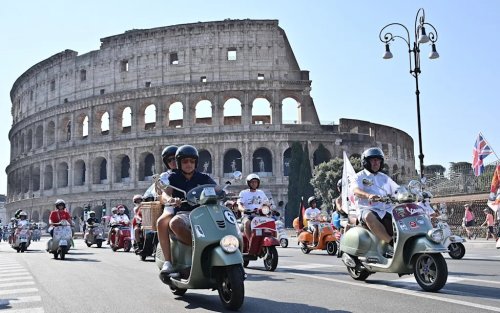
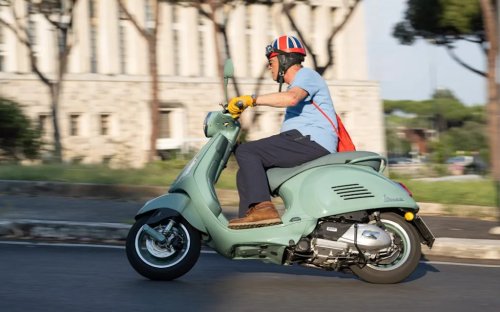
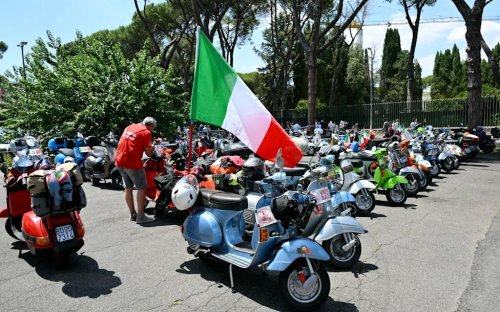
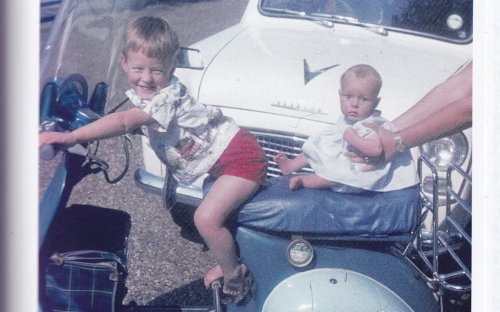


















Audrey Hepburn and Gregory Peck in Roman Holiday (1953); legend has it that Piaggio sold 100,000 Vespas off the back of the film - Screen ArchivesIt's hotter than an Italian brick factory on the streets of the Eternal City. What is it they say about mad dogs and Englishmen? Yet despite the oppressive heat, more than 25,000 Vespa scooters from 67 countries are noisily parading round the terracotta-hued heat of Rome's best-known tourist sites: the Colosseum, the Trevi fountain, roaring past the Vatican and along the banks of the Tiber, looking cool and stylish even 80 years after the diminutive scooter was revealed.More than 20 million have been built since that debut at the Milan design show, more than two million in the last decade. You can look back at the scooter's retro charm, but owner Piaggio is looking to the future. The Vespa is more popular than ever, so what's the secret to its longevity?Vespa enthusiasts from around the world riding to mark the 80th anniversary of the iconic Italian brand on June 27 2026 - GettyFirstly, we have to credit the sheer rightness of the design, credited to Corradino D'Ascanio, a well-regarded aeronautical engineer. He initially produced the design for industrialist Ferdinando Innocenti, but when Innocenti, a major Italian supplier of steel tubing, bridled at D'Ascanio's pressed-steel Vespa body, they rowed and the designer took his draft to Enrico Piaggio.AdvertisementAdvertisementEnrico, son of the company founder Rinaldo Piaggio, had been looking for a design upgrade for his ugly-duckling fully enclosed scooter, codenamed MP5, but which quickly gained the sobriquet Paperino (Donald Duck). D'Ascanio's design, with better proportions and looks, had been inspired in part by aeronautical practice and by the Cushman scooters used by American paratroopers during the Second World War.Writer Andrew English whizzing through the Eternal City on a Vespa - Alberto CervettiTimeless designWhy was the Vespa so good? Its spar frame was simple and cheap to make, using sheet steel stamped with press tools exploiting Italy's existing expertise in car and aircraft construction. The single-sided link-arm front suspension aided fast wheel changing, an internal-mesh transmission eliminated a messy, oily final-drive chain of conventional powered two-wheelers and the modular construction allowed new model derivatives to be quickly developed.The wasp-waisted profile and two-stroke exhaust note provided Piaggio with the name Vespa (Italian for wasp) and the patent was filed in April 1946, with sales of the 98cc three-speed machine beginning that autumn. Lacking any sales outlets, Piaggio shrewdly sought out Lancia dealers to initially sell the Vespa; at that time Lancia made high-quality prestige cars, exactly the audience Piaggio sought.It wasn't cheap initially, at 55,000 lira for the base model and 61,000 lira for the "deluxe" version – which in today's values would be just either side of £2,000. These days UK Vespa prices run from about £3,200 to more than £8,000 depending on engine and specification, with the Elettrica battery-electric version from £4,800.More than 20 million Vespas have been built since its debut at the Milan design show - Alberto PizzoliCinematic coolAnother reason is it that it looked cool – and still does. And one reason we are in the Italian capital for this celebration is the 1953 film Roman Holiday, William Wyler's enchanting romance starring Gregory Peck as Joe Bradley, the jaded but ultimately decent journalist who encourages Princess Ann (Audrey Hepburn) to "live dangerously, take the whole day [off]" from her royal duties.AdvertisementAdvertisementThe hero scooter is the Vespa, a 1951 125 V30T "faro basso" (low headlight) on which they escape the paparazzi and tour the Eternal City, even outrunning the carabinieri in Jeeps.The Vespa was a light green, but you wouldn't know it since Wyler had filmed in black and white. Determined to escape the strictures of the McCarthyite witch hunts for so-called communist sympathisers in Hollywood, the director had eschewed the considerable resources of Paramount and elected to film in Rome, saving money by shooting in monochrome.Hepburn won an Oscar for her role, which launched her career. The story goes that she left it in the ladies' toilet at the awards ceremony.The world went mad for the film and the little Vespa. Legend has it that Piaggio sold 100,000 off the back of it, although that seems a suspiciously round number.AdvertisementAdvertisementThe film credits kept rolling in. Piaggio reckons the Vespa has more than 2,000 appearances, notably Quadrophenia (1979), in which Sting's Vespa went up against Phil Daniels's Lambretta and Jessica (1962), with Angie Dickinson as a Vespa-riding midwife who beguiles the local men. Matt Damon rode a Vespa in The Talented Mr Ripley (1999), Gwen Stefani sang from the seat of one in the video for her 2007 single Now That You've Got It. A Vespa has been used to symbolise romance, escape and freedom in La Dolce Vita (1960) and Luce in 2021.It's not just film. There's a symbolic Vespa in William Klein's startling photographs of Nina Simone in his Vogue magazine shoot in 1960. These days a Vespa is a passport to celebrity cool, with endless shots of celebrities on a Vespa in the sunshine.I have a family connection, too. Back in 1963, I was photographed on board my uncle Richard's Vespa, with my brother Simon on the pillion. Richard and my aunt Patricia went everywhere on it, even riding from Essex to Hastings on the day of the Great Train Robbery. Well, that's what they told everyone…English, left, on his uncle Richard's Vespa, with his brother, Simon, riding pillionContinued successPart of the success story has been the way that Piaggio has never lost faith in its street-smart scooter. "The line of evolution has never been cut," says a Piaggio spokesman. That continuous production matches cars such as the Porsche 911 and Morgan Plus 4. Subtly marketed, Piaggio continues to keep the pot boiling with specials and limited editions.AdvertisementAdvertisementIt's a chameleon. As a Piaggio source puts it: "Mods in the UK only, in Japan it's a high-style scooter, but in France and Germany it's all about young girls having independence. A Vespa has always been easy to ride."The latest special is the Vespa Edizione Ottantesimo (Italian for 80) to celebrate the anniversary. Costing £12,115 including a helmet, it has a 25bhp single-cylinder engine, anti-lock brakes, electronic traction control and keyless starting.In the furnace heat of the evening, my Vespa test machine and I found ourselves on opposing sides of the city to our photographer, separated by Rome's notorious rush hour. I've done more dangerous stuff for The Telegraph, but not by much. My escort rider, Fulvio Virgili, is a local and rides like it. We swoop through the traffic, squishing between buses and cars, always at the front of queues, clattering over the cobbles and cornering like a rollercoaster.The Vespa symbolises romance, escape and freedomVespas are the simplest things to ride. You plant your feet, twist the throttle and go. The brakes are strong and so is the performance up to 50mph. The perfect urban vehicle, then.AdvertisementAdvertisementJust when I think I've got the hang of Roman traffic and am cornering as hard as I dare around a fountain, a young woman comes past, diaphanous summer dress flapping and with open-toed sandals on her feet…"Rome is beautiful," says Fulvio, gesturing at the vision of St Peter's Church looming into view in the umber sunset. It most certainly is, Fulvio.The Telegraph verdictMany point to Dante Giacosa's Fiat Nuova 500 of 1957, or even the American Marshall Plan of investment in Europe as the means by which Italy became mobile and reindustrialised after the Second World War.I think that D'Ascanio's Vespa should take some credit to the extent that in the 1980s Italian cities were shrouded in a miasma of two-stroke exhaust fumes, although the classic Vespa's status, value and increasing rarity mean that fewer are used for daily commuting these days. And Italy still loves the Vespa; when a ban on pre-1999 scooters, including Vespas, was proposed by authorities in Genoa, there was uproar.AdvertisementAdvertisementAnd the wasp has outlasted its rivals. Lambretta stopped production of its scooter in 1972, Honda's 1958 Supercub is still (just) in production, but who remembers the contemporary Heinkel Tourist, the Zündapp Bella, the Fuji Rabbit or the Triumph Tigress?Vespa even entered the Italian lexicon: Vespisti for the enthusiasts, Vespino for the machines and the verb Vespare denoting going somewhere on a Vespa.For there really is nothing like a Vespa to get you across town faster or more stylishly than this 80-year-old design.So forza Vespa, felice anniversario and many happy returns.Try full access to The Telegraph free today. Unlock their award-winning website and essential news app, plus useful tools and expert guides for your money, health and holidays.