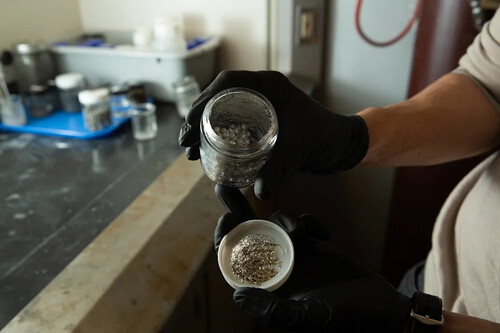
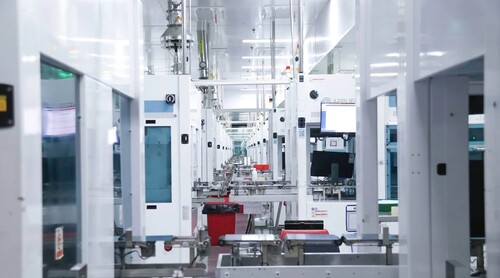
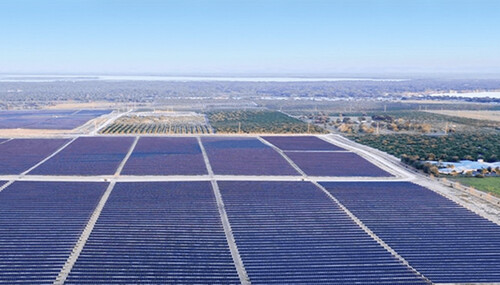
Despite the sharp U-turn in federal energy policy, demand for solar power is booming, and US President Trump’s war in Iran has added even more fuel to the fire. With all that simmering in the background, it’s no surprise to see a once-tottering, now-thriving US solar cell manufacturer announce plans to bump its current 1-gigawatt annual capacity up to more than 5.5 gigawatts. A Second Life For Made-in-America Solar Cells If you’re thinking the phoenix-like manufacturer in question is Suniva, run out and buy yourself a cigar. The Georgia-headquartered firm spun out of research at Georgia Tech University in 2007. By 2014 Suniva was laying plans to produce its crystalline silicon solar cells and modules at scale in a repurposed Sears warehouse in Saginaw, Michigan. On the financial side, in 2014 Suniva also hooked up with the leading firm Technology Credit Corporation. “TCC’s expertise in providing financial packages allows us to expand the customer segments to which we sell while yielding a cash-positive solution for our customers; this is a win-win situation,” explained Suniva’s VP of global sales and marketing Matt Card. Investors also piled on. In 2015, Shunfeng International, the parent company of the leading solar firm Suntech, acquired a 65% majority stake in Suniva, joining minority investors Goldman Sachs, NEA, Prelude Ventures, and Warburg Pincus. When Suniva Almost Fell Off A Cliff All that came to a screeching halt in April of 2017, when Suniva declared bankruptcy. Meanwhile, the firm also petitioned the International Trade Commission to investigate anti-competitive practices by its overseas rivals. The contentious petition resulted in 30% tariffs on imported solar hardware, imposed in 2017 under Section 201 of the 1974 Trade Act. Accordlingly, Suniva eventually emerged from bankruptcy with an assist from the firm SQN Capital Management. Much water has passed under the bridge since then, including plans for a new solar cell factory to be located in Norcross, Georgia, with an initial output of 1 gigawatt per year. Reuters reported the Norcross news in March of 2024, citing Matt Card, now holding the title of Suniva President. “Solar cells can succeed in this market. We’re proving that and we’re coming back in a major way very, very quickly,” Card said. By major, Card meant major. Suniva emerged from bankruptcy in 2019 under the wing of New York-based Lion Point Capital as the new owner. As noted by Reuters, another New York firm is also in the mix, Orion Infrastructure Capital. Orion provided funds for Suniva to expand the Georgia facility, and it also provided financial support for the Canadian solar manufacturer Heliene to establish a factory in Minnesota. That’s not a coincidence. In March of 2024, Suniva announced a three-year strategic contract aimed at sending Suniva’s solar cells to Heliene’s new factory in Minnesota. “Heliene’s modules will be the first crystalline solar modules with a U.S.-made solar cell,” Suniva emphasized in a press statement, making them eligible for a 10% tax credit carved out for renewable energy technologies under the Inflation Reduction Act. “Currently, all U.S.-made solar crystalline modules use only imported cells,” Suniva added. “This partnership will directly address that gap in the U.S. solar supply chain and help strengthen manufacturing capacity to meet increased demand for domestic products.” More Made-In-The-USA Solar Cells For The USA That brings us up to the lastest news from Suniva. Earlier this week, the company announced plans for bringing a new 4.5-gigawatt solar cell factory to Laurens, South Carolina. “The new facility, coupled with Suniva’s existing facility at its headquarters in metro Atlanta, will bring the company’s total domestic solar cell manufacturing capacity to over 5.5GW annually — the largest of any merchant solar cell manufacturer in the United States,” Suniva emphasized. Contrary to the Energy Department’s fantasy world of fossil fuels, Suniva CEO Tony Etnyre articulated what everybody else knows. “Solar energy is the fastest and most economical way to grow our nation’s energy supply,” Etnyre said in a press statement. “Our expansion means that domestically produced renewable energy will do more than ever to secure America’s energy future,” he added. The Sun Does Not Care About Your Strait Of Hormuz US President Donald Trump’s decision to launch a war against Iran resulted in the closure of a key shipping lane, the Strait of Hormuz, providing renewable energy advocates with an opportunity to point out that wind and solar energy are not vulnerable to such disruptions. Card, who has now added COO to his title of Suniva President, also did not let the opportunity go by. “At this moment in history, the question of where our energy comes from – and who controls the supply chain that delivers it – is among the most consequential questions America faces,” Card stated, adding that the expansion to 5.5 gigawatts is “a national imperative.” Card also noted that the new expansion is good business, too. He’s not the only one. The business case for solar power is overwhelming. Take Texas, for example, where state legislators have bent themselves into pretzels in an effort to stop new wind and solar farms. Meanwhile, new solar factories from pouring into the state like an avalanche. To cite just one case, last spring, the firm FREYER Battery dropped plans for a battery factory in Georgia and repurposed itself as T1 Energy, with the aim of reviving a former Trina Solar factory in Texas. By December, T1 was pushing ahead with its new G2_Austin solar cell factory in Milam County, Texas, at a Phase One output of 2.1 gigawatts. In a press release announcing the new construction plan, the company also took a poke at the Energy Department’s fossil-friendly priorities. “Supported by the Trump Administration’s pro-growth economic and trade policies, T1’s investment in G2_Austin is part of its ongoing commitment to building a strong domestic silicon-based manufacturing industry, bolstering American energy security, and creating skilled American jobs,” T1 elaborated. T1 plans to steer the output from G2_Austin over to its G1_Dallas solar module factory in Texas, (the former Trina Solar facility) with a capacity of 5 gigawatts. “Combined with a contract to source polysilicon and solar wafers from our partners Hemlock Semiconductor and Corning Inc. in Michigan, T1 anticipates the solar cell fab will be the final major link in a domestic solar supply chain,” T1 explained. Stay tuned for more. Phase 2 aims at another 3.2 gigawatts and beyond, depending on the demand for solar cells. Image: The US solar cell manufacturer Suniva is back in action with plans to bump its capacity up from 1 gigawatt annually to 5.5 gigawatts (courtesy of Suniva).