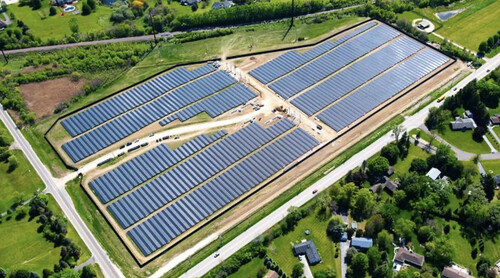
Notwithstanding the sharp U-turn in federal energy policy, the US Air Force continues to pursue the next generation of decarbonization solutions, and space solar is in the mix. Yes, space solar. That nutty idea about beaming solar energy down to Earth from space is not so nutty after all, and the Air Force is among those taking steps to move the needle from the lab into real world applications. Space Solar, Coming Soon To A Solar Array Near You US scientist and writer Isaac Asimov is credited with formulating space solar as a 24/7 energy solution all the way back in the 1940s. In theory, orbiting solar panels could collect solar energy regardless of the weather or time of day, and beam it down to Earth. Putting that theory to work has been a distant dream until recent years, though. Solar panels have been a fixture in space applications since the 1950s, but the beaming end of things has been among the hurdles faced by space-to-earth systems (see lots more space-to-earth background here). The cost of rocket launches has been another formidable challenge, but that has faded out as costs have dropped substantially in recent years. With that, the technology pieces are now in place and more than a few ambitious startups have thrown their hat into the ring. Cost still remains an obstacle to widespread commercial adoption, but the US startup Overview Energy has come up with a solution. Instead of building standalone receivers here on Earth, the company has designed a space solar system that can piggyback on existing solar power plants. So Much For The War On Renewables Overview organized itself in 2022 and it surfaced on the CleanTechnica radar in December of 2025, when the company let word slip that it attracted $20 million from Engine Ventures and Lowercarbon Capital, among other investors. “The cash infusion is significant because it demonstrates, yet again, that private sector investors can still push the envelope on solar innovation here in the US, regardless of this year’s abrupt shift in federal energy policy,” CleanTechnica observed. “Launch costs have dropped more than tenfold, and annual launches have grown just as dramatically,” Overview noted in a press statement last December. “Mass manufacturing satellites is now routine. High-efficiency photovoltaics and high-power, high-efficiency lasers have become inexpensive, reliable, and commercially available.” Overview’s space solar solution eliminates the time, cost, and siting limitations of standalone receivers, by taking advantage of existing solar facilities. The system is designed to function as a sort of roaming peaker plant, but without the gas turbines. “Overview’s satellites will operate at an altitude of approximately 36,000 kilometers (about 22,000 miles) in geosynchronous orbit, collecting sunlight continuously and transmitting it as low-intensity, invisible infrared light,” Overview explains. The system deploys the same wavelength as night vision security cameras, commonly used in homes. “The beam is never more intense than the sun, never visible, and never harmful — passively safe for people, wildlife, aircraft, and other spacecraft,” the company emphasizes. The US Air Force Spots A Space Solar Opportunity The Air Force emerged as an early adopter of solar technology during the Obama administration, as military planners recognized the value of utility scale on-site solar arrays to improve energy security and resiliency at its facilities. The agency has also adopted small-scale solar applications and transportable solar systems, and the Air Force Research Laboratory has been front and center in cutting edge solar R&D, so it’s no surprise to see an interest in space solar float across the radar. On May 6, Overview announced the award of its first Air Force contract. Issued through the Secretary of the Air Force for Installations, Energy, and Environment, the contract tasks Overview with demonstrating how its technology can support Defense Department operations. “The work will focus on energy applications in constrained and contested logistics environments, including how this approach can help power large U.S. military installations in remote locations and reduce reliance on fuel supply chains,” Overview explains. “The effort will investigate applications across a range of environments, from remote bases like Eielson Air Force Base in Alaska to strategically important locations such as Anderson Air Force Base in Guam, where fuel supply chains can become constrained in contested scenarios,” the company elaborates. “By reducing the need to transport fuel for power, space solar energy has the potential to improve operational flexibility and support the safety and effectiveness of U.S. personnel,” the company adds. If that sounds familiar, it is. The high cost and human toll of fuel transportation has been part and parcel of modern warfare ever since internal combustion engines replaced horses and mules in the 20th century, with the Bush presidency providing many 21st century examples during the Iraq and Afghanistan wars, and US President Donald Trump adding yet another dimension to the fuel cost issue when he decided to launch a war against Iran. Space Solar Really Is Happening In its May 6 announcement, Overview affirmed that it has already has a capacity reservation in place with Meta among other agreements. Additionally, the company reminded everyone that it has successfully demonstrated the system on an airborne platform using the same equipment to be hosted by its satellites. Overview expects to send its satellites into low Earth orbit in 2028, followed by megawatt-scale transmission in 2030. “In the early 2030s, we’ll be capable of delivering more than a gigawatt of 24/7 clean energy anywhere on Earth,” the company states. By that time, there will be more than enough existing solar arrays on Earth to provide Overview with plenty of opportunities to put its orbiting peaker plants to work. The company points out that solar arrays typically sit idle for 65-75% of a day. While batteries and other energy storage systems can squeeze some extra value out of a solar array, Overview notes that its space solar solution will extend revenue-producing hours into the night. “Utilities can bypass congested corridors and draw on infinite energy reserves above the atmosphere. Households see lower electricity costs as satellites blunt the peaks that drive price spikes,” the company adds. Data centers and other large-load facilities can also deploy space solar to access utility-scale capacity without having to wait in a long grid connection queue. Extending operational hours for solar power plants could also foster a ripple effect in the green hydrogen and e-fuels field, which has also caught the eye of military planners and defense suppliers (here’s another example). If you have any thoughts about that, drop a note in the comment thread. Image: The US startup Overview Energy is developing a space solar solution that will extend the operational hours of existing solar power plants on Earth (courtesy of Overview Energy).