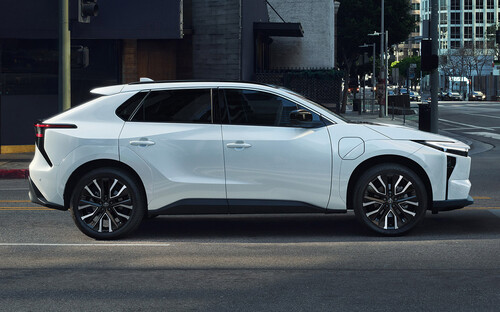
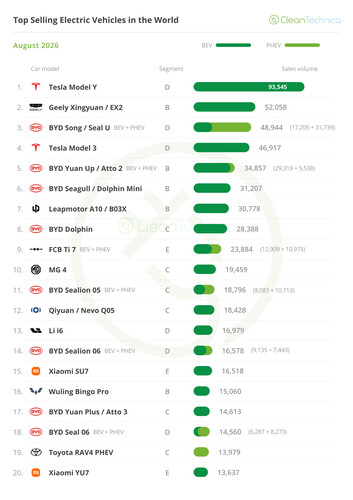
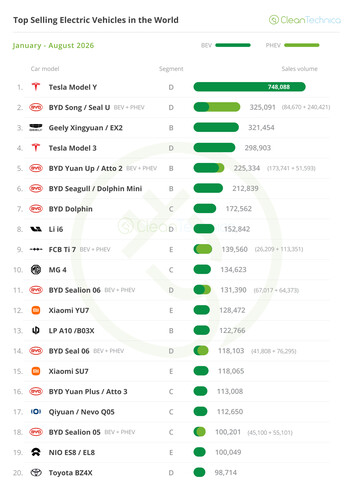
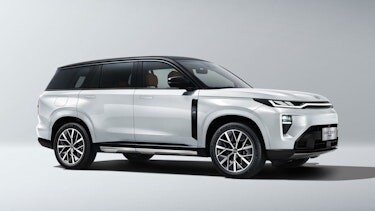
Once a British heritage brand, MG Motor now belongs to China’s SAIC Motor following the insolvency of the MG Rover Group. Since returning to the European market in 2011 and launching in Germany in 2021, the brand has rapidly expanded its presence and gained market share. According to its own figures, MG has now delivered one million vehicles in Europe.In the past two years alone, MG has registered more than 500,000 new vehicles across 34 European countries, including 317,000 electric models. The compact MG4 Electric has played a central role in this growth. With the new flagship MGS6 EV, the manufacturer now targets a stronger position in the electric mid-size SUV segment.Between segments C and DThere are no fixed boundaries between vehicle segments. Whether a model falls into the C or D segment depends on factors such as size, positioning, price, body style and its competitive environment. MG Motor classifies its new electric SUV as a C-segment model, but the key specifications of the MGS6 EV point clearly to the class above.The model measures 4.71 metres in length, 1.66 metres in height and 1.91 metres in width, with a wheelbase of nearly 2.84 metres. This places it above rivals such as the Volkswagen ID.4, Škoda Enyaq, Hyundai Ioniq 5 and Kia EV6, while remaining below models such as the Tesla Model Y, Xpeng G6, Audi Q6 e-tron and BMW iX3.While some competitors focus on a striking appearance, the MGS6 EV deliberately adopts a more understated design. The front, with its slim LED lights, is pleasing, and the continuous light strip at the rear is now common practice in the industry. Overall, the MG does not aim to provoke or polarise but rather to appeal to as many buyers as possible. It succeeds: the electric SUV does not stand out negatively but also does not set any particular design accents.Under the bonnet, MG Motor focuses on a well-balanced overall package rather than gimmicks. The specifications underline this approach: at launch, the MGS6 EV comes in two variants. The tested long-range rear-wheel-drive version delivers 180 kW and 350 Nm of torque, accelerating from 0 to 100 km/h in 7.3 seconds.The all-wheel-drive version sits above it, offering 266 kW and 540 Nm, with a sprint time of 5.1 seconds. Both variants reach a top speed of 200 km/h, placing them among the frontrunners in their competitive field. Image: Daniel Bönnighausen Image: MG Motor Image: MG Motor Image: MG Motor Image: MG Motor Image: MG Motor Image: MG Motor Image: MG Motor Image: MG MotorAdequate performanceThe first drive in Portugal showed how these figures translate into everyday use: even the rear-wheel-drive version of the MGS6 EV feels sufficiently powerful. The electric SUV delivers its performance smoothly and effortlessly, without aiming for a particularly sporty character.On Portuguese country roads, the model remains composed and predictable. The suspension clearly prioritises comfort, absorbing smaller bumps with ease.However, the first drive also revealed minor weaknesses over larger bumps and on poor road surfaces. In these situations, occupants feel impacts more clearly than expected in this segment. Even so, the MGS6 EV remains stable, while the steering responds in a linear and predictable manner.Overall, the electric SUV delivers a comfortable travelling experience. Effective sound insulation also contributes to this impression, keeping the interior relatively quiet even in strong winds.The regenerative braking system of the MGS6 EV is not entirely without criticism. While the adaptive energy recuperation works reasonably well, it does not always feel as smooth or predictable as in some rival models. In everyday driving, this can lead to slightly uneven deceleration.On the plus side, the vehicle offers well-calibrated one-pedal driving.Despite some minor criticisms, the MGS6 EV demonstrated its comfort strengths under demanding conditions on the Portuguese coast. The test drive did not take place in typical presentation weather. Instead of sunshine and mild temperatures, strong winds, temperatures between eight and 13 degrees Celsius, and frequent heavy rain dominated the day.The route led through hills and valleys, mostly via smaller Portuguese towns and along challenging country roads, with some motorway sections included.Consumption and rangeThe rear-wheel-drive version of the MGS6 EV offers a combined WLTP range of up to 530 kilometres. In practice, however, this remains a theoretical figure. Under the described conditions, the onboard computer showed consumption of around 18 kWh/100 km, rising to 22–24 kWh/100 km on the motorway. This results in calculated ranges of roughly 413 to 310 kilometres. Within its competitive field, the model neither stands out nor falls behind in this respect.For a vehicle of this size, these figures are respectable. The 77 kWh battery – with 74.3 kWh usable – provides sufficient range for everyday driving. However, MG Motor does not offer a larger battery option. This is a drawback, as some competitors in this segment provide higher capacities and therefore greater range.Room for improvement at the fast chargerWhen the battery runs low, the MGS6 EV charges at up to 11 kW on AC – in line with the industry standard. At DC fast-charging stations, however, one of the model’s key weaknesses becomes apparent. SAIC Motor quotes a maximum DC charging power of 144 kW and a charging time of around 38 minutes from 10 to 80 per cent. By 2026, this places the model behind the curve in its segment.Many competitors have already moved ahead in this area. Models based on the Volkswagen Group’s MEB platform, such as the Volkswagen ID.4, achieve charging times of under 30 minutes with comparable battery sizes. The BMW iX3 charges its 82.6 kWh battery to the same level in just 21 minutes. Rivals from Hyundai Motor Company, Kia Corporation and Xpeng are faster still at rapid-charging stations.For customers who mainly cover short daily distances and charge at home or at work, this limitation may be less relevant. However, anyone who regularly undertakes longer journeys will notice the comparatively slow charging speed of the MGS6 EV at every stop.On the plus side, the model comes standard with a heat pump, manual and automatic battery preconditioning, and route-based charging planning. These features help to mitigate the issue, but they do not fully offset it. A more comprehensive test will be needed to assess how effectively preconditioning and charging planning perform in everyday use. Image: MG Motor Image: MG Motor Image: MG Motor Image: MG Motor Image: MG Motor Image: Daniel Bönnighausen Image: MG MotorDisplay and controls: A mixed bagInside the cockpit, MG relies on a 12.8-inch touchscreen, complemented by a 10.25-inch driver display behind the steering wheel. The infotainment system is well-structured, and all functions are easy to find. The ‘MG Pilot’ system even allows saved preferences to be restored with a few simple steps – eliminating the need to reconfigure each function individually after every start.However, some weaknesses remain in the details. While the MGS6 EV supports wireless Apple CarPlay and Android Auto, the standard head-up display projects its information somewhat indistinctly onto the windscreen and only shows data from the built-in navigation system. Content from Google Maps or smartphone-based navigation is not integrated. The same limitation applies to the driver information display.However, MG Motor is not alone in this respect. On the plus side, the brand retains physical controls for key functions such as climate settings and volume.Plenty of space and high practicalityBeyond the cockpit, the interior of the MGS6 EV leaves a generally positive impression. The material selection is appropriate for this class: synthetic leather with a suede-like finish, soft surfaces at relevant contact points, and overall neat workmanship. While MG does not claim premium status, the quality feel is convincing.The standard panoramic glass roof gives the interior an airy feel. Rear passengers particularly benefit from the long wheelbase. Even tall passengers can sit comfortably, and the flat floor makes using the middle seat easier. At least four large adults can travel in the MGS6 EV without any issues.The boot also offers practical values. The electric SUV provides 674 litres of luggage space, which increases to 1,910 litres with the rear seats folded down. Additionally, there is a frunk with 124 litres in the rear-wheel-drive version and 102 litres in the all-wheel-drive model. This large frunk is a practical feature that some direct competitors do not offer.For those needing even more transport capacity, the MGS6 EV can tow up to 1,500 kilograms (braked) or 750 kilograms (unbraked). This is reasonable, though the tow ball load is limited to just 60 kilograms.LuxuryLuxury AWDDrivetrainRWDAWDPower180 kW266 kWAcceleration7.3 s5.1 sTop speed200 km/h200 km/hWLTP range530 km485 kmBattery capacity (gross)77 kWh77 kWhDC charging power144 kW144 kWDC charging time 10-80%approx. 38 min.approx. 38 min.AC charging power11 kW11 kWAC charging time 10-100%approx. 7 happrox. 7 hFully equipped as standardIn Germany, MG offers the MGS6 EV in only one highly comprehensive trim level called ‘Luxury.’ Standard equipment includes the aforementioned heat pump, head-up display, heated steering wheel, heated and ventilated front seats, heated outer rear seats, and a 360-degree camera. All driver assistance systems are also included as standard.This keeps the configuration process straightforward. Buyers essentially only choose between rear-wheel and all-wheel drive, the exterior colour, and a light or dark interior. In many competing models, similar equipment levels lead to long options lists and significantly higher final prices.The rear-wheel-drive MGS6 EV starts at €49,990. With a different exterior colour (+€900) and a light interior (+€450), the price rises to a maximum of €51,340. The all-wheel-drive version starts at €53,990, or up to €55,340 with the same options. This positions the electric SUV as competitively priced within its segment.ConclusionWith the MGS6 EV, MG Motor delivers an electric SUV that performs strongly in many areas. It offers generous space, ample storage capacity, a comprehensive list of standard features and a high level of comfort on long journeys. Efficiency and range are also solid for a vehicle of this size.However, the model still shows clear room for improvement in fast charging. With a peak of 144 kW and around 38 minutes for a 10–80 per cent charge, it no longer ranks among the leaders in its segment by 2026. How much this matters depends on usage: drivers who mainly cover short distances and value a well-equipped vehicle at a fixed price will find a well-rounded package here. Frequent long-distance drivers, by contrast, will find alternatives with significantly faster charging performance.