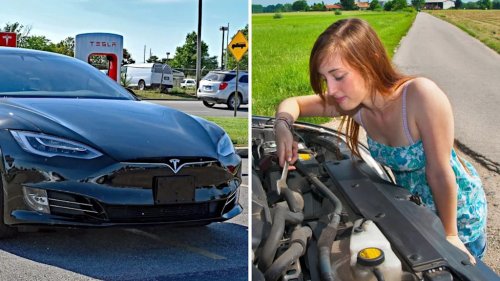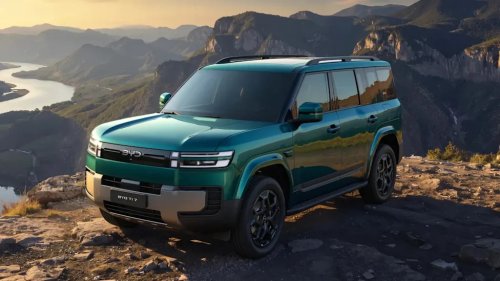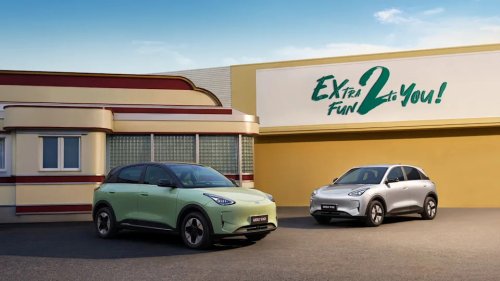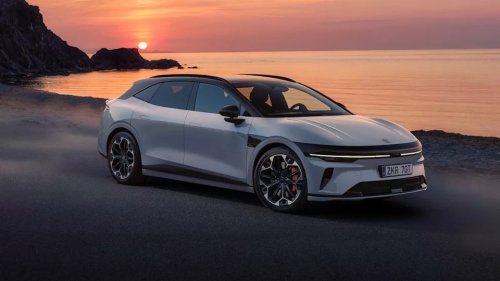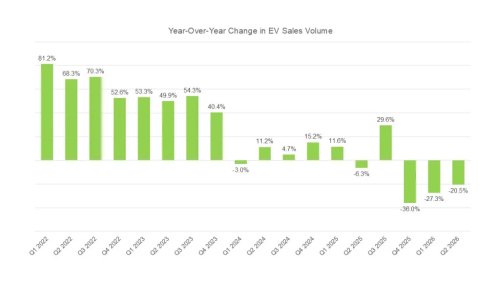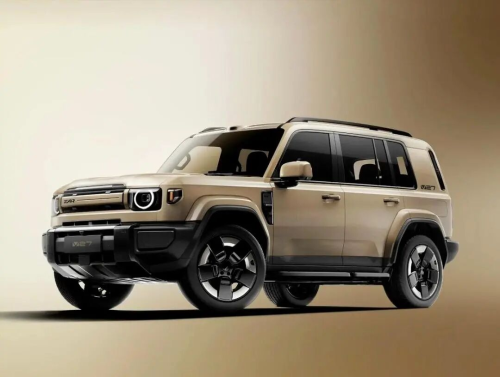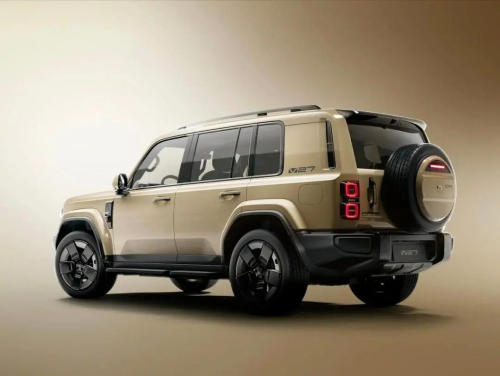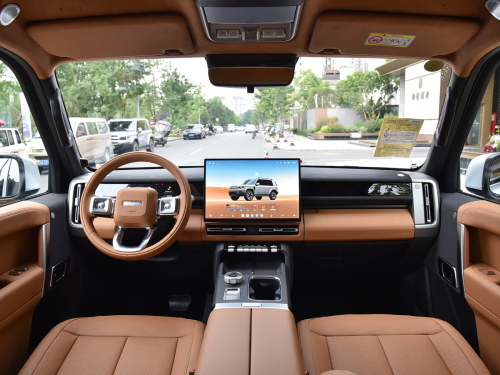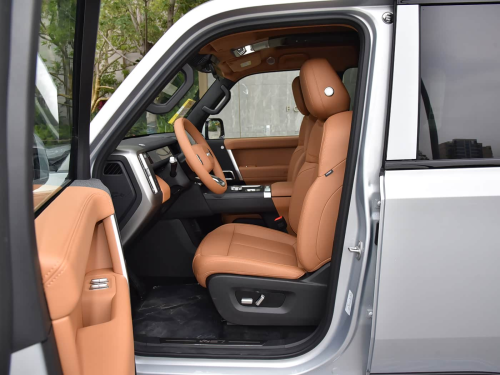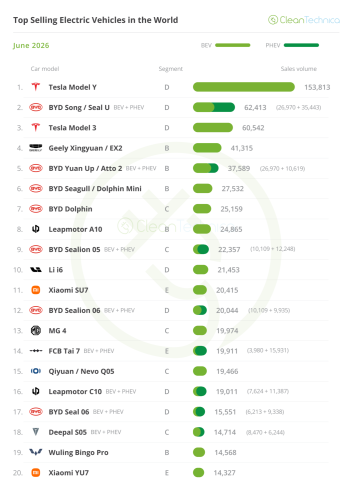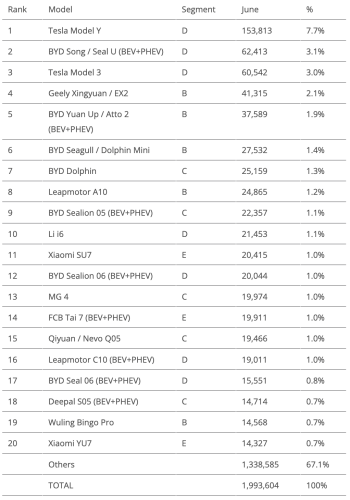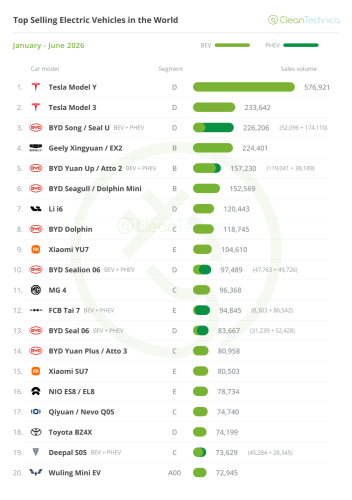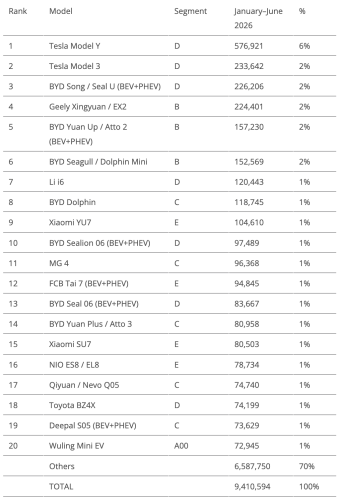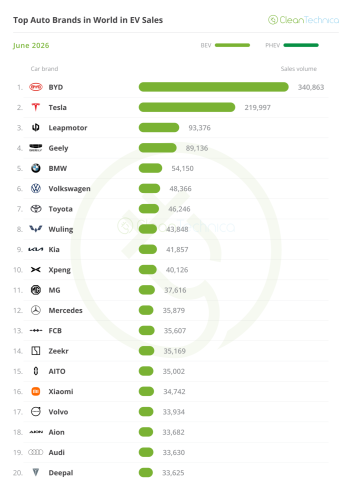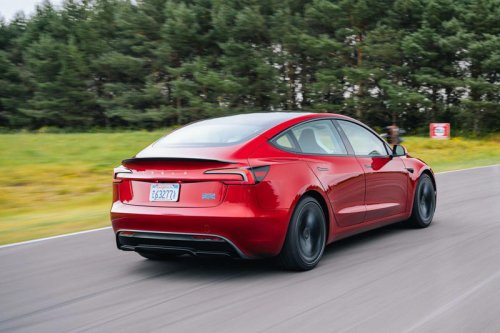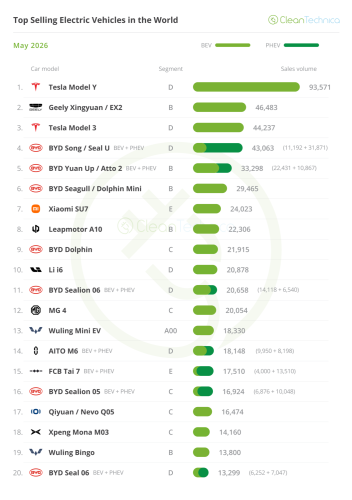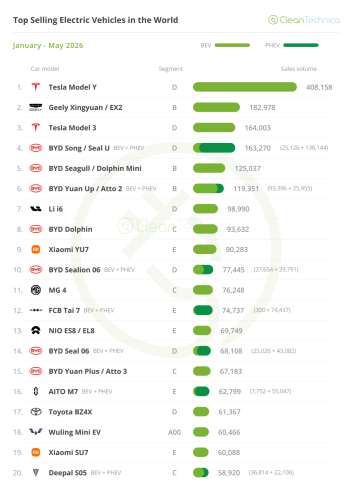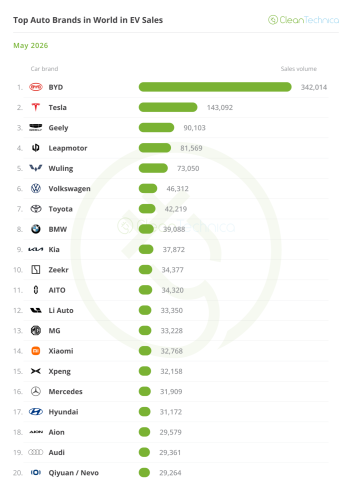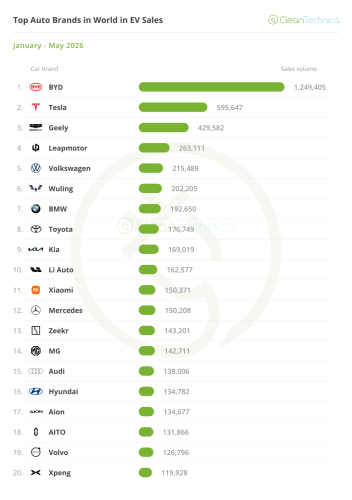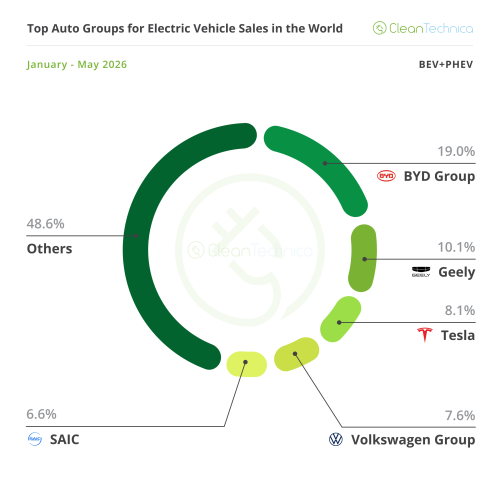
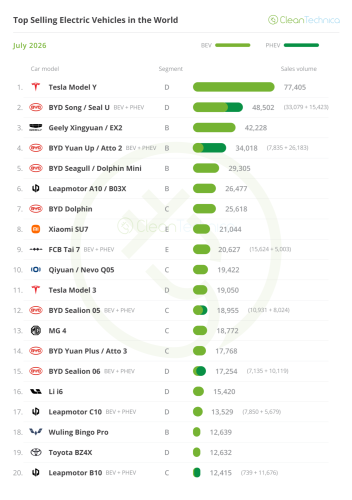
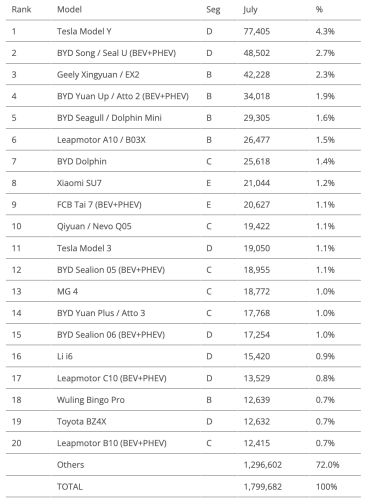
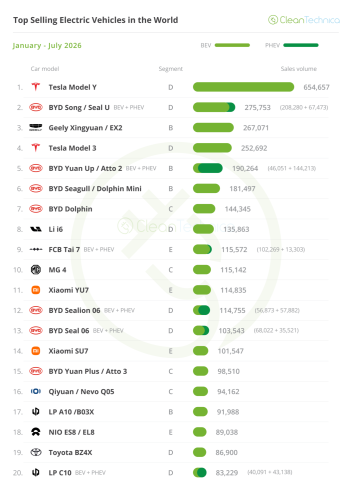
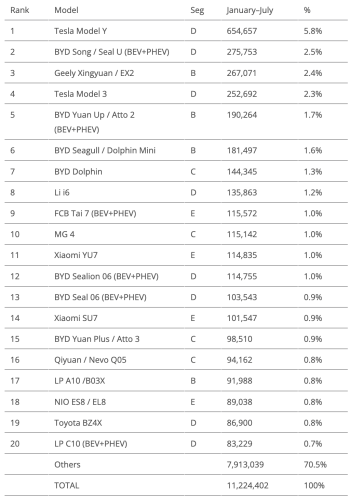
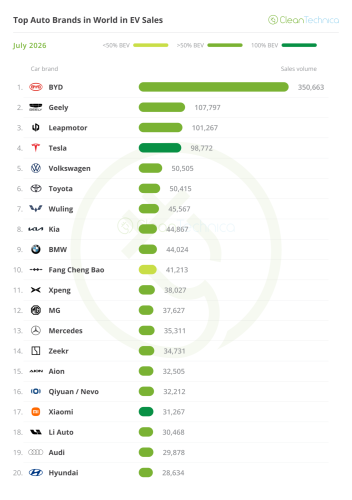






















Plugin vehicle registrations were up 7% year over year (YoY) globally in July, ending the month at around 1.8 million units. Once again, BEVs (+16% YoY) and PHEVs (-11% YoY) are experiencing opposite dynamics, with pure electrics firm in double-digit growth while plugin hybrids remain in deep red (since the beginning of the year). This means that, while the plugin YTD growth remains low (+4% YoY), that is solely due to the PHEV blues (-11% YoY). BEVs are on their way back to normal (+12%). And the different dynamics between pure electrics and plugin hybrids are reflected in the BEV vs. PHEV share of plugin sales. In July, BEVs represented 71% of all plugin sales, or about 1.3 million units, one of the best results of the past few years. That led the YTD breakdown to 71% vs. 29% in favor of pure electrics, which is their highest since 2022 (72% back then). Let’s see what happens if we remove China and the USA from the tally, which are experiencing their own market dynamics — PHEVs in China are crashing, while in the USA, EVs are still reeling from the end of the federal tax credit (although, to be fair, Q1 was worse than Q2 — plugins dropped 40% in the former while they dropped around 20% in the latter). Excluding those two auto markets, EVs are flying high, jumping 50% YoY globally in July. BEVs surged 61% YoY. Share-wise, July saw BEVs end the month at 19% share, with the tally increasing to 27% if we add in PHEVs. This performance kept the 2026 plugin share at high levels. BEVs are at 17%, while plugin hybrids are at 7% share. Therefore, the 2026 EV share is 24%. For context, five years ago, the EV share was 6% (4% for BEVs only), while ten years ago, it was around … 1% (and 0.6% for BEVs). We’ve come a long way, baby…. Looking at the best selling models, it’s finally time for some news. True, the Tesla Model Y remained on top, despite deliveries dropping 9% YoY, but it’s below it that we find something to talk about. The Tesla Model 3 has seen its deliveries crash 44% YoY, to 19,000 units, ending the month in 11th, its lowest standing since January 2018…. Heck, even the Xiaomi SU7 (8th, 21,000 units) ended up in front of it! But there is a silver lining to this, as this drop is probably due to the lack of available units to deliver, so expect the Tesla sedan to rebound in August, and especially in September. But back to the July numbers, the BYD Song’s second place finish came about thanks to an export push and the new-generation Ultra body. Flash charging capabilities promise to recharge the Song’s sales and make it a serious candidate, not only for podium positions in the second half of the year, but also to give the Model Y a run for its money in some off-peak months, like October. But the main beneficiaries of the Tesla Model 3’s slow month were a group of small EVs that packed the table, from 3rd to 7th — the #3 Geely Xingyuan, #4 BYD Yuan Up, #5 BYD Seagull, #6 Leapmotor A10, and #7 BYD Dolphin. It seems small is hot right now. This is good news not only because small EVs are more efficient, but also because the EV revolution is finally reaching the masses, and it is no longer something for the elites. Mass adoption, here we go! Of the aforementioned pack, a special mention goes out to the rapid rise of the Leapmotor A10 (B03X in export markets), which is becoming something of a sales phenomenon. It reached 3rd in China this month, and with exports set to start in a few months, expect it to become top 5 material globally, maybe even reaching the podium a couple of times. The BYD Dolphin also had a great performance. Its 26,000 registrations were its best score since last September. In this case, export markets have added significant volumes to the tally. Those markets include South Korea (1,264 registrations) and especially Brazil (6,492 registrations), with the Latin American country quickly becoming BYD’s home away from home. Another example is the Seagull — or Dolphin Mini as it is locally known — which got 7,265 registrations in July alone. Still in BYD’s stable, the Fang Cheng Bao Tai 7, the most successful model from its premium brand, ended the month in 9th, with close to 21,000 registrations. That’s a new year best for the large crossover EV. One wonders what level of success these Fang Cheng Bao crossovers and SUVs could achieve in export markets once BYD finally decides to export them in high volume. Makes like Land Rover, Toyota, and Jeep should keep a close eye on them, as they might just steal their lunch…. Looking at the second half of the table, one highlight is the BYD Yuan Plus returning to the table thanks to the rollout of its newest generation. The model scored some 18,000 registrations, its best result since last September. Additionally, in 20th, we witnessed the Leapmotor B10’s debut on the table, with the compact crossover joining two other Leapmotor representatives in the top 20, the midsize C10 crossover, in 17th, and the aforementioned Leapmotor A10, the new star player of the startup’s lineup. Leapmotor thus has three representatives in the top 20, only behind BYD’s seven, which gives proof to the claim that Leapmotor is probably the EV company with the most effective lineup on the market. Focusing on value-for-money, high-volume models, they might not be the most attractive EVs out there, but they sell. A lot. And that’s what matters. It’s kind of like when Germany was a football/soccer powerhouse and won World Cups. They won not because they played the most attractive football, but because they were the most effective at winning games. Leapmotor is like that. A final reference goes out to the 19th place finish of the Toyota BZ4X, the sole representative of a legacy OEM on the table. Outside the top 20, there are a few models that deserve a mention. Chery’s Jaecoo 5 is one of them. This is a sort of Range Rover Evoque for half the price. The electric Jaecoo scored a record 11,969 registrations thanks to its success in markets like Australia, Indonesia, Thailand, the UK, and Israel, all markets where the compact crossover scored four-digit results in July. Another record result came from GAC’s Aion brand, with the i60 compact crossover hitting 11,206 registrations. Additionally, the Zeekr 007/7 GT twins had a record 9,477 registrations, while their higher riding sibling, the 7X crossover, had its best result since November 2024, 10,086 registrations. Both of these performances from Zeekr EVs had significant contributions from export markets, like Australia (1,892 registrations of the 7X) and Europe (782 registrations of the 7 GT wagon). Finally, and most surprising of all, the new generation of the Toyota RAV4 PHEV is pulling compact SUV sales to new heights. The Japanese plugin hybrid reached a record 12,236 registrations in July, fewer than 200 units from a top 20 spot. Interestingly, the difference between the #20 Leapmotor B10 and the #24 VW ID.4 (12,045 registrations, a new year best) was under 400 units, which shows well how tight the race for the 20th position is between the aforementioned Leapmotor B10, the #21 BYD Seal 06, the #22 Geely EX5, the #23 Toyota RAV4 PHEV, and the #24 VW ID.4. Funny enough, this also meant that Toyota won 1st and 2nd place among legacy OEMs. The giant is rising … (but more on that below). Year to date, the leader Tesla Model Y is really in its own league, selling twice as many units as the new runner-up BYD Song. With Tesla’s sedan having a slow month, the Chinese SUV took the opportunity to return to the runner-up position. The BYD bread and butter model is ramping up a new generation in China, and the current one is still selling in high volumes in export markets, so it will be difficult for the Model 3 to recover the #2 spot. The real race, though, will be for the bronze medal. With the Geely Xingyuan now in 3rd, and a 15,000-unit advantage over the Tesla sedan, will the small hatchback be able to stave off the Model 3 from the third podium position in September? I have my doubts. Unless the Model 3 drop is related to demand and not production cycles, I believe the Texan will recover the #3 spot in September, even if by just a couple thousand units. This would still leave the race for the bronze medal open until the last quarter, which would be a welcome point of interest. Elsewhere, there were a couple more BYDs on the rise, with the Seal 06 climbing one position to 13th while the BYD Yuan Plus/Atto 3 was up to 14th. Elsewhere, the Fang Cheng Bao Tai 7 jumped three positions, into 9th, while just behind it, the MG 4 hatchback was also up, to 10th. In the second half of the table, the highlights are the ongoing rise of the sporty Xiaomi SU7, now in 14th, and Changan’s Qiyuan Q05 also continuing to move up the ladd, in this case to #16. Finally, we have two new faces on the table, both coming from Leapmotor! The B10 small crossover joined the table at #17 and should climb further up the ranking in the coming months, while the C10 midsizer is now 20th, meaning the hot startup now has two representatives on the table, something only three other brands are able to do at the moment — Tesla, BYD, and Xiaomi. Yep, Leapmotor is now at the Big Boys Table. Not bad for an 11-year-old carmaker, huh? In the same timeline, Tesla was still preparing to land the Model X. Manufacturers: Leapmotor is becoming a serious business The big news is Leapmotor continuing to surge, having scored yet another record sales month. In fact, it reached the six-digit level for the first time ever and doubled its output YoY (+102%, to be more precise). The startup was actually close to reaching the runner-up position, losing only to Geely, which had to make an effort to keep Leapmotor at bay, scoring its best result since November on the way (108,000 registrations). (One could say that Leapmotor screwed up Geely’s holidays and forced the company to work overtime in order to not be surpassed by the startup again.) With a slew of fresh metal landing or ramping up (the A10 small crossover, A05 small hatchback, D19 large SUV, D99 large MPV…), expect the startup’s sales to continue growing significantly. While BYD won’t have to worry about Leapmotor (for now, at least), everyone else has to. As for Tesla, it was also caught up in Leapmotor’s never ending rise, ending the month in 4th, its worst standing since … January 2018! (The podium at the time was: #1 BAIC, #2 BMW, #3 BYD.) Tesla’s 19% delivery drop in July is probably linked to lack of available units, and the Texan brand will no doubt rebound in the next couple of months, but … the limits of a small (and ageing) lineup are starting to show. Toyota threatens Volkswagen Immediately below the top four, we have another eventful thing happening — the rise and rise of Toyota (50,415 registrations, a new record) is now directly threatening Volkswagen, which ended fewer than 100 units ahead of the Japanese globetrotter. Here, also, the establishment is being challenged, with the longtime leader of legacy brands almost being surpassed by a player that many still consider a sleeping giant. Well, I guess the giant is now awake … and ready to beat the German make soon! Still on the legacy league, Kia ended the month in 8th, with a record 44,867 registrations, thanks to an extensive lineup of dedicated BEVs (EV2/3/4/5/6/9, PV5…). That lineup is only set to grow further in the next couple of years (EV1,/7/8, PV3/7/9). The Korean brand is now earning the profits of a clear strategy, something that its own partner/frenemy Hyundai is failing to do (it was only 20th, with 29,000 units delivered). Hyundai spread its investments more evenly (fuel cells, ICE-based BEVs like the Hyundai Kona EV, dedicated BEVs like the IONIQ 5, etc.), and was less focused on the pure BEV strategy. Other highlights included Fang Cheng Bao, which scored a year best result of 41,213 units, and Aion, which profited from its new i60 crossover to also score a new year best, 32,505 registrations. Leapmotor leaves Volkswagen behind and is now going after Geely As for the year-to-date table, there was no major news on the podium, but right below it, things are changing. #4 Leapmotor has distanced itself from the competition, and while #3 Geely should be too far ahead this year for the startup to aspire to a podium position, 2027 will be a different story — especially if, in the meantime, Leapmotor manages to buy or make a joint venture for a couple of Stellantis brands. Lancia? Opel? Both? Actually, a portfolio with those three together would make sense in Europe — the Italian as the premium option, the German as the mainstream brand, and the Chinese as the value-for-money make. Just my 2 cents…. Two more Chinese brands going up are SAIC’s MG, which climbed to 12th thanks to the new-generation MG 4, and Xpeng, which thanks to strong performances across the lineup was able to go up to 16th in July. And with the ambitious L03 compact crossover landing soon, the startup brand could climb a couple more positions before the year end. Looking at OEMs, BYD (19.8%) is stable in the lead, while runner-up Geely (9.9%) gained significant ground over slow moving Tesla, which lost 0.6% share in July and ended at its current 8.3%. In fact, the US OEM ended the month of July in 6th, behind not only the other top 5 members, but also 5th placed … Leapmotor! This was the first time in nine years that this has happened, Tesla being out of the top 5 in a given month! #4 Volkswagen Group (7.2%, down from 7.3% in June) is stable in 4th, just like SAIC (6.3%) is in 5th. Behind the top 5, though, things are shaking up. Leapmotor (4.1%, up from 3.8% in June) has just surpassed Hyundai–Kia (4.1%, up 0.1%) and is the new 6th placed OEM. And while #5 SAIC is too far for Leapmotor to pose a threat, next year things can get interesting…. Looking just at BEVs, there were about 7.9 million registrations so far this year, or 71% of total plugin sales. Will they end the year above 75%? Probably not, but if they did, that would be their best result since 2012. BYD (14.8%) is at the top, followed by Tesla (11.8%, down 0.8%), so the top two positions should be decided by now. In 3rd place, we have Geely (8.7%), also safe in the last place on the podium. It has had no problem keeping #4 Volkswagen Group (6.6%) at bay. Meanwhile, #5 SAIC (6.3%) is looking for a sign of weakness from the German OEM to steal its #4 spot. Outside the top 5, while Hyundai–Kia (4.6% share) is still safe in the #6 spot, a rising Leapmotor (4.2% vs. 3.9% in June) could pose a threat to the Koreans in a couple of months.