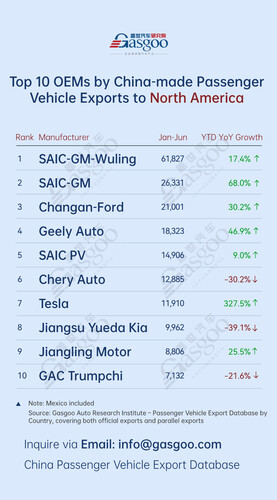
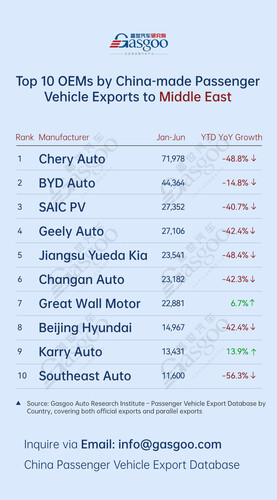
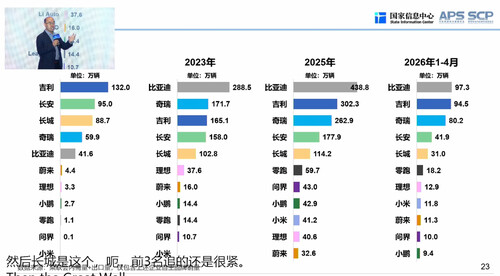
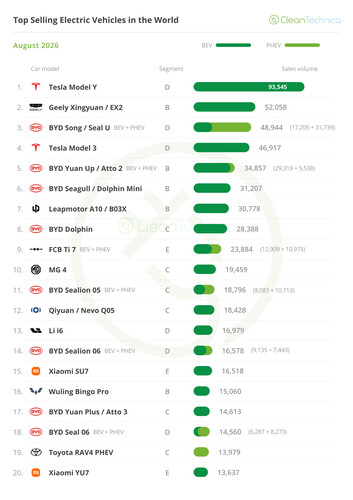
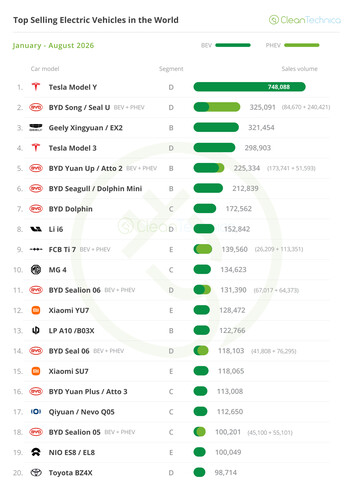
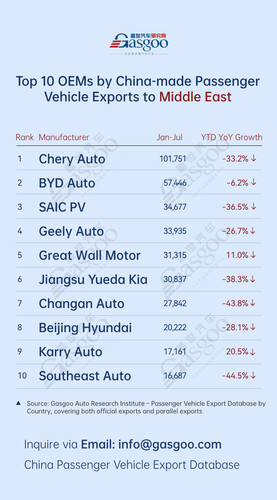
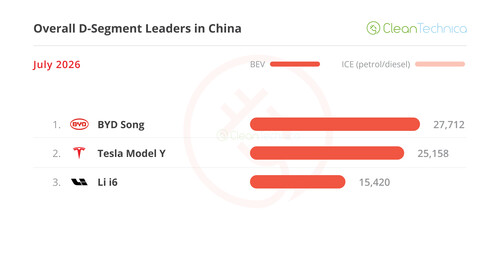
China’s Passenger Car Association (CPCA) released its analysis report on the national passenger vehicle market for April 2026. The report noted that the market in April showed a complex pattern of “overall pressure on volume alongside structural divergence.” I. Retail Down, Exports Up Data showed that April retail sales of passenger vehicles nationwide reached 1.384 million units, down 21.5% year-on-year and 16.0% month-on-month. Cumulative retail sales for January–April stood at 5.604 million units, a year-on-year decline of 18.5%. Wholesale also faced pressure, with April factory wholesale volume of 2.110 million units, down 4.0% year-on-year and 11.3% month-on-month. In stark contrast to weak domestic demand, exports performed strongly. Sales trends from 2022 to April 2026. April passenger vehicle exports (including finished vehicles and CKD) reached 769,000 units, up 80.7% year-on-year and 11.8% month-on-month, accounting for 36% of passenger vehicle manufacturer sales (compared to just 19% in the same period of 2025). Among these, Chinese indigenous brands exported 653,000 units, up 91% year-on-year; joint venture and premium brands exported 117,000 units, up 39% year-on-year. The report emphasized that the core reason for the decline in domestic retail sales in April was the “collapse of gasoline vehicles.” Data showed that gasoline vehicle retail sales fell by 365,000 units year-on-year, accounting for 84% of the total decline in passenger vehicle retail. Factors such as high oil prices, weak consumer confidence, and tighter auto finance combined to keep the domestic consumption recovery moderate. II. NEV Penetration Rate Breaches 60% for First Time In the new energy vehicle (NEV) segment, April NEV passenger retail sales reached 849,000 units, down 6.8% year-on-year and down 0.3% month-on-month. Nevertheless, the NEV penetration rate hit a record high of 61.4%, up 9.7 percentage points year-on-year and 9.6 percentage points month-on-month. This means that for every 10 new cars sold domestically, more than six are NEVs. Analysis of retail and export data for April 2026. On wholesale data, NEV passenger wholesale sales reached 1.225 million units, up 7.5% year-on-year and 7.0% month-on-month. The wholesale penetration rate for NEVs in April was 58.0%, up 6 percentage points year-on-year. There were 15 models with wholesale sales exceeding 20,000 units this month. The BYD Song topped the list with 67,351 units, followed by the Model Y (52,143 units) and the Tansuo 06 (42,978 units). Analysis of production and wholesale data for April 2026. By powertrain type, pure electric (BEV) wholesale reached 776,000 units, up 7.0% year-on-year, accounting for 63.3% of the total; narrow-sense plug‑in hybrids (PHEV) came in at 362,000 units (29.6%), and range‑extended (EREV) at 87,000 units (7.1%). By segment, B‑segment BEVs wholesaled 243,000 units, up 27% year-on-year. In contrast, A00+A0‑segment affordable electric vehicles faced significant market pressure, with A00 wholesale sales of 70,000 units, down 55% year-on-year. The report pointed out that, from a long‑term penetration perspective, the popularization of affordable electric vehicles is the real driver of sustainable incremental growth in the auto market. III. Indigenous Brands Take the Lead From an overall market perspective, NEV passenger vehicle companies performed strongly in April. Traditional automakers such as BYD, Geely Auto, and Chery continued to strengthen their performance in plug‑in hybrids. In terms of product launches, indigenous brands adopted a “multi‑track parallel” strategy in NEV routes, continuously expanding their base. Manufacturer rankings for April. Data shows that 20 automakers achieved monthly NEV wholesale sales exceeding 10,000 units, accounting for 93% of total NEV passenger sales. The top three were BYD Auto (314,100 units), Geely Auto (135,591 units), and Chery Auto (93,043 units). Tesla China ranked fourth with 79,478 units, and six new‑energy vehicle startups (NEV upstarts) also made the list. There were 16 brands with domestic NEV retail sales exceeding 20,000 units. The top three were again traditional automakers: BYD Auto (182,025 units), Geely Auto (95,585 units), and Chang’an Auto (64,471 units). They were followed by two NEV upstarts – Leapmotor (57,162 units) and Xiaomi Auto (36,702 units). Tesla China ranked 13th with 25,956 units. IV. NEV Exports Breach 50% for First Time April NEV passenger exports reached 406,000 units, up 111.8% year-on-year and 18.3% month-on-month, accounting for 52.7% of total passenger vehicle exports. Notably, this marks the first time that NEV exports have exceeded 50% of total exports. Additionally, the export powertrain mix changed significantly this month. BEVs accounted for 57.2% of NEV exports, PHEVs 39.9%, and EREVs 3%. PHEVs are gradually becoming a new growth engine for exports. NEV market sales trends from 2022 to April 2026. By manufacturer exports, BYD led with 130,000 units, followed by Chery with 58,000 units and Tesla China with 54,000 units. At the same time, NEV upstarts accelerated their overseas push, with Leapmotor exporting 14,000 units and XPeng 6,006 units, ranking sixth and tenth respectively. Looking at overseas markets, China exported 2.34 million vehicles in the first quarter of 2026 (January–March), up 53% year-on-year. However, due to the situation in the Middle East, exports to the UAE fell 87% in March and to Saudi Arabia 42%, causing significant losses. Meanwhile, markets such as Brazil, Russia, the UK, and Germany saw notable increases. Data shows that the top 10 countries for Chinese NEV exports in January–March were: Brazil (129,706 units), Belgium (80,634), United Kingdom (76,493), UAE (49,151), Italy (43,702), Australia (42,193), Germany (40,745), Thailand (39,659), Spain (32,331), and South Korea (31,222). In the concluding part of the report, the CPCA noted that the May Day holiday combined with regional auto shows will stimulate car buying demand, but the weakening impact of subsidies for trade‑in replacement of passenger vehicles will continue to fade. It expects that the NEV penetration rate will remain stable above 60% in May, and that exports will maintain high growth, offsetting the sharp drop in demand from the Middle East.