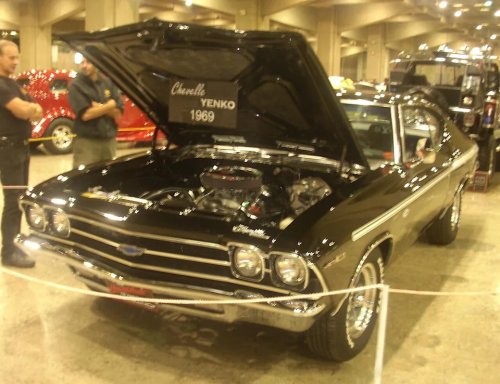
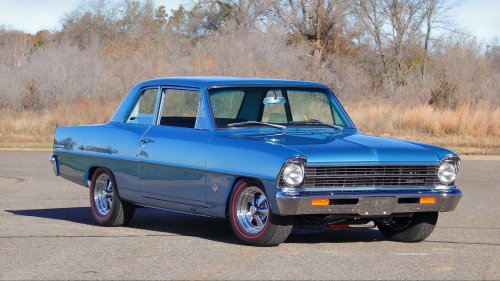
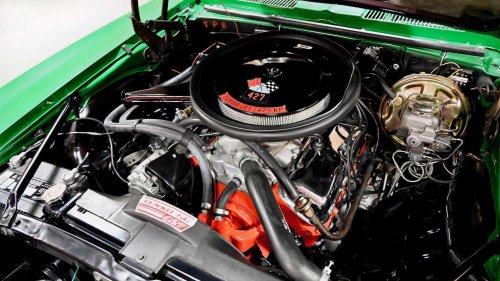
Insurance companies in the late '60s didn’t need telematics, crash data, or some guy in a khaki jacket holding a clipboard. They just needed eyeballs. Show them a compact Chevrolet with a dealer-installed 427 big-block stuffed between the fenders, and they could already hear the claims department groaning from three states away. This was the kind of machine that made common sense pack up and leave through the side door.Therein lies the intrigue. It was a muscle car that was a workaround, a loophole, and a rolling bad decision in the most glorious sense. It also became one of the clearest examples of the muscle car era running straight into a wall made of liability, insurance panic, and the growing realization that maybe giving a lightweight economy car this much engine was, technically speaking, a bit stupid. When A Small-Block Body Started Looking Like A Very Bad Idea MecumBefore this thing became an insurance underwriter’s stress dream, the Nova had already earned a rep as a compact Chevy that could punch way above its class. By 1968, the redesigned Nova SS had turned into a serious performance machine, with the hottest version packing the L78 396 rated at 375 horsepower and 415 pound-feet of torque. In a car weighing around 3,100 pounds, that was already enough to make the front end feel like it was constantly trying to file for independence.That’s where Don Yenko came in. He looked at Chevy’s already quick compact and decided it still needed more motor, because apparently 396 cubic inches was merely a polite suggestion. He pitched the idea of putting the same L72 427 used in his other high-performance projects into the 1969 Nova SS. Understandably, Chevy executives wanted no part of it. Their concerns weren't subtle, either. Safety and liability were front and center, and insurance standards were tightening fast enough to make the whole proposal feel radioactive.The funny part is that the car’s basic layout almost encouraged bad ideas. The 1968 redesign gave the Nova a lightweight structure and enough room up front to accept just about any Chevy V8 and transmission combo without a fight. That made it a fantastic foundation for speed and an equally fantastic way to terrify anyone paid to think about consequences. However, in the wrong hands, it looked like a short route to a phone call your insurance agent did not want to answer. The Yenko/SC 427 Nova Was Too Fast For Its Own Insurance Policy Bring A TrailerYenko built the car anyway, and the result was exactly what the worried adults feared. Some insurance companies outright refused to cover the Yenko/SC 427 Nova. This was a car that landed on the desk of an insurer and made them say, “Absolutely not,” probably before finishing their coffee. Yenko himself later admitted the combination was “barely legal at best,” which is about as close as a builder can get to saying, “Oops, this got a bit out of hand.”The numbers help to explain the panic. Chevrolet rated the L72 427 at 425 horsepower and 460 pound-feet of torque, but once Yenko tuned the engine, output was said to be closer to 450 horsepower. That’s a ridiculous amount of power for a compact Nova in 1969, and the performance backed it up. One dealer-prepped Phase III example, fitted with the full Yenko super tune, headers, and likely drag slicks, recorded a 0-60 mph run of 5.1 seconds and a top speed of 120 mph. Words like “real beast” and “almost lethal” kept showing up for a reason with regard to the 427 Nova. Insurance Pressure Building Bring A TrailerThere’s also a big difference between a fast car and a car that feels like it’s trying to settle a personal score with the driver. The latter was the Yenko Nova’s lane. Small dimensions, a huge big-block, and enough torque to rearrange your plans made it thrilling in the same way lighting fireworks indoors might be thrilling.What doomed the car was that it was fast enough to trigger a financial backlash in real time. Insurance pressure was already building around ultra-fast Novas, Camaros, and Chevelles, and this little monster pushed the situation from concern into outright refusal. The muscle car era loved horsepower, but insurers loved not losing money more, and it doesn't take a genius to understand that the second group was about to win. Yenko Built It Anyway, Just Not The Easy Way Bring A TrailerSince Chevrolet wouldn't officially sanction the package, Yenko found the side door. He ordered Nova SS models with the L78 396, then had his shop pull the engine and replace it with either an 11.0:1 compression 427 crate engine or a 427 warranty block, depending on what was available. That workaround shifted the liability burden away from General Motors and onto Yenko Sportscars. Corporate America basically looked at this plan, coughed once, and backed slowly out of the room.The finished hardware was admittedly serious. All 1969 Yenko/SC 427 Novas were sold as four-speed cars, aside from one automatic prototype. They used a Muncie M21 transmission, a 12-bolt Positraction rear axle with either 4.10 or 3.55 gearing, F41 heavy-duty suspension, upgraded front springs to handle the extra engine weight, and power front disc brakes with power rear drums. In other words, Yenko built a whole package that could at least pretend to keep up with the violence happening under the hood.The exterior was almost hilariously understated for something this savage. Aside from the graphics, wheels, and a few details, the car stayed plain enough to pass for a regular Nova at a glance. That sleeper quality is a huge part of its charm now. It looked like a compact Chevy you’d park at the grocery store, then turned into a full-scale event the second your right foot got serious. There's something deeply funny about a car with this much chaos in reserve wearing such an ordinary face. Why The 427 Nova Burned Bright And Brief Bring A TrailerThe Yenko/SC 427 Nova was effectively a one-year fireball. Insurance problems were already choking demand, and the changing regulatory climate heading into 1970 made cars like this even harder to justify. That’s why the 427 version vanished almost as quickly as it arrived. It got squeezed from both sides by economics and legislation, which is a much less romantic ending but a very real one.In all, only 38 Yenko Nova S/C 427s were built, made up of 37 production cars and one automatic prototype. For a muscle car, that's blink-and-you-miss-it rare. This thing was scarce because the conditions that allowed it to exist were already collapsing underneath it. Too Fast, Too Early, Too Risky Bring A TrailerA lot of them also lived exactly the sort of life you’d expect. Many were wrecked or destroyed by drivers who were not fully up to the task, and only seven are known to survive. Cars like this don't spend their lives idling gently into climate-controlled garages. They get raced, leaned on, and occasionally introduced to ditches at regrettable speeds. The Yenko Nova was built for action, and a lot of them got a little too much of it.For 1970, Yenko pivoted to the LT1-powered Yenko Deuce Nova, a much more realistic answer to the new environment. It still offered strong performance, but it was meant to sneak under the worst of the insurance and emissions storm rather than charge straight through it with a 427 and a grin. With hindsight, it's easy to see the Yenko/SC 427 Nova was one of the last moments when somebody could look at a small Chevy, install an absurdly large engine, and sell the result with something close to a straight face. It was too fast, too early, too risky, and maybe a little too dumb in the best possible way.Sources: HotRod, Street Muscle Magazine.



















 +5 others