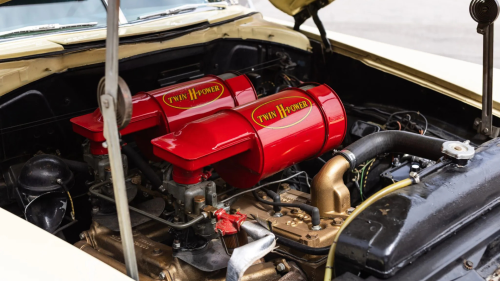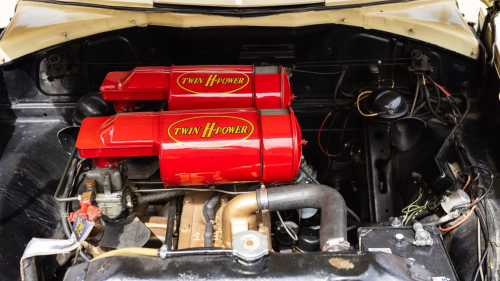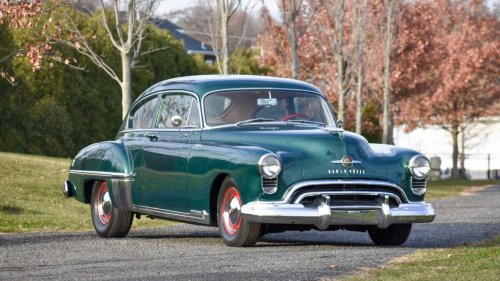
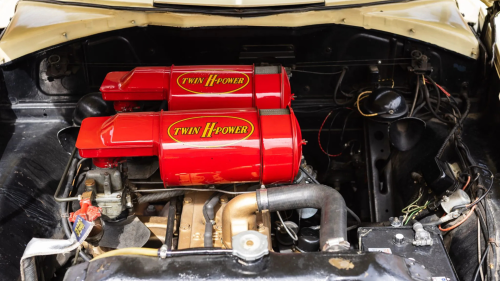
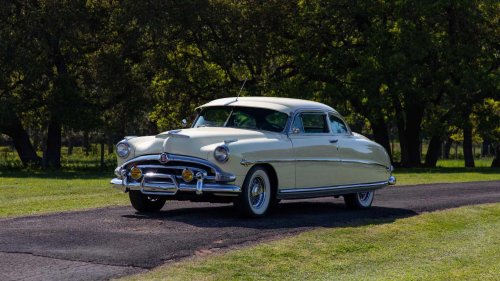
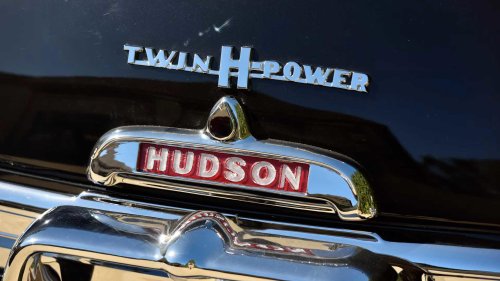
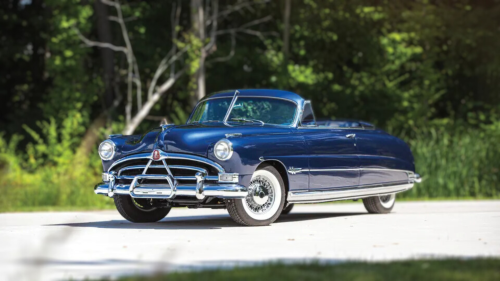


















In the late 1940s and 1950s, the Detroit Big Three were starting to gain a choke hold on NASCAR with lightweight cars and stout power. The dominance of Ford, General Motors, and Chrysler was becoming so widely recognized that fans didn’t expect underdogs to come close to winning. This era is also when the first true muscle cars were born.NASCAR didn’t officially begin until 1948, and in the years prior, Ford was fighting back against moonshine runners by using modified family cars to take over the National Championship Stock Car Circuit (NCSCC). Ford and Buick cars were the most popular among the earliest seasons. Then the Oldsmobile got its iconic overhead-valve V8 engine.This was the most powerful engine offered by the Detroit Big Three at the time. But an independent automaker was inspired to fight back. By thinking a bit differently about engineering, one straight-six delayed the Big Three’s NASCAR takeover by a few years until larger automakers abandoned their anti-racing stances to avoid losing more sales. A Forgotten American Brand Needed To Beat Detroit V8s Bring a TrailerIn 1949 and 1950, the Oldsmobile 88 or Rocket 88 was the kind of NASCAR. It owned the Grand National Division, which is now the Cup Series, by winning 10 out of 19 races to secure the 1950 Manufacturers' Championship with drivers like Curtis Turner, Bed Byron, and Bill Rexford behind the wheel.The 303-cubic-inch (5.0-liter) "Rocket" V8 engine delivers 135 horsepower and 263 pound-feet of torque. It can accelerate from 0 to 60 mph in about 12.0 seconds with a top speed of 91 mph. It's one of the fastest and most popular high-performance cars of its era. Naturally, the 88 quickly became a top-selling option as the phrase, “Win on Sunday and Sell on Monday," started trending.Ford and General Motors took notice and started developing overhead-valve V8 engines. But one independent automaker decided to take a different approach to outmuscle top competitors. By studying top-heavy V8 beasts to exploit their weaknesses, an underdog used precise engineering to become one of the most historic winners in NASCAR history. The Hudson Hornet 308 Flat-Head Six Punched Above Its Weight Bring a Trailer Back in 1951, the Hudson Hornet 308 engine arrived to give the Hudson Motor Cars Company a competitive, high-performance edge. The 308-cubic-inch (5.0-liter) inline-six flathead engine delivers between 145 and 170 hp and 257 lb-ft of torque. The variant with the “Twin H” dual-carburetor setup delivered the most power.The L-head six engine was the biggest of its kind and provided impressive straight-line performance with excellent handling characteristics. It was the fastest production car of the time. This heavy car benefits from immense straight-line speed to outrace larger V8-powered rivals.Plus, the car features a step-down design as passengers step down into the cabin. This creates a lower center of gravity to enhance the car’s cornering abilities and handling. It was sleek, safe, and aerodynamically advanced compared to bulky competitors that required drivers to sit on top of their frames. The Hudson Hornet 308 Embarrassed The Detroit Big Three Mecum Legendary NASCAR drivers such as Marshall Teague, Tim Flock, and most notably, Herb Thomas drove the Hornet Hudson to victory in multiple races and championships from 1951 to 1954. Marshall traveled to Detroit to secure factory backing from Hudson and coined the name, “Fabulous Hudson Hornet,” and had his brother paint the name on the side of the car. He won Hudson’s first major NASCAR race at Daytona Beach. In 1951, Herb Thomas won the Hornet 308’s first NASCAR Grand National Championship.Then in 1953, the Hornet 308 claimed 27 of 34 Grand National race wins, with Tim Flock getting the season championship. Its dominance continued through 1953 as Thomas secured his second championship with the Hornet 308. Overall, it had three consecutive Manufacturers Championships and 79 race victories. The Hudson continued securing massive wins in 1954 and 1955, but rivals finally started catching up with V8 engines to outmuscle the straight-six.Also, NASCAR shifted the rules to prioritize raw power over advanced handling. Hudson merged with Nash to form American Motors Corporation (AMC) in 1954, but the Nash vehicles lacked the low-slung step-down chassis that gave the original Hornet models their legendary cornering stability. However, in 1955, the Hornet still got its 80th victory at West Palm Beach. The Hudson Hornet 308 Laid The Foundation For 1960s Muscle Cars Mecum As a proven winner, the Hudson Hornet 308 heavily influenced the 1960s muscle car era. It showed that lightweight, agile cars could achieve victory against heavy V8 giants on the racetrack, and helped high-performance cars evolve as accessible, everyday cars or comfortable sedans. Best of all, it proved that these types of family cars or sedans could sell.The Hornet also changed the game by making high-performance parts available directly from the factory to the public, inspiring other automakers to jump on this trend. Hudson established one of the first factory-backed racing teams via funding crews and partnering with racing legends. This led to other automakers investing in performance divisions that fueled the 1960s muscle car wars.Its unibody construction and low center of gravity led to a focus on improved handling of 1960s options. The Pontiac OHC Six and Ford Mustang six-cylinder models are two top icons that borrowed from the Hornet 308’s straight-six trend. The Hornet DNA lived on under the AMC brand as it revived the nameplate for 1970 with the SC/360 V8 engine. The Hudson Hornet 308 Is Still Quietly Worshipped RM Sotheby'sThe historic legend of the Hudson Hornet 308 still has plenty of gas as collectors hunt for this rare muscle car, and it’s referenced in pop culture. For example, the animated Cars film had a character named Doc Hornet that’s based on the series-winning model. After Paul Newman passed, the Piston Cup was renamed to the Hudson Hornet Memorial Piston Cup in Cars 2.Enthusiasts are eager to scoop this rare muscle car up as it has historical NASCAR dominance as a proven underdog. The ability to outrace potent V8 engines made the 308 straight-six an innovative engineering icon. Also, its attractive, sleek styling helps it stand out against boxy rivals.Roughly 90,000 to 100,000 Hudson Hornet 308 models were built, and a few thousand may still exist today as restorations or unrestored barn finds. The value of the Hornet 308 ranges between $14,000 and over $90,000 based on condition and configuration. Two-door Club Coupe models are often more valuable than four-door sedans. The most sought-after models include documented NASCAR racing history.Source: Savoy Automobile Museum, Hagerty, Classic