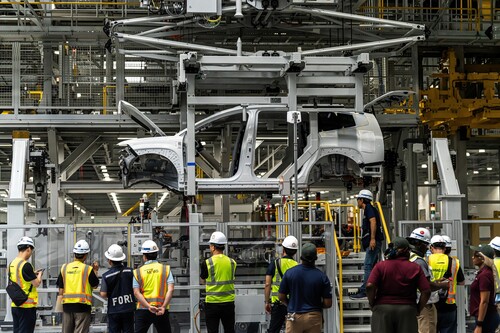
Photo: CATL The world’s largest EV battery maker says all 20 of its operating battery plants are now carbon neutral – but most of its batteries’ emissions still occur outside its factories. CATL announced today that it has met the carbon-neutrality target it set for its core operations in 2025. All 20 plants have been ISO 14068-1 certified, and the Chinese battery giant is now turning its attention to the much harder job of decarbonizing its entire value chain by 2035. It’s a huge commitment because CATL supplies nearly 4 in every 10 EV batteries worldwide. The company held a 39.2% share of the global EV battery market in 2025, ranking first for the ninth consecutive year, according to SNE Research data cited by CATL. CATL says zero-carbon electricity supplied 100% of the power used by its core operations in 2025. Since 2023, its plants have consumed more than 18 billion kilowatt-hours of that electricity. Advertisement - scroll for more content Compared with 2022, energy use per unit of production fell by 28%, while carbon emissions per unit fell by about 77%. CATL estimates that its measures cut more than 10 million metric tons of carbon dioxide equivalent between 2023 and 2025. The company tracks emissions through its internally developed CATL Carbon Chain Management System, or CCMS. Introduced in 2022, the platform collects carbon data from plants, production lines, products, raw materials, and core suppliers. It has generated more than 1,000 product and material emissions models so far. “Carbon neutrality cannot be built on estimates alone. It requires reliable data, clear boundaries, and systematic execution,” said Jiang Li, CATL vice president, board secretary, and head of its Corporate Sustainable Development Management Committee. Carbon-neutral certification does not mean CATL’s factories produce no greenhouse gas emissions. ISO 14068-1 requires companies to quantify and reduce emissions, prioritizing direct cuts before using carbon offsets to cover the rest. CATL’s announcement doesn’t disclose its remaining gross operational emissions or how many carbon credits were used to balance them. It also doesn’t break down how much of its zero-carbon electricity came directly from renewable generation and how much was accounted for through green electricity certificates or other purchasing arrangements. CATL’s supply chain is the bigger challenge CATL says more than 80% of the emissions across a battery’s lifecycle come from its supply chain. Its total value-chain emissions are more than five times those generated by its core operations. That includes emissions from mining, refining, chemical processing, materials manufacturing, and transportation – areas outside CATL’s direct control. The company has established baseline carbon data for more than 100 core Tier 1 suppliers and wants to eventually cover all key upstream links. Beginning in 2027, new suppliers will have to provide product carbon-footprint data, while renewable electricity use and energy efficiency will become part of CATL’s annual supplier reviews. Suppliers with stronger emissions performance could receive priority in CATL’s order allocation and gain access to longer-term contracts. CATL will initially work more closely with 30 core suppliers through a new supply-chain decarbonization program. Its 2035 plan focuses on lower-carbon materials and production processes, renewable electricity for suppliers, zero-carbon freight, and battery recycling through its Brunp Recycling subsidiary. CATL is already helping suppliers install distributed solar, with more than 60 projects completed and annual generation topping 450 million kWh. It also plans to expand shared purchasing of renewable electricity and green certificates. “CATL will advance value-chain decarbonization across key areas, including material innovation, material manufacturing, green logistics, and battery recycling,” said Bryan Huang, head of CATL’s Procurement Center. “This requires collaboration across the entire battery value chain.” Read more: Octopus and CATL unveil a giant EV truck battery-swapping network If you’ve ever considered going solar, make it easy by finding a trusted, reliable solar installer near you that offers competitive pricing by checking out EnergySage. It has hundreds of pre-vetted solar installers competing for your business, ensuring you get high-quality solutions and save 20-30% compared to going it alone. Plus, it’s free to use, and you won’t get sales calls until you select an installer and share your phone number with them. Your personalized solar quotes are easy to compare online, and you’ll get access to unbiased Energy Advisors to help you every step of the way. Get started here. Stay up to date with the latest content by subscribing to Electrek on Google News. You’re reading Electrek— experts who break news about Tesla, electric vehicles, and green energy, day after day. Be sure to check out our homepage for all the latest news, and follow Electrek on Twitter, Facebook, and LinkedIn to stay in the loop. Don’t know where to start? Check out our YouTube channel for the latest reviews.