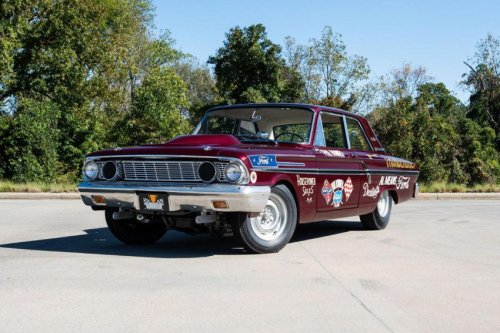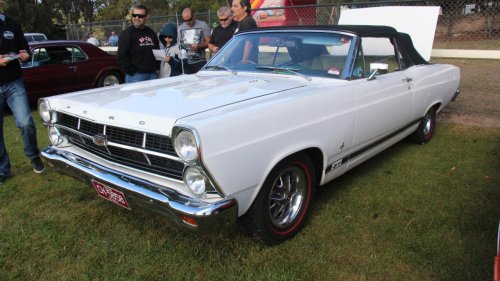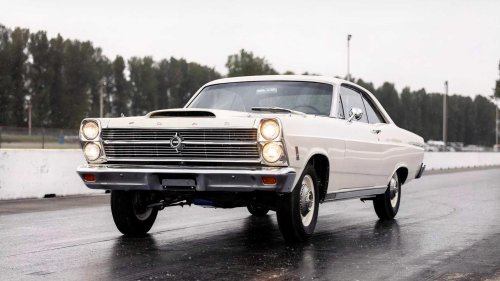
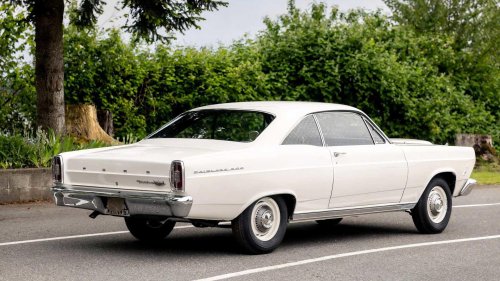
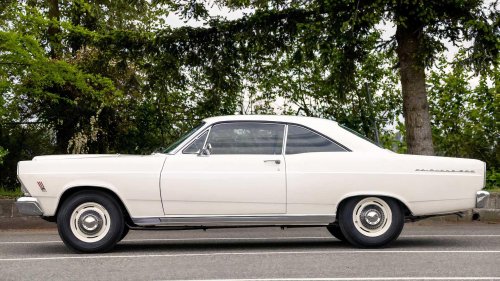
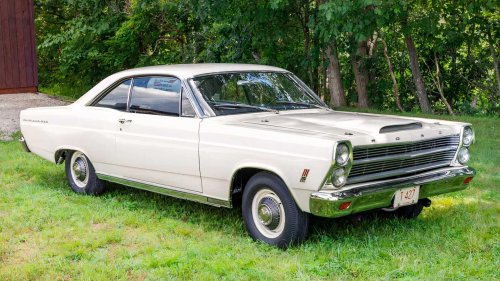
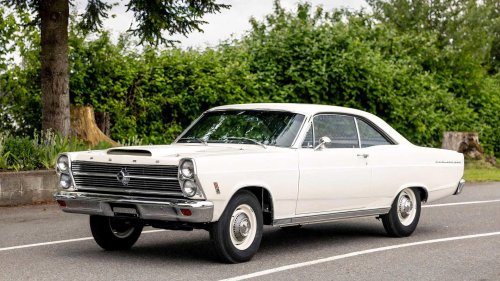
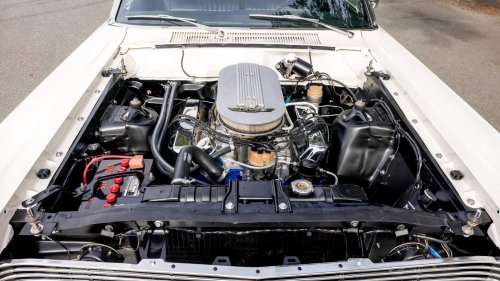
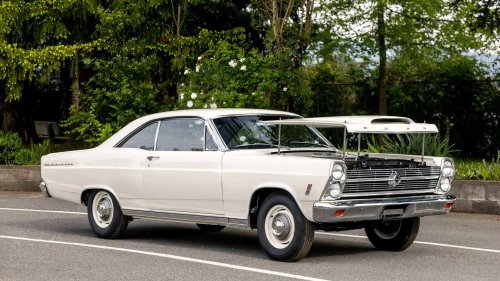
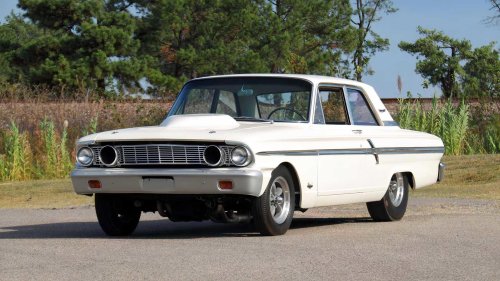
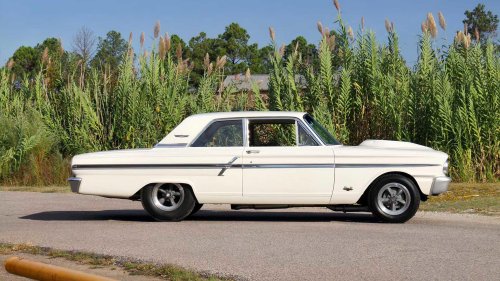
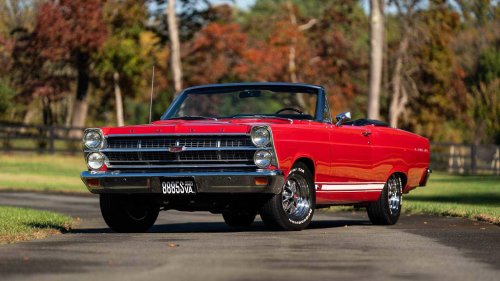
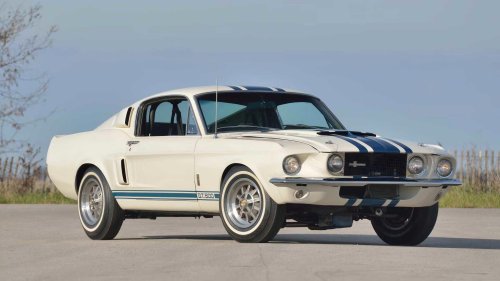


















Think rare classic Ford muscle cars, and the Mustang is the name that typically pops up. It's no surprise that Ford's legendary muscle car basks in endless acclaim, especially considering the fact that it churned out more smash hits than Elvis Presley, particularly in the '60s. There were the Shelby GT350s that Carroll Shelby built barely a year into the Ford Mustang's production run, the Shelby GT500s that followed soon after, and even the Boss Mustangs that closed out the decade with race-spec 302s or 429s under the hood. UPDATE: 2026/04/02 03:42 EST BY JARED SOLOMON This article has been updated to include additional context on homologation rules and the factors driving the Fairlane 500 R-Code’s modern collector value.Those cars usually get the plaudits they deserve, but there's another Ford muscle car from the same era that flies under the radar of most gearheads, even though it was a fire-breathing drag strip monster that Ford produced in far fewer numbers than the more famous models. Casual muscle car fans may not even know of its existence, but collectors worth their salt are always looking out for upcoming auctions, hoping that it might pop up on sale and give them a chance to own a serious piece of Blue Oval muscle car history. The 1966 Ford Fairlane 500 R-Code Is A Muscle Car Unicorn Via Bring A TrailerThe '60s decade marked a huge shift in the American automotive landscape, with buyers seeking more performance and affordability. At the same time, the drag racing scene was becoming a legitimate, major sport with official racing organizations, official rules, well-organized tracks, and growing fan interest. While hot rodders pioneered the drag racing scene, manufacturers soon wanted a piece of the pie as it gave them a platform to create and showcase their engineering prowess, with some adopting the mantra of "Win on Sunday, Sell on Monday."Ford was one of the first manufacturers to get involved in drag racing as part of the "Total Performance" marketing campaign, with the gargantuan Galaxie joining the NHRA Super Stock party. While the Galaxie was highly successful in the early '60s, its full-size proportions put it at a huge disadvantage as other manufacturers started racing smaller and lighter models. As such, Ford came up with a new type of drag racer built on the bones of the intermediate-sized Ford Fairlane, resulting in the insane 1964 Thunderbolt that became one of the most successful factory drag racers ever (more on that later). The Thunderbolt was such a success that Ford used a similar blueprint to build the legend we're discussing today, the 1966 Fairlane 500 R-Code.Via Bring A Trailer Like the Thunderbolt, the R-Code was based on the Fairlane, though fewer modifications had to be made to the updated 1966 Fairlane body compared to the Thunderbolt's 1964 Fairlane base. The R-Code used an evolution of the engine used in the Thunderbolt and had weight-saving measures that allowed it to destroy everything it faced on the track. Ford had to build 50 units to meet NHRA homologation rules, but they ended up building 57 Fairlane 500 R-Codes in 1966, making it one of the rarest Fords ever. Why Homologation Rules Created Legends Like The R-Code One of the biggest reasons cars like the 1966 Fairlane 500 R-Code even existed comes down to racing regulations—specifically homologation rules set by organizations like the National Hot Rod Association.To compete in certain drag racing classes, manufacturers were required to build and sell a minimum number of road-legal versions of their race cars. This forced automakers like Ford Motor Company to produce limited runs of highly specialized machines that were essentially race cars with license plates.In the R-Code’s case, Ford needed to produce at least 50 units to qualify for Super Stock competition—but the end result was something far more significant than just a compliance exercise. These cars were: Built with racing as the primary focus, not comfort or practicality Produced in extremely limited numbers, instantly creating rarity Packed with cutting-edge performance technology for the time This approach is what turned cars like the R-Code into instant collectibles. Unlike mass-produced muscle cars, homologation specials were never meant for everyone—they were built to win first, and sell just enough to qualify. A Showstopper At Auctions Today Via Bring A TrailerAn ultra-rare factory-built street-legal dragster from the muscle car golden era? Where can we sign up? The 1966 Fairlane 500 R-Code is a holy-grail type of muscle car that any serious collector would gladly welcome to their garage, and it's always a special occasion whenever one of the surviving examples goes up for sale.The last time a hammer fell on one of these bad boys was in 2024, selling for $267,000 on Bring a Trailer. Since then, two have gone up for sale on Bring a Trailer and Mecum Auctions but failed to hit the reserve price. The most expensive R-Code sold in recent years went for $296,000 in 2022 on Bring a Trailer, which is almost the same price the Hagerty Valuation Tool estimates one in concours condition to go for today. It Was Always Expensive Via Bring A Trailer Most muscle car legends were born out of the fact that they were unobtainable to mortals of meagre means, and such is the case for the 1966 Fairlane 500 R-Code. Hemmings reports that the R-Code engine alone, officially called the '427-8V CID Engine Race Car Pkg.,' cost a staggering $1,725 in 1966, pushing the $2,378 Fairlane beyond the $4,000 range, which translates to around $40,000 in 2026 terms. While that made the R-Code one of the most expensive muscle cars of the day, it's actually not a bad price for top-tier performance and exclusivity.That said, the eye-watering price tag wasn't the main reason why Ford ended up building only 57 of the 70 R-Code Fairlanes in 1966. Rather, Hemmings reports that the car's exhaust manifold castings had issues that prevented Ford from hitting the total production goal. What Makes The R-Code So Valuable Today? The six-figure valuations of the Fairlane 500 R-Code aren’t just about rarity—they’re about a perfect storm of historical significance, performance pedigree, and collector demand.First, provenance plays a huge role. Cars that can be traced back to original owners, documented race history, or period-correct components tend to command a premium. Given how many of these cars were raced hard, finding an example with matching numbers and original hardware is incredibly difficult.Second, originality matters more than restoration in many cases. Collectors often prefer, factory-correct paint and finishes, original drivetrain components, and period-correct modifications rather than modern upgradesFinally, market trends have increasingly favored analog, race-bred classics. As modern performance cars become more digital and insulated, raw machines like the R-Code have become even more desirable to enthusiasts looking for an authentic connection to the golden age of muscle.All of this combines to make the R-Code not just rare—but genuinely irreplaceable in today’s collector car landscape. The 1966 Ford Fairlane 500 R-Code Is A Drag Strip Monster Via Bring A TrailerThe 1966 Fairlane 500 R-Code was developed exclusively for drag racing and was meant to be a successor to the highly successful 1964 Thunderbolt. According to Hemmings, a November 1964 memo from Ford product planner Hal Sperlich to Ford Racing overseer Leo Beebe revealed plans to build the R-code in 1966.Sperlich outlined a plan to offer the FE series engine on a limited basis in the upcoming Fairlane generation, and since he knew that Beebe preferred the engine to be dropped in a Mustang, he further argued that the Fairlane would be a better candidate since it would help it maintain the dragster image the '64 Thunderbolt Fairlane program had created. Sperlich wanted the Fairlane to maintain its position as Ford's drag racer and the Mustang to compete with sports cars, and he got his way, though the FE engines still found their way to the Mustang later on.The name "R-code" was also chosen because the fifth spot in its VIN was an "R", denoting the race-oriented 427 under the hood. Even the Wimbledon White paint job was chosen because it made it easy for racers to apply their graphics without having to worry too much about their chosen stripes or lettering clashing with some flashier hue. Apart from the engine, other mandatory upgrades that came with the R-code included a Toploader four-speed manual, specific springs, slower manual steering, a 2 ¼-inch dual exhaust system, 11.375-inch front disc brakes, and an open 9-inch rear differential with 3.89:1 gears. It Used A Race-Bred Engine Via Bring A Trailer The beating heart of the 1966 Fairlane 500 R-Code was a 427 cubic-inch "Side-Oiler" V8 running an 11.0:1 compression ratio designed specifically for drag racing, which was an evolution of the 1964 Thunderbolt's 427 cubic-inch High-Riser V8. The "Side Oiler" moniker was derived from the engine's unique lubrication system, which featured a specialized external oil gallery cast into one side of the engine block. This design sent oil to the crankshaft's main bearings first before sending it to the top-end valvetrain, preventing fatal high-RPM oil starvation during high-speed and endurance races.Ford also replaced the Thunderbolt engine's hydraulic camshafts with solid-lifter units, replaced cast-iron crankshafts with forged steel, and reinforced the main bearing webs, further improving its performance and endurance. With dual Holley four-barrel carburetors, this sucker gobbled gas like a freshman did beer at their first college party and pooped out ponies — 425 of them, though it's widely accepted that these engines were massively underrated and actually made north of 500 hp. This engine not only made the Fairlane 500 R-Code the legend it is today, but it also made its way to several other iconic cars, including the Shelby Cobra and the Le-Mans-Winning Ford GT40. Lightweight Tricks From Ford's Drag-Racing Playbook Via Bring A TrailerTo create the R-Code, the Fairlane had to go on a serious diet that cut weight down to just over 3,300 pounds and turned it into an all-out barebones racer. The steel hood was replaced by a lightweight, lift-off fiberglass hood with a functional scoop, shaving off a reported 17 pounds. Creature comforts like power steering, power brakes, a radio, and even sound deadening were sacrificed to turn the Fairlane 500 R-Code into the quarter-mile missile it was always intended to be. A Proper Ford Fairlane Thunderbolt Successor Mecum When the full-size Galaxie grew too big to be competitive at NHRA Super Stock events in the early '60s, Ford turned to the intermediate-sized Fairlane platform and built one of the most feared factory dragsters ever — the 1964 Fairlane Thunderbolt. If the 1966 R-Code was a Fairlane on a diet, the Thunderbolt can best be described as a Fairlane that went on a 40-day fast because of the weight-cutting measures it went through to tip the scales at around 3,200 pounds. Fiberglass hoods, trunk lids, and fenders replaced factory sheetmetal while aluminum bumpers replaced the heavy steel pieces. Heaters, radios, sound deadeners, and other creature comforts were jettisoned, leaving a spartan interior that ensured that the only purpose was to get to the quarter-mile line long before the other guy.Mecum Of course, the Fairlane's Hi-Po 289 was yanked in favor of a built FE-based 427 that was engineered to compete, but extensive modifications were needed to ensure that it fit. The result? The Thunderbolt was an absolute animal on the track, dominating the NHRA Super Stock 1964 season with 11-second quarter-mile runs. It won the NHRA Super Stock championship and Manufacturers Cup titles with legends like Gas Ronda and Butch Leal behind the wheel, cementing its position in the drag racing Hall of Fame.The 1966 Fairlane 500 R-Code picked up right where the Thunderbolt left off, but there were stark differences in its construction. For one, the updated 1966 Fairlane was designed to accept FE engines from the get-go, which means no modifications were required. Stricter NHRA rules against lightweight bodywork also resulted in the 1966 car having fewer weight-saving measures than the Thunderbolt, even though the Thunderbolt was only marginally lighter. Though the R-Code wasn't as successful as the Thunderbolt in the racing scene, it was a proper successor in its construction and overall performance. The R-Code Muscle-fied The Fairlane Platform Mecum The Fairlane started life in 1955 as Ford's flagship full-size car, replacing the Crestline. It had all the bells and whistles of a premium luxury car, including elegant chrome-capped designs, flamboyant tail fins, and spacious interiors full of upscale materials and features. In 1962, the Fairlane was demoted to an intermediate econo-car, withthe Ford Galaxie taking its place as the Blue Oval flagship full-size model. In 1966, the Fairlane reached its peak with the launch of the updated fifth-generation model. The 1966 Fairlane shed its antiquated look and adopted a more muscular quasi-Coke bottle look with crisp, squared-off lines, with the two-door versions adopting a new, swept-back semi-fastback roofline. The new front end also looked more menacing than ever and featured vertically stacked headlights similar to the updated 1965 Galaxie.With the platform also updated to allow for the installation of a 335-hp FE-series 390 in the standard models, the 1966 Fairlane checked all the boxes of what a proper muscle car was, but for some reason, its name rarely comes up in conversations about the best Golden Age muscle cars. Thankfully, the R-Code injected a lot more power and performance into the 1966 Fairlane, raising the Fairlane's profile among muscle car enthusiasts. Other Rare 1960s Muscle Cars MecumThe 1960s will go down in history as the best for muscle cars, which is why it's commonly referred to as the Golden era. Most muscle car icons were born and bred during that era, and some survived for decades after. While most '60s muscle cars were built for the masses, some had extremely limited production numbers due to the high cost or complexity of production, manufacturers limiting production to maintain exclusivity, production being capped at the numbers required to meet homologation requirements, and trim levels or option packages that just weren't picked for various reasons. The 1966 Fairlane 500 R-Code's 57 units put it in rarified air as far as '60s muscle car production numbers are concerned, but it sits in the company of several other muscle car unicorns from the era that collectors drool over, including some with single-digit production numbers.Sources: Hemmings, Hagerty Valuation Tool, Bring A Trailer, Mecum