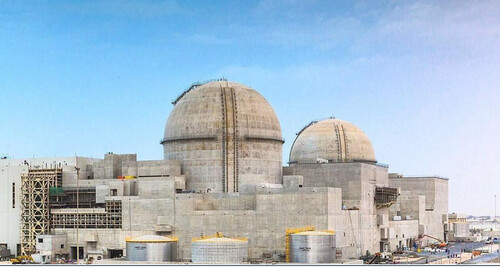
The claim that nuclear power uses less land than renewables is making the rounds again, usually presented as if it settles a complex debate with one clean visual. A nuclear plant fits inside a compact fenced site. Wind turbines are spread across plains and ridgelines. Solar arrays cover visible surfaces. The eye sees density and jumps to efficiency. From there, advocates leap to superiority. It sounds like engineering. But it collapses once it is tested against project economics, land use categories, siting practice, and decarbonization timelines. Google Trends searches on phrases relevant to inane nuclear land efficiency arguments. I started noticing the meme again in LinkedIn posts, where nuclear advocates were presenting compact footprint as if it were a serious strike against wind and solar. That led me to look for whether I was seeing a few repetitive posts or something broader. Search interest around phrases like “nuclear land use” and “nuclear footprint” have risen in 2025 and 2026. The World Nuclear Association resurfaced the claim in late 2025 through a biodiversity frame, while the Nuclear Energy Institute had been making the same comparison years earlier. At the same time, the claim is increasingly bundled with small modular reactor messaging, where compact footprint, siting flexibility, and proximity to data centers or industrial loads are packaged together. This is not a new insight. It is an old and long debunked talking point getting a fresh round of circulation. The easiest way to expose the weakness of the argument is economic. Land is already priced into electricity. Developers lease land, buy land, permit land, grade land, build roads, build substations, and compensate landowners. Those costs show up in the delivered price of power. If land efficiency mattered as much as nuclear advocates imply, nuclear would already be winning in market outcomes. It is not. Wind and solar, even including land costs, are far cheaper new sources of electricity than new nuclear in market after market. Storage and transmission add costs, but so do nuclear delays, financing risk, and long construction schedules. Markets have already run the experiment. Small site footprint did not rescue nuclear. The math is not hard. A utility solar project may need 2 to 3 hectares per MW depending on terrain, layout, and tracking. If a 100 MW solar farm occupies 250 hectares and pays $1,500 per hectare annually, the land bill is $375,000 per year. At a 25% capacity factor, it produces around 219,000 MWh annually. The land cost is about $1.70 per MWh. Double it and it is still small. Wind land economics are often even less burdensome because only a small share of the lease area is directly occupied. Nuclear’s financing costs, by contrast, can add tens or hundreds of dollars per MWh when schedules stretch and capital costs run into the tens of billions. If your preferred technology loses even after the market has counted land, land is not your winning argument. A second problem is that the argument cheats with definitions. People slide between project area, disturbed land, and land taken out of productive use as if they were the same thing. They are not. Wind may span a large geographic area, but most of that land remains in farming, grazing, or open use. Solar occupies more of the land inside its fence line, but it can go on rooftops, parking lots, reservoirs, brownfields, industrial sites, and degraded land as well as open ground. Nuclear may have a compact operating site, but it still has a broader physical system behind it, including mining, fuel processing, waste management, cooling needs, exclusion practices, and transmission. Once the categories are kept straight, the rhetorical advantage starts disappearing. Wind is where the land use argument is most abused. Critics routinely count the entire spacing between turbines as if it were sterilized industrial land. It is not. Turbine pads, access roads, substations, and some electrical equipment take land out of other use. The spaces between turbines usually do not. In agricultural regions, crops grow around turbines. Livestock graze around turbines. Farm machinery operates around turbines. Farmers receive lease payments and continue producing food. That is not an edge case. It is normal operating practice in large portions of wind development in the United States, Canada, Europe, and Australia. That distinction matters because it changes the answer completely. Years ago, I did a thought experiment for the United States asking how much land wind would actually consume if it supplied all U.S. electricity. Not the full spread of the wind farms. The actual dedicated footprint of turbine bases and supporting infrastructure. The answer came out to an area only a bit larger than Delaware, around 5,000 km², roughly 0.055% of U.S. land area. That was not because wind is magic. It was because the real disturbed footprint is small. The visible spread is large. The actual land removed from other productive use is not. Solar is a bit different. A ground-mounted solar array occupies most of the land within its boundaries. That makes siting more important. But it still does not make the anti-solar case persuasive. There is a vast amount of already disturbed land suitable for solar. Rooftops, parking canopies, warehouses, logistics centers, airports, canals, reservoirs, landfills, brownfields, and retired industrial sites all exist at large scale. My recent work on Hawaii makes that practical rather than abstract. On Oahu alone, there is substantial already disturbed surface area on rooftops, parking lots, former refinery land, and other developed sites before anyone needs to start telling a story about solar marching across scarce farmland. The global scale makes the point even more clearly. The world has about 1.6 billion hectares of cropland, about 3.2 billion hectares of pasture and meadow, and over 4 billion hectares of other land, including deserts, rocky areas, built surfaces, and non-arable land. Studies of aggressive solar deployment still find that the land covered by ground-mounted solar is a tiny fraction of global land area. One recent global study found that strong solar growth to mid-century would cover only around 0.1% to 0.2% of global land mass. The physical scale of the planet is not the constraint implied by anti-solar rhetoric. The phrase “prime agricultural land” often does too much work in these arguments. It sounds precise, but it is often used vaguely. In the United States, where the data are relatively good, utility solar has often been built on agricultural land broadly defined because flat open land near infrastructure is attractive for development. But that does not mean solar is consuming a meaningful share of prime farmland. USDA data show that rural solar sites from 2009 to 2020 were often on cropland or pasture, but the total solar footprint remained tiny compared to U.S. farmland, on the order of 336,000 acres against roughly 897 million acres of farmland. Industry summaries put utility solar on about 0.07% of prime farmland on average at the state level, with most states below 0.1%. Even if those figures move around at the margins, the order of magnitude matters. This is not an agricultural land crisis. That does not mean every solar project belongs on every site. It means the issue is siting quality, not land scarcity. In some places, brownfields and rooftops are better. In others, parking canopies or irrigation districts work. In others, farmers will choose lease revenue over crop volatility, and that is their decision. Agrivoltaics further weakens the simplistic claim that solar and agriculture are natural enemies. Grazing under panels and some crop-integrated designs are real options in some regions. Not everywhere. Not for every crop. But enough to show that the anti-solar story is too crude to survive contact with reality. The best serious version of the land use critique comes from biodiversity and siting literature, not from meme circulation. The IEA’s 2025 report on land-use competition between biodiversity and net-zero goals is a good example. It does not say wind and solar are bad choices. It says their expansion creates real siting conflicts that should be managed carefully. It estimates that tripling renewables globally by 2030 could require up to 600,000 km² of additional land for utility-scale solar PV and onshore wind, rising toward 2 million km² by 2050. Those are large numbers in isolation. But the report’s actual conclusion is that countries should steer development away from the most sensitive biodiversity areas while continuing the buildout needed for net zero. That is a planning conclusion, not an anti-renewables conclusion. The Nature Communications Earth & Environment paper on the western United States lands in much the same place. It finds that a high-renewables pathway uses more land for new power infrastructure than a business-as-usual case and that stricter exclusions around natural areas, farmland, and disadvantaged communities can make some pathways harder. That is useful work. But it is not saying renewables are environmentally worse than fossil fuels or that nuclear has solved the problem. It is saying siting matters, exclusions matter, and coordinated planning matters. That last point is often lost in online argument. These papers quantify visible, mappable, local conflicts. They do not usually perform a full comparative accounting of what happens if society continues with fossil fuels instead. Fossil systems also take land and damage ecosystems through mines, wells, pipelines, refineries, terminals, waste streams, spills, and methane leakage. Beyond that are the dispersed effects of global warming itself, including heat, drought, wildfire, shifting habitat, flooding, and crop losses. A bad-faith reader can take a siting paper about renewables and pretend it proves renewables are the real environmental problem. That is not what the literature says. Nuclear advocates also tend to leave out much of nuclear’s own land story. The common image is the neat plant site. But uranium must be mined, milled, enriched, fabricated, transported, and eventually managed as waste. Cooling and water constraints exist. Security and exclusion practices exist. Transmission still exists because reactors are rarely placed in dense urban cores beside load centers. None of that means nuclear is always more land intensive than renewables. It means the comparison is usually made dishonestly. Advocates count all of renewables and only the postcard version of nuclear. The political side of nuclear siting gets ignored too. Compactness does not mean unconstrained siting. Very few jurisdictions are eager to site nuclear facilities near urban populations, even when the safety case is strong. Public acceptance, liability, cooling needs, emergency planning, and regulatory requirements narrow the real options. Manhattan is often invoked rhetorically in these debates, as if dense cities prove the need for compact generation. But no one is seriously proposing a Manhattan reactor to solve a solar land use concern. Compactness matters in some edge cases. It does not erase nuclear’s real siting limits. And that leads to the central point. Land is not what is stopping nuclear. Cost, schedule, financing, and project execution are. Modern nuclear projects in Europe and North America have been defined by cost blowouts, long delays, contractor failures, and financing burdens that make them unattractive compared to wind, solar, storage, and transmission. Vogtle ended up around $35 billion. Hinkley Point C has seen repeated cost increases into the tens of billions of pounds. Flamanville and Olkiluoto became case studies in delay and overrun. Investors did not misunderstand land efficiency. They understood capital risk. Even where nuclear is still being built, it is not because markets discovered a hidden land penalty in renewables. It is because state-backed systems chose to sustain nuclear industries for industrial and policy reasons. China is the obvious example. But China is building wind and solar much faster and at much larger scale than nuclear because they are fast, cheap, modular, and increasingly easy to pair with storage and transmission. If land efficiency were enough to overcome economics, nuclear would dominate liberalized power markets. It does not. Time matters as much as cost. Decarbonization is a race against accumulating emissions, not a contest for the most elegant site plan. Wind and solar projects can move from development to operation in a few years. Nuclear projects commonly need a decade or more from planning to power before even counting the risk of financing delays, licensing complexity, and supply chain problems. If one technology uses fewer hectares per TWh but arrives 10 years later at several times the cost, that is not a trivial trade. It can mean a decade more fossil generation. Small footprint does not rescue slow decarbonization. There are edge cases where compactness deserves more attention. Small islands, dense industrial clusters, remote mining sites, military installations, and a handful of data center cases all fit that description. But edge cases do not validate a broad anti-renewables argument. In most of those contexts, the actual solutions are mixes of rooftop solar, parking canopies, batteries, flexible demand, transmission, imports where available, and selective local generation. Compactness can be valuable. It still does not overturn the economics and timelines that dominate real-world power decisions. The basic problem with the nuclear land use meme is that it takes a manageable siting variable and tries to inflate it into a decisive system constraint. It ignores that land costs are already embedded in project economics. It ignores that wind coexists with agriculture. It ignores that solar has a large menu of already disturbed and dual-use sites. It ignores that the best scholarly work on land conflict says site renewables better, not abandon them. It ignores fossil land impacts. And it ignores that nuclear’s real barriers are cost, schedule, financing, and delivery. Electricity systems are not chosen on one metric. They are chosen on delivered cost, build speed, financing risk, fuel security, operational value, grid integration, local acceptance, climate performance, and environmental impact. Land is one variable among many. It matters. It should be planned carefully. But isolating footprint and presenting it as dispositive is not analysis. It is advocacy dressed up as analysis. A serious planner would do something much simpler. Build wind where the resource is strong and farming or grazing can continue. Build solar first on rooftops, parking lots, brownfields, reservoirs, and other disturbed land where practical. Use ground-mounted solar on open land where the energy value is high and conflicts are low. Use agrivoltaics where local conditions support it. Steer projects away from high-biodiversity and high-conflict areas. Invest in transmission, storage, and flexibility. And if nuclear fits a jurisdiction’s capabilities and economics, judge it on real delivered cost and real schedules, not on a simplistic footprint talking point. Because I’m focused on messaging spanning Haidt’s moral foundations, here are some choices of phrases to use if you run across the inane land use argument in person or online. Pick 2–3 out of the list to adapt to the discussion. Care / harm Slow, expensive reactors do not protect people from climate harm. Fast, cheap clean power does. If you care about harm, count emissions cut this decade, not acres. Fairness / cheating Land costs are already in the price of electricity. Pretending nuclear still wins is just rigging the comparison. Counting all the space around wind turbines but only the reactor fence line is not analysis. It is cheating. Loyalty / betrayal Climate first, not nuclear tribalism. Backing delay with a bad meme is not loyalty. It is betrayal. Authority / competence Every serious planner knows land is one variable. Cost, speed, and delivery decide what gets built. Anyone using this as a killer argument is showing they have not done the homework. Sanctity / degradation The insult to the land is not wind or solar. It is poisoning air, water, and climate to avoid building it. If the sacred thing is the living world, then the offense is delay. Every year of fossil burning does more damage than well-sited renewables ever will. Liberty / coercion Farmers can host turbines and keep farming. Landowners can lease for solar. That is property rights and choice. Trying to block renewables with a bad land-use meme is not freedom. It is control dressed up as concern. The conclusion is straightforward. Land use is a real siting and planning consideration for renewables. It is not a serious argument against renewables. It is not a rescue argument for nuclear. And anyone still presenting it as a decisive anti-renewables point is either arguing in bad faith, because they are leaving out the basic facts that undo the claim, or they are showing a deficiency in research and analysis skills that should make readers skeptical of anything else they say on energy systems.