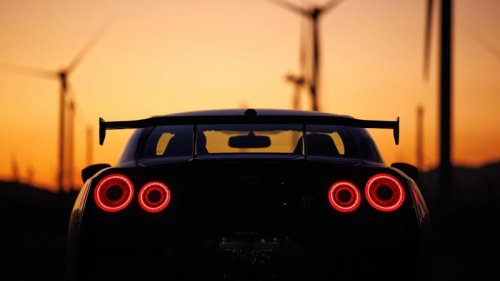
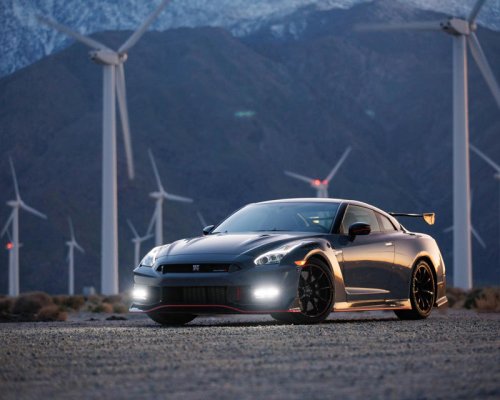
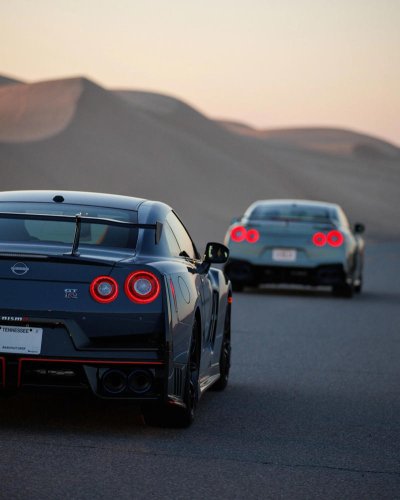
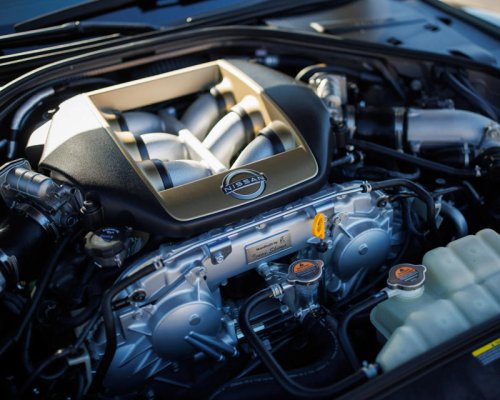
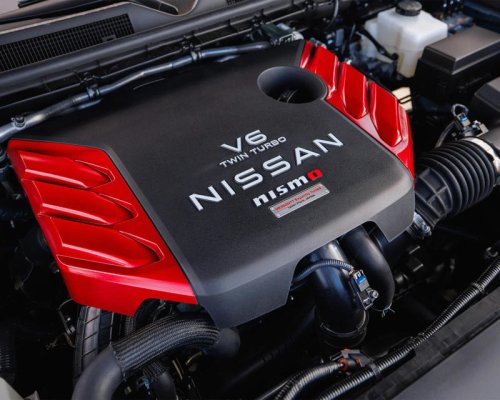




















Godzilla will be sticking to good ‘ol internal combustion. Rear view of a black Nissan GT-R with illuminated round taillights at sunset with wind turbines in the background. It appears the Nissan GT-R isn’t going all-electric after all. A new report from The Drive says the next-gen model will forgo its hyper-EV pitch and instead keep its twin-turbo V6. For the most part. According to Nissan’s North American chief for product planning, Ponz Pandikuthira, executives made the decision to retain the GT-R’s signature “VR38” for the next-generation R36. But while it won’t be transitioning into an EV, it will still get some sort of electric assist. The next-gen GT-R is going hybrid Godzilla isn’t dead, it’s just on hiatus for another few years. When Nissan discontinued the previous R35 generation GT-R in 2024, sports car fans and enthusiasts were biting their nails as to what would happen for the R36. Originally, rumors began swirling about, suggesting Nissan would go all-electric for the R36. While that had purists foaming at the mouth, some rumors suggested it could become a 1,000-horsepower electric monster. But Nissan apparently had second thoughts. Due to the lukewarm EV market and still ailing charging infrastructure, such an ambitious plan didn’t seem to align with the market. So, Nissan decided not to proceed with an all-electric GT-R, but rather a gas-electric hybrid one. The next-gen R36 GT-R will keep its original VR-based V6. “I’d say by 2028 you’ll see some concrete announcements, and hopefully before the decade turns you’ll see an R36 GT-R,” Pandikuthira told The Drive. He also said the new GT-R “has to be” built on a new platform and “it’s going to be an all-new car.” He also echoed the same sentiments for what will lie under the hood. However, the main reason for aiming for a hybrid powertrain isn’t just to align with market trends, but to meet new European emissions standards. “The next generation GT-R will need some level of electrification,” Pandikuthira continued. “So, does it need to be a full EV? Probably not, but it does need to have some level of electrification to meet, to future-proof emissions, compatibility.” The GT-R’s legendary V6 will undergo significant changes Despite launching in 2007, the “VR” V6 set the stage for a next-gen family of gasoline six-cylinders as a replacement for the aging VQ. Because the old, original VR38DETT from the original GT-R revival won’t meet Europe’s new Euro 7 emissions standards, that means Nissan engineers will have to make some changes to the engine itself. Additionally, Pandikuthira said the team wants to keep the GT-R as a “global car” for all markets. Meaning, if they want to sell it worldwide, it’ll have to comply with all the regions’ respective regulations. However, designing a completely new V6 would be woefully inefficient, as Nissan launched the VR family of V6s as an eventual successor to the tried, tested and true VQ family. The latest VR-based V6 is also found in the latest Nissan Armada/Patrol and Infiniti QX80. “If there was a hybrid powertrain, the block of that VR38 engine is so great. Why would you throw that away? But maybe the way combustions matter needs to be very different,” Pandikuthira continued. ”Maybe the heads are very different. Maybe the pistons are very different. So maybe we have to change top end.” The VR V6 already began replacing the old VQ V6 in a variety of applications, such as the previous Q50 sedan and Q60 coupes. It’s also currently driving the latest Armada/Patrol, Infiniti QX80 and the latest Nissan Z. About the Author: Chris Chin is an associate editor at Gear Patrol, covering cars, trucks and anything else with four wheels. He has over a decade of experience writing news and reviews but considers himself an enthusiast first, with a passion for classics and European cars. His daily driver is a 1987 Mercedes-Benz 560SEL with nearly 250,000 miles (87,000 are his). Want to stay up to date on the latest product news and releases? Add Gear Patrol as a preferred source to ensure our independent journalism makes it to the top of your Google search results. add as a preferred source on google