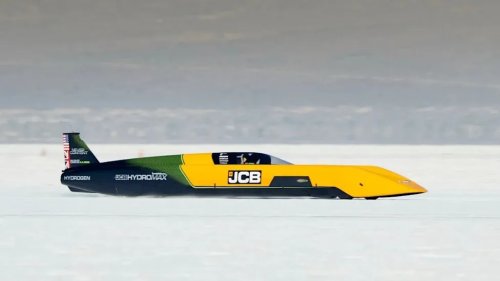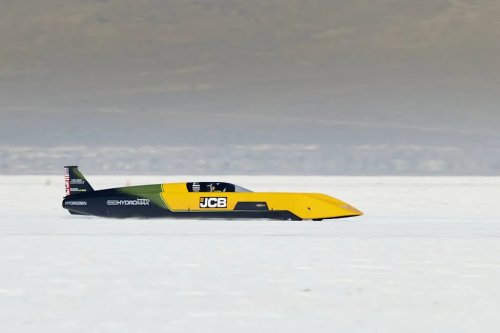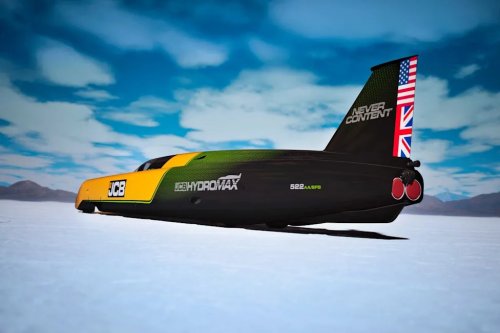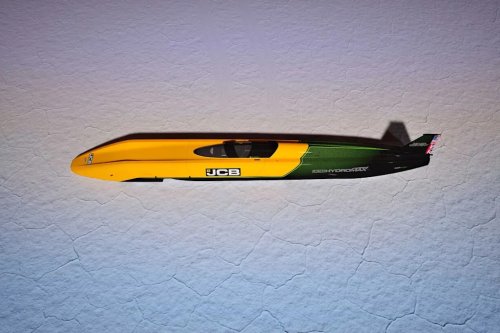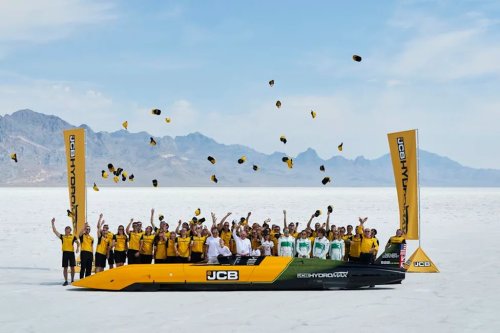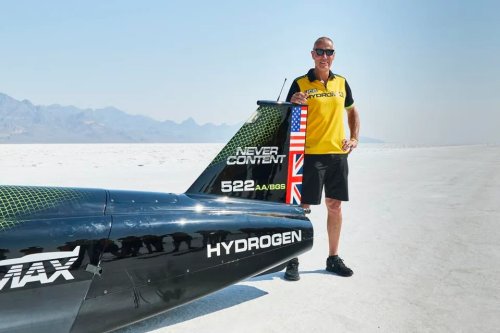
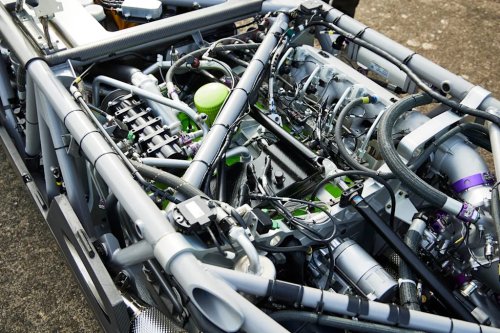
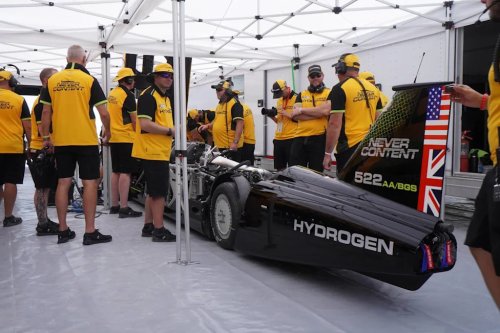
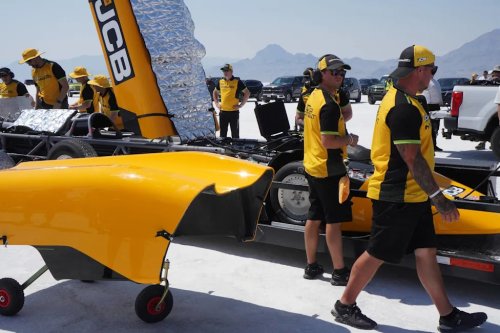
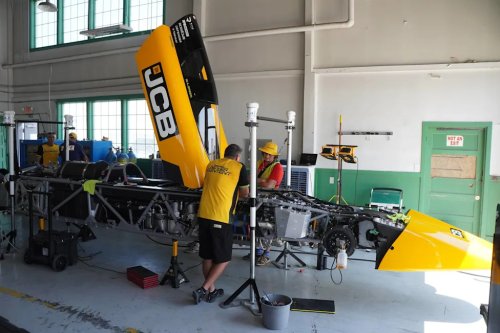
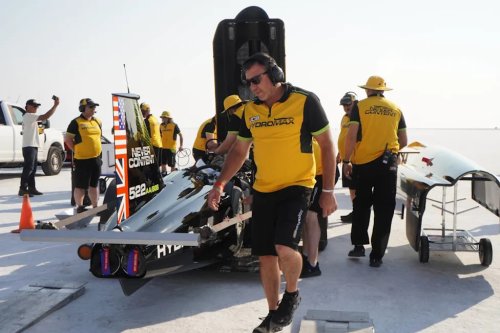
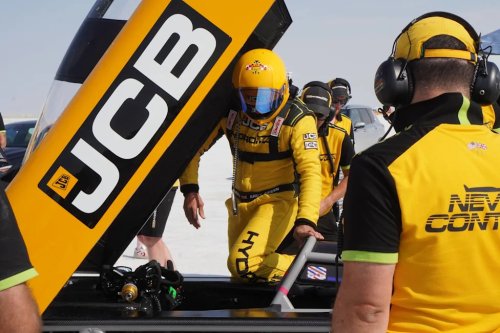



















Autoblog and Yahoo may earn commission from links in this article.A Construction Company That Goes FastIn 2006, JCB, the British firm whose name has become shorthand for backhoes and diggers across the UK, took on a challenge that had nothing to do with construction sites. With help from Envisage (formerly Visioneering), Ricardo and high-speed aerodynamics specialist Ron Ayers, the tractor-and-loader manufacturer built the JCB Dieselmax, a sleek streamliner designed for one purpose: crushing the land speed record for a diesel-powered vehicle. Retired RAF Wing Commander and outright land speed record holder Andy Green took the wheel, and that summer on the Bonneville Salt Flats, he delivered. The Dieselmax took the SCTA-BNI event record during Speed Week 2006 before breaking the official FIA diesel land speed record outright, hitting 350.092 mph on August 23, 2006.JCB wasn't done etching its name into the salt. About 18 months ago, the company decided to chase its own two-decade-old result with a new streamliner built around new technology developed in-house. That car is the Hydromax, and it just went considerably faster than its predecessor. Where the Dieselmax existed largely as a showcase for what JCB's diesel engines could do under extraordinary conditions, the Hydromax carries a heavier mission: proving that the company's next generation of powertrains can perform just as hard, without burning a drop of fossil fuel.JCBView the 2 images of this gallery on the original articleJCB, Hydrogen and HydromaxxingDuring Speed Week 2026, JCB returned to Bonneville with the Hydromax, a streamliner powered by two of the motors the company uses in its heavy machinery. That's where the similarities to Dieselmax end. At the center of the new car are two of JCB's latest combustion engines: hydrogen-powered 4.8-liter turbocharged four-cylinders, the same units found under the hood of the company's upcoming backhoes and generators. These engines were developed as a genuine alternative to JCB's diesel lineup, and they work differently than the hydrogen setups most people have encountered in passenger cars.AdvertisementAdvertisementWhere a Toyota Mirai or Honda FCX Clarity relies on a fuel cell to power electric motors and batteries, the Hydromax runs real combustion engines, complete with pistons, spark plugs and valves that make all the noise you'd expect. But instead of fumes, the only thing coming out of the tailpipe is water. JCB's reasoning for combustion over fuel cells comes down to where its equipment actually works: job sites, which can be located anywhere and everywhere they are needed. "People have done that, but they're not robust enough for our industry," JCB Hydromax Project Leader Ryan Ballard told Autoblog. "In our industry, our people are working in dust, they're working in debris, they're laying tarmac, they're building roads, they're working in the petrochemical industry; that contamination is really bad news for a fuel cell." JCBView the 3 images of this gallery on the original articleIn stock construction-equipment trim, these hydrogen four-bangers make around 74 horsepower and 325 lb-ft of torque at 2,200 rpm. But for Bonneville, JCB worked with Ricardo and Prodrive (yes, the rally specialists) to build a wildly different version, with upgraded fuel injection and valvetrain, a raised rev limiter of 4,000 rpm, a dry sump oil system and much bigger turbochargers. The result is 600 horsepower in Speed Week trim and up to 800 in the car's most aggressive configuration, with two of these engines packed into a T45 tubular steel spaceframe wrapped in a carbon fiber tub and bodywork.AdvertisementAdvertisementThe Hydromax isn't a Dieselmax with a different engine bolted in; it's a longer, lighter, more advanced machine built with technology that didn't exist 20 years ago, including 3D-printed components. No wind tunnel in the UK could fit a 32-foot-long car, so the team leaned on computational fluid dynamics (CFD) software to shape the bodywork through simulation instead. Each engine sits at an axle, front and rear, and both feed into a six-speed racing gearbox from XTRAC that Green shifts through paddles wired into a bespoke electronic system running over a kilometer of cable to monitor the car's vitals. Land Rover pitched in too, supplying Defenders for the team, including a 600-horsepower Defender Octa — the most powerful factory production Defender Land Rover builds — tasked with push-starting the Hydromax to 52 mph; the speed at which its tall, top-speed-oriented gearing can actually engage. While other teams on the salt may have taken years of blood, sweat and tears to build their machines, this all came together very quickly. Per Ballard, the Hydromax went from boardroom idea to active development within a month, and the team had only 15 to 16 months to build a running car before Bonneville's weather-dependent window closed on them. "We've set our ambitions," Ballard said. "We want to do this record and we need to do it now."James OchoaGetting Well SeasonedThe 2026 Bonneville Speed Week served as the Hydromax's first real test, as it ran in the Blown Gas Streamliner class for cars over 500 cubic inches. With Dieselmax's 350 mph mark as the target, JCB was aiming for at least 351 mph. For those unfamiliar with how Speed Week actually works as an actual event, it isn't exactly a free-for-all. The SCTA doesn't let anyone with a fast enough car and enough nerve simply line up and mash the throttle; drivers have to prove, run by run, that they and their machine belong on the course. That means working through a licensing system that ranks competitors from D up through AA before granting the "Unlimited" license required to actually chase a record, with each step requiring a faster, cleaner run than the last. AdvertisementAdvertisementI landed at the Salt Flats on the afternoon of August 3, in time to watch the Hydromax team prep the car for its second run of the day. Photos and spec sheets hadn't prepared me for what the car actually looked like in person; it was less a machine built from statistics and more like a sculpture that happened to move at 350-plus mph. Unlike the finished pieces you'd find in a gallery, though, this work of art was still a piece that was perpetually in progress. Inside the pit tent and out on the trailer at the start line, dozens of JCB and Prodrive engineers hovered over every inch of the car with laptops and tablets, working it over like a colony of worker bees. Their JCB-digger-yellow uniforms popped hard against the bleached-white salt, especially next to the crews that brought the hot rods and street machines that make up the rest of Speed Week's field. James OchoaView the 3 images of this gallery on the original articleShaken UpThat first run gave the Hydromax a chance to stretch its legs, and it also exposed that anything it encounters could potentially unlock new scenarios and challenges in the pursuit of its speed goals. During testing after the August 3 afternoon run, its onboard telemetry flagged an anomaly in the front engine's oil pressure. Ballard was clear that the number itself hadn't dropped to a dangerous level; the system had simply noticed the reading had deviated from what it should have been for that specific combination of engine speed, vehicle speed and load, and that the computer told Green to stop. "It's going for this RPM, this speed, this load, et cetera," Ballard explained, walking through the onboard computer's logic. "I should be at this level, and now at this level. That's too big a delta. Something's not right. Stop."AdvertisementAdvertisementThat call sent the team into the night. Between August 3 and 4, JCB pulled out the front engine and swapped in one of the four spares it brought to Utah, and despite the Hydromax's modular design, an engine swap on this car isn't like popping a motor out of a Beetle or a '96 Civic. Replacing the front engine meant rebuilding the entire front end of the car before running a laser alignment to make sure everything lined back up. James OchoaView the 3 images of this gallery on the original articleWe spent part of August 4 watching the team work out of JCB's Bonneville base, a converted historic firehouse at the Wendover Airport Museum. The whole process burned an entire day on a schedule that had none to spare, but it was a clear demonstration of the discipline JCB wanted the project to reflect: collect data, catch problems early, fix them properly, and only then go faster.If anyone on the team seemed unbothered by the engine swap, it was Green himself. He'd been involved in the Hydromax's design from early on, shaping the cockpit and telemetry around his own needs as a driver, and his background as a fighter pilot clearly shows in how the car talks to him. AdvertisementAdvertisement"He's been part of the design process," Ballard said. "He knows what's going to happen. He knows the sequence of lights and messages that he gets. He's definitely got an engineer's brain."James OchoaView the 4 images of this gallery on the original articleA BreakthroughWe ended August 4 unsure whether we'd see the Hydromax run again, but the next morning turned things around. Around 9 a.m. on August 5, the team gathered at the start line for a lower-speed shakedown run to gather data after the engine swap, followed by a second run at around 1:30 p.m. that hit 307 mph. That was enough to earn Green his Unlimited license and put the Hydromax in position for an actual record attempt later that day.The record run came that same afternoon. At around 4 p.m., our group of media split in two: one set watched from the start line, while the other watched from a vantage point near the three-mile marker, close to JCB's pit area. I went with the second group because I wanted to see the car pass with my own eyes, even from 300 yards off the track. Shortly after the Hydromax was pushed off the line, though, Green aborted the run when the cooling system threw a warning. We were shuttled back into vans bound for our hotel in West Wendover, and with the flats closing to racing at 5:30 p.m. and seemingly no time for another attempt, it looked like we'd seen the last of the Hydromax for the trip.James OchoaView the 3 images of this gallery on the original articleAdvertisementAdvertisementBut it wasn't. Partway back, our media handler took a call and immediately redirected the driver toward the start line instead of the hotel. "They are going to make another run," she told us. JCB had determined the cooling alert was a false alarm, and the team was going again — a do-over of the aborted attempt, thrown together at the last possible minute. We got back to the start line to witness the crew begin to finish its pre-run checks, and then we watched Hydromax get pushed and launch the instant the push car peeled off the course.Every member of the JCB crew crowded around a radio on a nearby trailer to listen in, campfire-style, as the run played out on the course. After a few tense moments of anticipation, a muffled voice cut through: "Congratulations JCB… 367.141 [miles per hour] through the 5 mile… exit speed 370.681." In that run, the run that we immediately detoured to see, Green had just beaten the Dieselmax's 20-year-old FIA record and the existing class record of 348.342 mph, set back in 2010."Why Hydrogen?"One run isn't enough to make it official. SCTA rules require the car to go to "impound" after a record pass, where the team gets four hours for approved maintenance before a second attempt the next morning; the two runs are then averaged for the record books. Early on August 6, around the same time I was enroute to the Salt Lake City airport, the Hydromax ran again, this time at 369.554 mph, giving it an average of 368.347 mph across the two runs. That result locked in the SCTA record, but it was really a warm-up for the bigger prize: an FIA-sanctioned attempt at the outright land speed record for a hydrogen-powered vehicle. On August 11, 2026, the Hydromax claimed that record too, averaging 406.320 mph across two runs.Before and after the trip, nearly everyone I talked to about the Hydromax asked me some version of the same question: Why hydrogen? I get the skepticism. Hydrogen hasn't had an easy run as a passenger-car fuel, and events in 2025 didn't help its case. That year Toyota sold just 210 Mirais, and three owners sued the automaker and its dealers and credit division, alleging they'd been sold cars dependent on a hydrogen refueling network that barely functions.AdvertisementAdvertisementJCB isn't in the passenger-car business, though. It plans to sell hydrogen-powered construction and agricultural equipment alongside its existing diesel lineup, and the Hydromax exists to prove that a hydrogen ecosystem can work under extreme conditions. Ballard told me back at the Wendover firehouse that battery power (like in EVs) wasn't a realistic option for JCB's decarbonization push because hauling charging infrastructure out to remote job sites is its own logistical nightmare. Hydrogen doesn't have that problem. "Hydrogen is a great solution," he said. "You can transport it to an incredibly remote location, the middle of the desert, in the middle of nowhere and refuel machines or refuel a race car."JCB isn't alone in betting on hydrogen combustion, either. Toyota's Gazoo Racing has run its own string of hydrogen-combustion concepts, from the GR LH2 Racing Concept at Le Mans in 2025 to a hydrogen-fueled GR Corolla in Super Taikyu competition in 2024 to a Toyota AE86 built around a modified hydrogen 4AGE four-cylinder.Plenty of technology that started on a racetrack eventually ended up in road cars — paddle shifters, dual-overhead cams, disc brakes, even the rearview mirror. Between EV mandates, shifting fuel economy rules and genuine confusion over which alternative fuel actually wins, it's easy to assume the future of the combustion engine is bleak. The Hydromax argues otherwise, and it does so with a soundtrack every bit as loud and raspy as a modern turbocharged engine. AdvertisementAdvertisementNobody buying one of JCB's hydrogen backhoes needs to worry about refueling infrastructure the way Mirai owners did, but the Hydromax still feels like a North Star for where hydrogen combustion could go next. We're a long way from a future where hydrogen-burning cars share the road with gas burners and EVs alike, but Bonneville just proved it's a real possibility, not a thought experiment. Whatever shape that future ends up taking, it's worth remembering it was proven out not in a boardroom or a press release, but on a stretch of salt in Utah, by a construction company that decided the best way to make its case was to go faster than anyone expected.This story was originally published by Autoblog on Aug 14, 2026, where it first appeared in the Features section. Add Autoblog as a Preferred Source by clicking here.