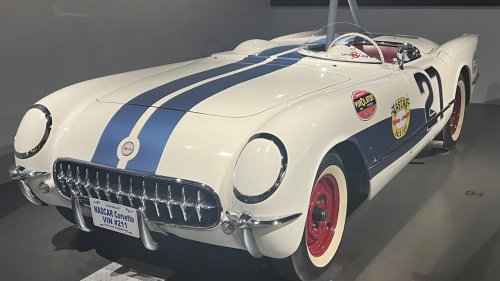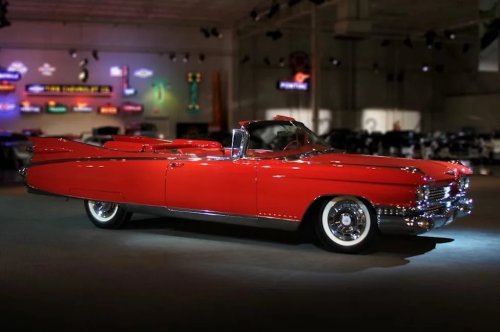
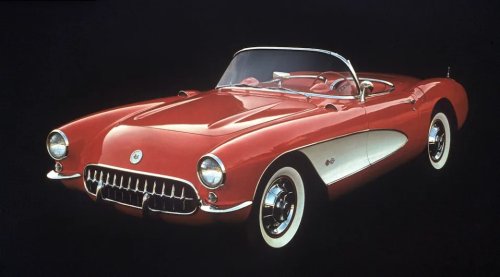
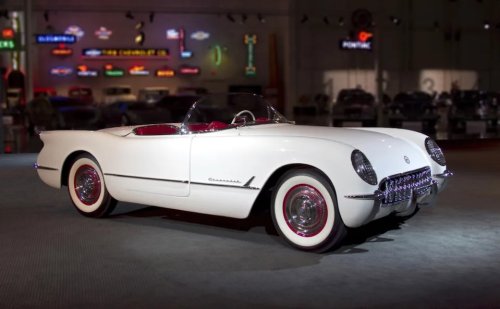
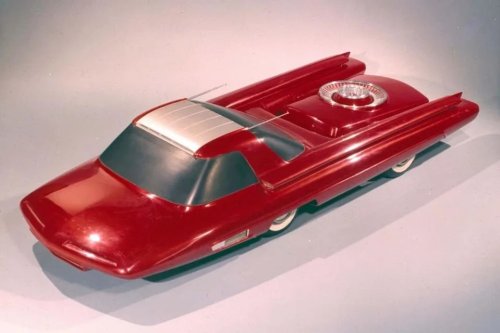



















The 1959 EldoradoPhoto by CadillacIf you think modern cars are ridiculous because they beep whenever you drift too close to a lane marker, complain when you remove your seatbelt for five seconds, or shut off their engines every time you stop at a traffic light, spare a thought for motorists of the 1950s.Long before regulators and safety advocates began influencing every aspect of vehicle design, Detroit's automakers operated in what can only be described as the Wild West of automotive creativity. Designers enjoyed almost unlimited freedom, engineers chased ideas that bordered on science fiction, and marketing departments seemed convinced Americans would buy almost anything as long as it contained enough chrome.The result was arguably the most entertaining decade in automotive history. It was an era that gave us gorgeous examples of kinetic art like the first-generation Chevrolet Corvette and Ford Thunderbird. Unfortunately, it also gave us nuclear-powered concept cars, dashboard gadgets nobody asked for, bumpers inspired by TV personalities shapely figures, and tail fins so large they needed air traffic control clearance to move.The 1956 Corvette was a design masterpieceTail Fins: When More Was Never EnoughThe tail-fin craze began innocently enough in 1948 when Cadillac designers, led by Harley Earl, borrowed inspiration from the twin tails of the Lockheed P-38 Lightning fighter aircraft. At first, the fins were tasteful and restrained, adding jet-age glamour to post-war American cars. Unfortunately, restraint was never Detroit's strongest quality.AdvertisementAdvertisementEach year the fins grew larger, until the 1959 Cadillac Eldorado arrived with rear appendages soaring almost three feet above the rear fenders. These chrome-tipped structures served no meaningful aerodynamic purpose, complicated rear visibility and made parking even more theatrical than necessary. But practicality was beside the point. In the optimistic atmosphere of the Space Age, Americans wanted cars that looked ready to launch.The Edsel: A Rolling Collection Of Questionable DecisionsFew vehicles symbolize Detroit's occasional tendency toward self-inflicted wounds better than the Edsel. Introduced by Ford in 1957, it was supposed to become the company's next great success story. Instead, after a sizable $250 million investment, it became one of the most famous failures in automotive history.Its most controversial feature was the large vertical oval grille, which Ford hoped would create instant recognition. It did. Unfortunately, many observers thought it resembled a horse collar, while others said it looked like a toilet seat. The Edsel also introduced the Teletouch transmission, which placed push-button gear selectors in the center of the steering wheel. It sounded futuristic, but drivers already had enough to think about without wondering whether they had accidentally selected Reverse while turning into a parking space.Then there was the speed-warning speedometer, which allowed drivers to set a maximum speed and then punished them with an annoying warning light if they exceeded it. Ford considered this a safety feature. Modern drivers might recognize it as the spiritual ancestor of today's endless electronic nagging.Hood Ornaments: Chrome Jewelry With A Dark SideThe 1950s were also the golden age of hood ornaments. Cadillac, Buick, Pontiac, Packard and others adorned their cars with rockets, birds, goddesses, jets and other chrome sculptures that looked magnificent in a showroom but considerably less charming in a pedestrian impact.AdvertisementAdvertisementThese ornaments were originally intended to symbolize speed, elegance and technological optimism. The problem was that many of them protruded from the front of vehicles like miniature medieval weapons. As safety regulations increased in later decades, the elaborate hood ornament largely disappeared, replaced by badges that were far less romantic but much less likely to impale anyone.Dagmar Bumpers Where Detroit Met Television GlamourCadillac's so-called Dagmar bumpers remain one of the strangest styling trends of the era. Officially, these prominent bumper protrusions were inspired by jet-age design and missile imagery. Unofficially, they became associated with Virginia "Dagmar" Lewis, a famously buxom television personality of the 1950s.Their purpose was partly decorative and partly protective, but the visual joke became unavoidable. Soon, these chrome projections became one of the most memorable symbols of Detroit's anything-goes styling culture. Subtle they were not. But then again, this was a decade when subtlety seemed to have been banned at the city limits.Bench Seats: The Sofa That Encouraged RomanceNearly every American manufacturer embraced the front bench seat, officially because it allowed three people to sit across the front row. Unofficially, it also suited the drive-in movie culture of the era rather nicely.AdvertisementAdvertisementFrom a driving perspective, bench seats were hopeless. They provided almost no lateral support, meaning that a brisk corner could see the passenger sliding across and ending up in the driver's lap. But for young couples at drive-in theaters, that lack of separation was part of the appeal. The bench seat was not designed for Nürburgring lap times. It was designed for Saturday night. Say no more.Wraparound windshieldWraparound Windscreens: Seeing The Future Through A FishbowlIn the 50s, General Motors, Ford and Chrysler all embraced panoramic wraparound windscreens, which gave cars a futuristic, aircraft-inspired appearance. From the outside, they looked sensational. From the inside, they could make reality appear slightly negotiable.Because the windshield glass curved sharply around to the A-pillars, drivers often experienced optical distortions near the edges. Road signs stretched. Other vehicles warped. Pedestrians could appear in odd places. It was like driving through a Salvador Dalí painting, only with more chrome and less explanation.The Door Re-Mi Chime: When Your Car Wanted To SingLong before modern infotainment systems and warning tones, Ford and Lincoln experimented with musical door chimes. Rather than simply clicking or buzzing, certain cars greeted occupants with a little "door re-mi" musical sequence.AdvertisementAdvertisementThe idea was to make the car feel more luxurious and sophisticated, as though the vehicle were welcoming you aboard rather than merely allowing entry. In practice, it was charming, strange and slightly unnecessary, especially if the door was left open while unloading groceries. Today, however, after decades of angry seatbelt alarms and parking sensor shrieks, a polite musical chime almost seems civilized.The Ford Nucleon concept car scale modelFord Nucleon: The Atomic Family CarIf the Chrysler turbine car represented ambitious engineering, the 1958 Ford Nucleon represented full-blown atomic-age optimism. Ford imagined a future in which cars would be powered by small nuclear reactors, theoretically allowing drivers to travel thousands of miles before replacing the power module.It was a spectacularly 1950s idea: bold, futuristic and completely terrifying. The Nucleon never advanced beyond concept form, which was probably wise, because few suburban families were likely to welcome the phrase "minor reactor incident" into their daily commute. Still, the concept perfectly captured the era's belief that technology could solve absolutely everything, preferably with fins.The Glorious Age Of Automotive InsanityMost of these features vanished because they were impractical, unsafe, expensive or simply absurd. Yet there is something undeniably charming about them. For one ridiculous, glorious decade, Detroit designers had almost total freedom, and they used it to create cars that were shapely, distinct, memorable and artistic.AdvertisementAdvertisementModern cars are safer, cleaner and smarter, but many are also bland enough to disappear in a supermarket parking lot. The 1950s gave us excess, yes, but it also gave us imagination, hope and some true design icons . And while we can laugh at Dagmar bumpers, nuclear cars and tail fins tall enough to require a weather report, we should also admit something uncomfortable: those cars had personality and were pretty to look at.Compared with today's start-stop systems, seatbelt alarms and constant sensor beeping, perhaps a musical door chime, an adventurous grille and a few outrageous fins were not the worst ideas after all.This article was originally published on Forbes.com