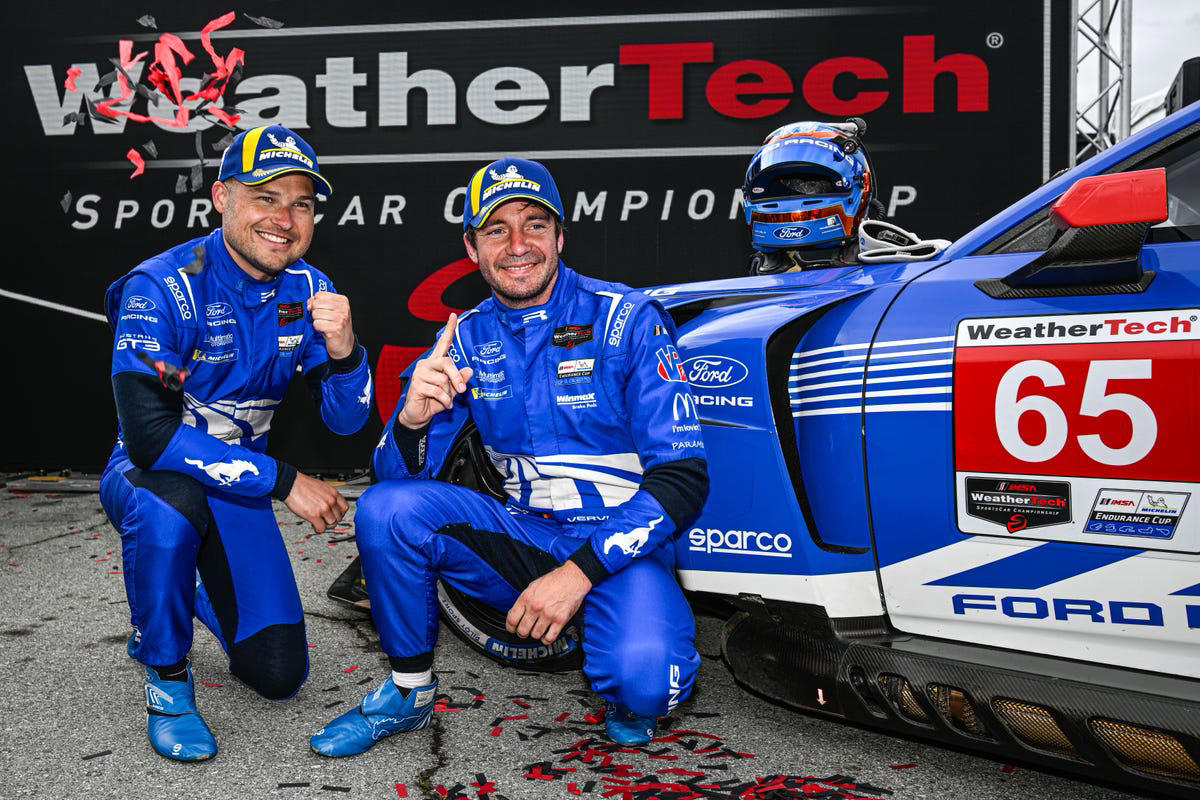
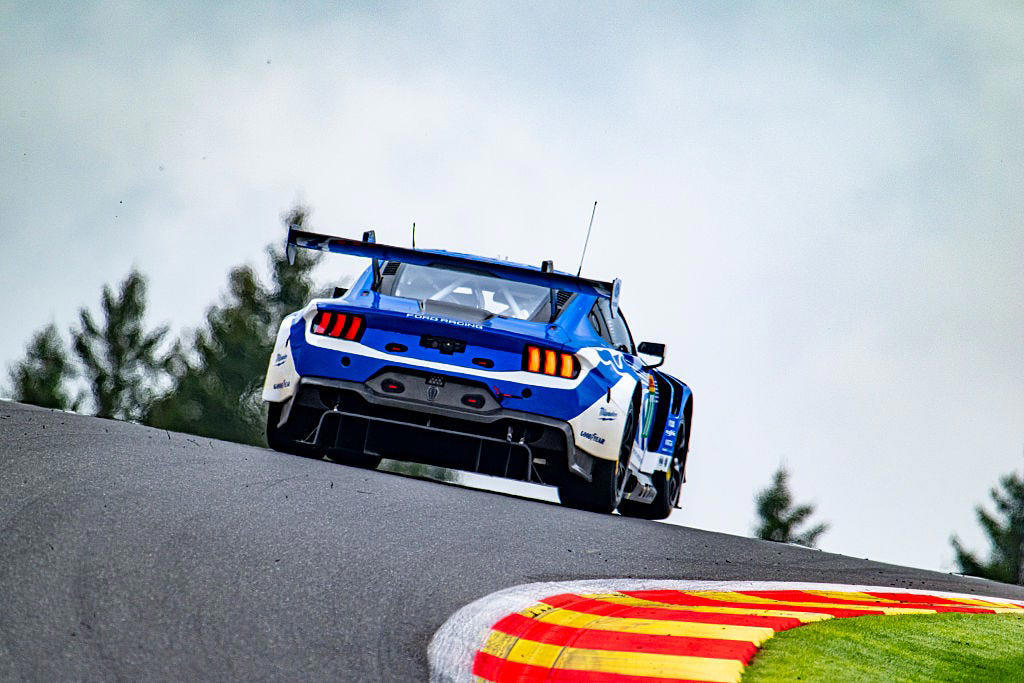
Ford Racing may have been late to the GT3 category that is marking its 20th year, but the Mustang GT3 is rapidly making up ground.That may come as a surprise to those who doubted the coupe’s ability to handle the two-seaters that have been the core of the GT3 class. But Ford’s aggressive world-wide program built on a relatively practical design by Larry Holt’s crew at Multimatic has made up for lost ground.The latest evidence was the first GTD Pro victory by the EVO version of the Mustang at Laguna Seca in round 4 of the IMSA WeatherTech Championship, where it won on pace and strategy. The next mission is the defense of last year’s victory in Detroit while again trying to relegate the Dearborn company’s GM rival, Corvette Racing, to somewhere down the order.Neither side in this internecine racing war likes losing to the other in front of the brass, let alone the rank-and-file. Dubbed the Chevrolet Detroit Sports Car Classic, the Saturday race is more like a football game between big yellow and big blue, said Antonio Garcia, who co-drove his Corvette Z06 GT3.R to second last year. “It feels more like a big match or Super Bowl… two big teams fighting against each other, so it is important (to beat the Mustangs) for sure.”Ford Mustang GT3, GTD Pro during the IMSA WeatherTech SportsCar Championship in May.’ expand='Garcia set the class track record in Detroit in 2024 and last year Seb Priaulx took the pole in his Mustang.This year, 10 GTD Pro cars will join 11 GTP entries for the 100-minute race. That includes a brace of Lexus RC F GT3s entered by Vasser Sullivan, whose entry won the GTD class in the street race in Long Beach.Long before GT3 was a twinkle in the eye of organizer Stephan Ratel and his SRO series, GM launched Corvette Racing with Michigan-based Pratt Miller, which ran its first full season in the American Le Mans Series in 2000. Arguably, Corvette Racing was years ahead when IMSA finally fully embraced GT3 in 2024. But thanks, in part, to the wonders of Balance of Performance, the Mustang has come on strong after pursuing the GT3 class worldwide.Taking a page from Porsche, which pioneered the sale of production-based 911s in the early 2000s for its own single-make series as well as international competition, Ford now maintains a major presence around the world with its Mustangs, including the production-based GT4 and Dark Horse R. The sale of race cars to privateers supports not only the development that has led to the EVO, it helps underwrite a racing budget. That’s the classic model that has sustained the GT3 category for two decades.The Mustang GT3 EVO represents what’s been learned in events like the Nürburgring 24 and the 24 Hours of Spa as well as in IMSA and the World Endurance Championship. “It’s a bit easier to drive. It’s more predictable.,” said Frederic Vervisch, the Belgian who co-dove to the win at Laguna with Christopher Mies before they were part of the crew that finished seventh in mid-May for HRT Ford Racing at the Nürburgring, where the IMSA team Winward Racing was the over-all winner with its Mercedes AMG.Ford Mustang LMGT3 at the 6 Hours of Spa-Francorchamps in May.“When you enter a corner, you know a bit more what to expect, which is important,” said Vervisch of the Mustang EVO. “I think for any driver. I mean, there are drivers who can cope with inconsistency better than others, but I think in general, you want a car that when you brake in the corner, you know what to expect. And they made really a good improvement. So that means it also can be more consistent with less mistakes.”Qualifying and racing on Detroit’s quadrangular 1.654-mile track are all about braking. Late braking helps in Friday’s time trials that determines track position for the start of the Saturday afternoon race. Out-braking and trading colors is just about the only way to pass absent a competitor’s mistake, a situation that can favor the relatively larger Mustangs.With its 5.4-liter Coyote V8, power has always been ample for the Mustang GT3. The car’s relative bulk, meanwhile, was retuned for this season’s re-homologation. “Aero-wise, we were (originally) in the lower box of the homologation, and now we are at the highest end that we can get for the GT3,” said Vervisch. “That makes the car just a bit easier to drive as well. High speed is more predictable. It’s also better for generating more grip on your tires, more pressure on your tires, or more downforce, which is also helping the tire wear. That’s less than before.”Vervisch and Mies will drive the blue No. 65 Mustang GT3 EVO and teammates Dennis Olsen and Ben Barker will wheel the No. 64. Their biggest rivals in this local showdown will be the yellow No. 3 Corvette (Garcia and Alexander Sims) and No.4 Corvette (Tommy Milner and Nicky Catsburg).“I’m very thankful to Multimatic and Ford for the effort to keep pushing and really giving us a better car,” said Vervisch. “I think we’re still not there, but the results we had the last race in IMSA and the 24 hours of Nürburgring really shows that we can compete all around the world.”