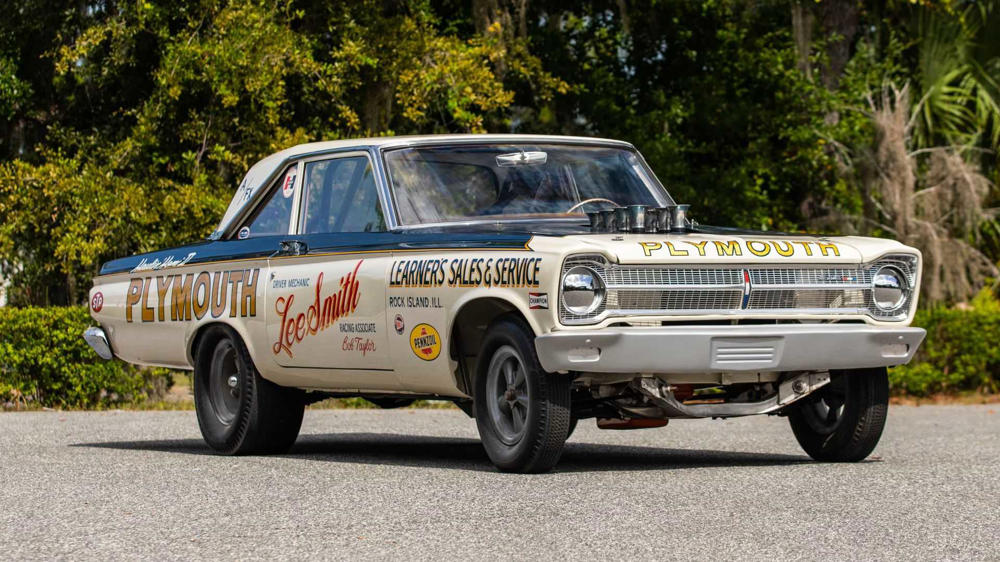
Ironically, funny cars aren't a joke, as they are serious drag racing builds. I’m also not joking about how Chrysler accidentally created the trend while trying to prove its grit on the track in the 1960s. However, the builds were so unconventional and so fast that the NHRA immediately banned them. But this didn't stop the funny car movement from entirely changing racing culture, because looking ‘funny’ didn’t matter if you got the win. Chrysler Wanted To Outrace The Ford 427 Mustang In the 1960s, the Ford Mustang 427 and Ford Comet Cyclone were prominent forces in the drag racing world, and Chrysler took notice. In 1965, factory-backed racing models gained the supercharged 427 cubic-inch (7.0-liter) SOHC Cammer V8 engine. It delivered an immense 657 hp and 515 lb-ft of torque. Unfortunately, as a purpose-built drag racing model that wasn’t available for street production, an official zero-to-60 time was never published. But it was probably blistering fast. This engine helped the Mustang cover a quarter mile in about 9.97 seconds at about 134 mph. It was insane compared to what buyers could buy. The beefiest street-legal Mustang came with an available 289 cubic-inch (4.7-liter) K-Code V8 with 271 hp and 312 lb-ft of torque. It could fly from 0 to 60 mph in roughly 7.5 seconds and cover a quarter mile in about 15.9 seconds at about 85 mph. So, Chrysler needed to quickly get creative in order to compete on the drag strip. The 1965 Plymouth Belvedere And Dodge Coronet Were Modified To Race Late in 1964, Chrysler heard about what Ford was planning to do for the 1965 NHRA season and was left scrambling to build something that would be able to compete against the looming threat. So the automaker tossed the official rule book aside and created a prototype in about eight weeks, and the 1965 Plymouth Belvedere A/FX and Dodge Coronet A/FX models were born. However, the modifications to these cars were so extreme that they couldn’t be built on the Chrysler assembly lines in time. So, the project builds were outsourced to Amblewagon, an ambulance-modification shop in Troy, Michigan. The cars received radical makeovers with an altered wheelbase that shifted the rear wheels forward by 15 inches and the front axle by 10 inches. This made the cars look different, or funny. This shortened the wheelbase to 110 inches and placed about 15% of the car’s weight over the rear tires. To reduce weight, the car received fiberglass body panels, and the steel panels were dipped in acid to strip extra pounds. Lexan or Plexiglas windows were also used, while the radios, heaters, and rear seats were deleted. They were powered by the 426 cubic-inch (7.0-liter) Hemi V8 engine with aluminum cylinder heads and a magnesium cross-ram intake manifold to reduce weight. The setup delivered an advertised 550 hp and 490 lb-ft of torque. These cars could cover a quarter mile in about 9.5 seconds at about 140 mph with the mid-season Hilborn fuel injection upgrade. The NHRA Quickly Banned The Funny Cars The 1965 Plymouth Belvedere A/FX and Dodge Coronet A/FX were off to a great start during the season and received plenty of upgrades to keep the heat burning. They achieved the first recorded nine-second pass for a naturally aspirated production-bodied car. But the NHRA quickly banned the funny cars. Moving the wheelbase forward by 10 inches violated the NHRA’s rule that limited wheelbase modifications to 2%. Plus, the NHRA had a minimum weight threshold of 3,200 lbs, and the Belvedere A/FX models only weighed in at 3,200 lbs. Also, chemical milling and the extreme modifications went against the racing spirit of factory-backed doorslammer classes. After being shut out of official NHRA competitions in the middle of the season, the racers participated in the match race circuit, independent events, and AHRA events. The two Mopar variants regularly battled each other, as well as Ford Mustang A/FX models, to the delight and entertainment of fans. But Funny Cars Couldn't Be Stopped The 1965 Plymouth Belvedere A/FX and its Coronet counterpart were the natural funny-looking precursors to actual funny cars, because the trend exploded like wildfire. The term "funny cars" may have been first used by Mercury's racing director, Fran Hernandez, or by track announcers to describe the models with disproportionate looks during the 1965 AHRA winter nationals. The term could also be attributed to the fans' reactions to the cars at the Beeline Raceway. But the factory experiments were never meant to be attractive. Instead, they were built with traction and weight-saving advantages. Between 1966 and 1968, the cars were ditching aluminum factory bodies for flip-top fiberglass. Then in 1967, the fastest cars achieved quarter-mile times under the eight-second barrier, and the Barracuda Funny Car managed to reach the mid-seven-second range. The NHRA officially adopted a Funny Car class in 1969. Modern builds produce well over 10,000 hp and launch with about six G’s of acceleration. Surviving Models Are Exceptionally Rare Records indicate that only 11 or 12 Plymouth Belvedere A/FX and Dodge Coronet A/FX models were built. Six of each may have graced the tracks. Somefunny carsmay have beenpushed too hard on the trackand raced into the ground. Others might have been cut up, more heavily modified, or written off by the end of the 1960s. A few models could have survived or may have been painstakingly restored. Lee Smith’s Haulin’ Hemi II reportedly passed through the hands of six different owners before being restored by Jim Welch. It was put up for auction in 2017, and Mopar bid $410,000. However, it failed to meet reserve and wasn’t sold. The Sox and Martin Plymouth Funny Car was sold to Flynn Warner, but Buddy Martin regrets that decision. He stated that he should have kept it as a piece of memorabilia. It made an appearance at the All-Hemi Reunion in 2008. Also, surviving models or parts of them could be on display in museums. Source: Barret Jackson, How Stuff Works, Hagerty

 Liked by Oliver Moreau, Caleb Brown










 Liked by Oliver Moreau, Caleb Brown