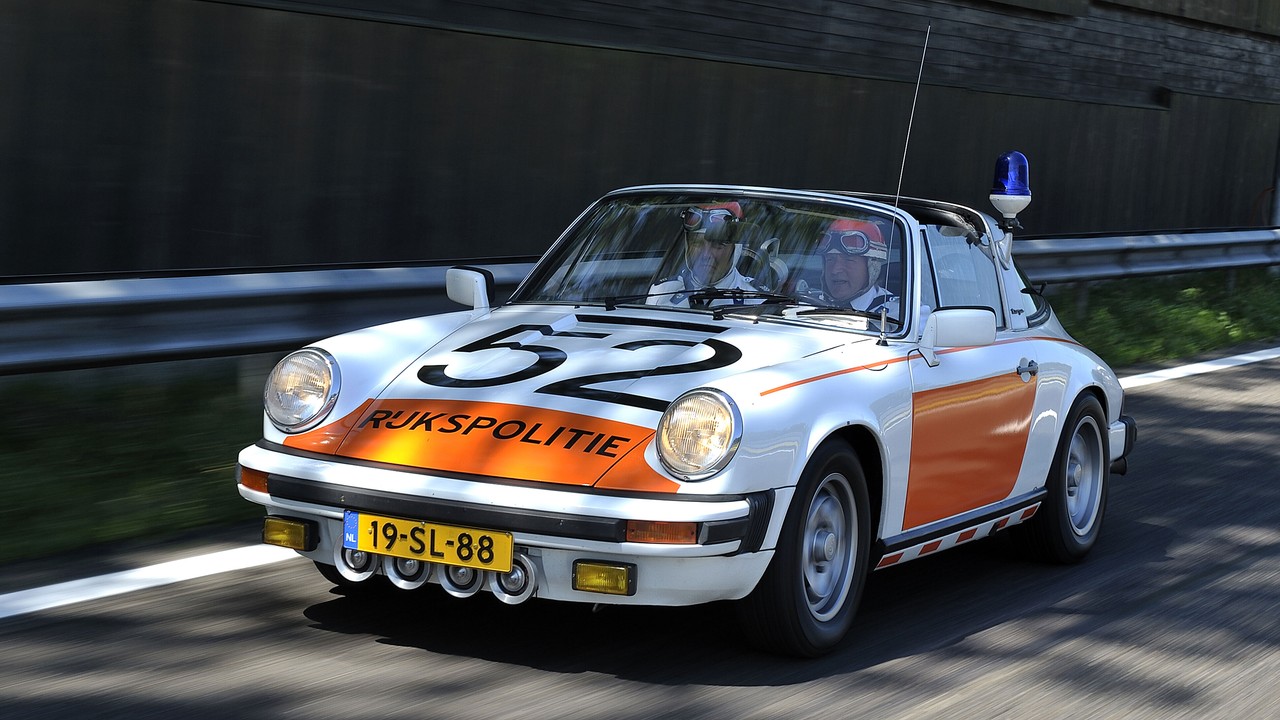
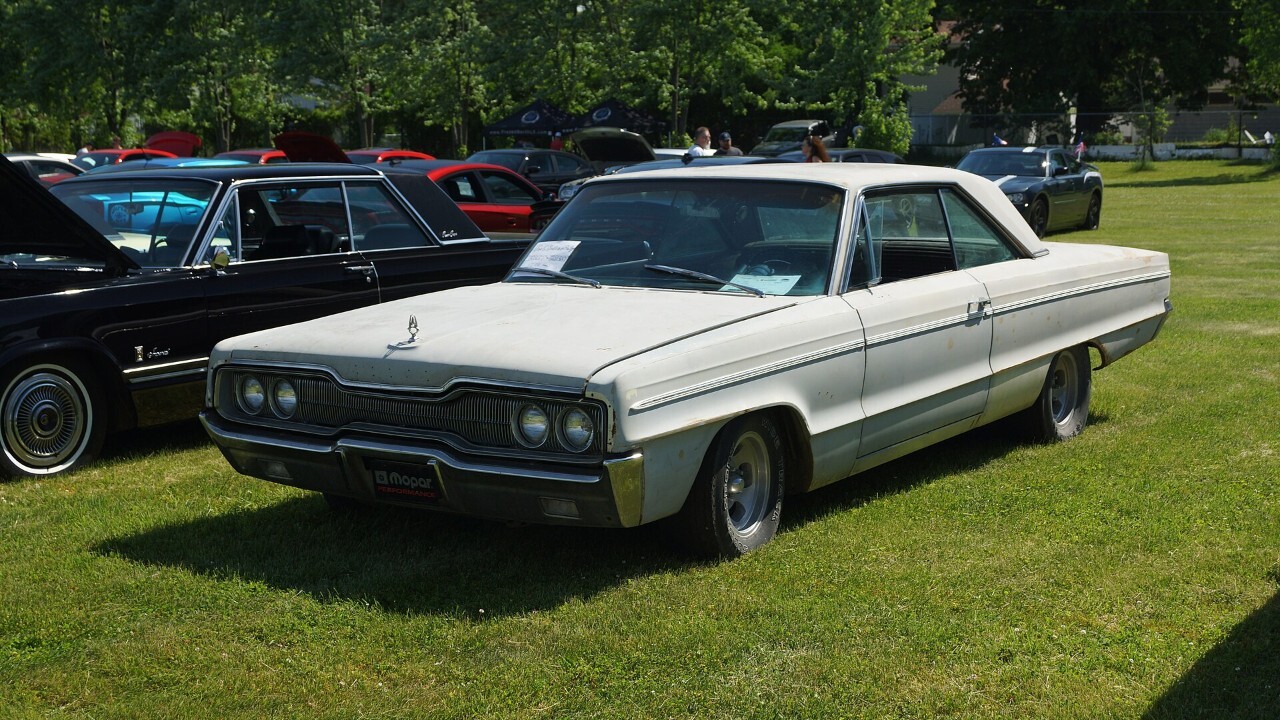
A vintage police car pulls a crowd at any car show, even when it is parked with the lights off. People wander over, peer inside at the radio gear and ask where it served. Few classics spark that kind of instant curiosity. Part of the appeal is that these cars were never meant to be pretty. Agencies bought them for speed, toughness or plain thrift, and then they worked them hard for years. Once retired, many were sold off and worn out, so a restored one in full livery feels like a time machine. These twelve are our picks for the retired patrol cars that turn the most heads today. The list mixes American highway cruisers with European sports cars and small British beat cars. Each one earned a spot for its story, its looks or the job it did. 1. Porsche 911 Rijkspolitie The Dutch national police, the Rijkspolitie, needed a fast patrol car in the early 1960s. Serious accidents were rising on motorways that had no speed limit, so the force wanted a car that could keep up. It also had to be reliable, handle well, stop quickly and offer an open top, so officers could stand up and direct traffic. The answer was Porsche. According to the Porsche Newsroom, the force ran orange-and-white 356s from 1962 to 1966. After Porsche unveiled the 911 Targa in 1967, that model took over, and it stayed in Dutch service until 1996. In total, 507 Porsches wore Rijkspolitie colors, including the 914, 924 and 964. In our view, no patrol car anywhere looks more purposeful than a 911 in that orange-and-white scheme. 2. 1972 Dodge Polara Maryland State Police The 1972 Polara was Dodge’s full-size sedan in its final years. That year, it got a facelift with new sheet metal, while the upscale Polara Brougham disappeared. This example wears Maryland State Police markings, a reminder that big Mopar sedans did serious duty for state agencies in that era. Dodge’s police reputation was well earned, too. In fact, a 1969 California Highway Patrol Polara set a Chrysler test-track record of 149.6 mph for a factory-built four-door sedan. That mark stood until a 1994 Chevrolet Caprice with the LT1 engine finally beat it. However, the Polara itself did not last much longer. The energy crisis of fall 1973 hurt big-car sales, and Dodge dropped the Polara after 1973 in favor of the redesigned 1974 Monaco. Our take: a restored Polara cruiser is the definitive image of a 1970s American trooper car. 3. 1975 Plymouth Gran Fury Michigan State Police For 1975, Plymouth shuffled its names. The mid-size Satellite became the Fury, so the full-size C-body car took the Gran Fury badge. Plymouth built 72,801 Gran Furys that first year, and the big 440 V8 was rated at 210 horsepower in 1975. Plymouth and Michigan went on to forge a strong bond. In 1978, the Michigan State Police began formal annual testing of patrol cars, according to Curbside Classic. The 440-powered Fury was by far the best performer in that first test, and the agency chose it. Yet 1978 was also the last year for the 440 on Chrysler’s police options list. Survivors are hard to find. Hagerty profiled a 1977 “Michigan Fury” found in a Mackinaw City barn, and its owner believes it is the sole survivor of a small pursuit fleet. We think the 1975 Gran Fury in these colors is just as special. 4. 1981 Dodge Diplomat sheriff police car The Diplomat began life in 1977 as a Dodge on Chrysler’s M-body platform. For the first few years, it was a civilian car. Then, in 1981, Chrysler began selling the Diplomat to police fleets, according to Drivingline. That makes this 1981 sheriff’s car, in Lafayette, Louisiana livery, part of the very first police wave. Almost every M-body used a 318-cubic-inch V8 rated at roughly 145 horsepower, and the police package added a four-barrel carburetor. Later, for 1985, a higher-compression police 318 made 175 horsepower. Fleets and taxi operators liked the car because its simple design was durable and cheap to repair. The M-body carried on through 1989, when fleets bought most of the Dodge and Plymouth sedans built. In our opinion, the Diplomat is the unsung workhorse of 1980s policing, boxy and honest. 5. 1985 Ford Mustang SSP 5.0 Police Coupe The Special Service Package Mustang began with a request from the California Highway Patrol in 1982. The CHP ordered 400 notchback coupes, and Ford built and shipped 394 of them. Ford then offered the SSP to other agencies from 1983, according to Hagerty. Under the skin, these were tougher than a showroom 5.0. Ford added an engine oil cooler, a transmission fluid cooler, silicone radiator hoses with aircraft-style clamps and heavy-duty alternators. It also fitted reinforced floor pans and a certified speedometer that read to 140 mph on cars built before early 1989. As for power, Hagerty says the V8 made 175 horsepower at first and 200 for 1986. If you want to know what actually makes police cars faster, the SSP is a good place to start. Our take: a 1985 SSP coupe in full livery is pure 1980s highway patrol. 6. 1992 Ford Mustang Michigan State Police By 1992, the SSP Mustang had matured. Hagerty says the 5.0 V8 was rated at 225 horsepower from 1989. Meanwhile, the certified speedometer now read to 160 mph on cars built from late 1989 through 1993. The Michigan State Police were among the agencies that ran these coupes. Altogether, Ford built nearly 15,000 SSP Mustangs between 1982 and 1993 for more than 60 law enforcement and government agencies. For years, neither Chrysler nor GM offered anything comparable, until Chevrolet’s B4C Camaro arrived in 1991. The 1992 car is one of the last of the breed, since the SSP ended after 1993. Decades later, the idea came back when New York State Police added the Mustang GT. In our view, a late Fox-body SSP in state police colors is about as cool as police cars get. 7. 1990s Chevrolet Caprice Maryland State Police Chevrolet introduced its 9C1 police package for the base Caprice in 1986, when the Caprice replaced the Impala in that role. The rounded 1991 to 1996 car was the final B-body Caprice. This one wears Maryland State Police markings over a sand-colored finish. The big news came in 1994. That year, the LT1 5.7-liter V8 became optional in 9C1 cars, aimed at highway and rural work. It made 260 horsepower and 330 lb-ft of torque from 1994 to 1996. Chevrolet ended production in December 1996. Departments were so attached to these cars that a cottage industry grew up refurbishing them after production stopped. Many agencies also kept theirs in service longer than other patrol cars of the time. Our take: the LT1 Caprice was one of the police cars that were factory monsters. 8. Morris Minor police car The Morris Minor was hardly a pursuit car, yet several British forces put it to work. The Metropolitan Police was probably its highest-profile user. Panda Minors came off the line at Cowley, near Oxford, and specifications varied from county to county. A 1968 Met Minor shows how basic these cars were. According to a profile of a former Met Minor, it topped out at 73 mph and had no radio. Instead, it carried a blue light, two-tone horns, a bell and a heater. One officer crewed it, while bigger Jaguars and Wolseleys carried a driver and a radio operator. By the early 1970s, the Met had replaced its last Minors with Austin 1100s. One enthusiast in that profile believes only 15 of the Met’s Minors survive. In our opinion, that small number makes every restored one a treat. 9. Rover 3500 P6 police car The Rover P6 was the first Rover to get the 3.5-liter V8, an engine that proved to be a highly effective motorway mile-muncher. That made it a natural choice for traffic patrol. For example, one English force took on the P6 as its standard Traffic Car in the early 1970s, after a short, unsuccessful trial of Vauxhall Victors with the 3.3-liter Ventora engine. According to Hertfordshire’s police history archive, the first cars were automatics. By 1972 a manual was available, and the force switched to it. Officers found the P6 comfortable and popular, but its boot was small. As a result, the cars ran without a spare wheel to make room for warning signs and other kit. A flat tire meant radioing for a spare. Our take: that quirk sums up the P6 nicely, a fast and stylish car that never quite fit its job description. 10. Jaguar Mark II police car Jaguar launched the Mark II in 1959, the same year Britain opened its first major motorway. Police forces that had to cover long distances at high speed soon took notice. Across the 1960s, they usually chose the 3.8-liter version. The numbers explain why. According to Lancaster Insurance’s history of police cars, the 3.8 made 220 bhp, ran from 0 to 60 mph in 8.5 seconds and reached 125 mph. Those were serious figures for a four-door saloon of the day. Later, the Mark II found a second career on television as Inspector Morse’s car. In our view, a Mark II in police trim is the classiest patrol car Britain ever fielded, with real speed to back up its looks. 11. Volkswagen Beetle Polizei The Beetle served German police for many years. In Dortmund, for instance, the force put a whole fleet of new Beetles into service in 1956, and from then on they worked as patrol cars, according to the Dortmund police. The Beetle was never fast, and in our view its appeal was simplicity. A 1979 Polizei Beetle profiled by Hagerty claimed 44 horsepower from its air-cooled four. It wore green and white with a blue light on the roof. It also carried a roof-mounted P.A. system, a Telefunken radio on the dash and sirens tucked under the front bumper. That simple setup is a big part of the charm. Our take: a Polizei Beetle is the friendliest-looking patrol car on this list, and it draws smiles wherever it parks. 12. 1967 Ford Anglia 105E police car The Anglia 105E is one of the cars most closely tied to the nickname “panda car.” In the mid-1960s, forces began trying unit beat policing, which put officers in small cars to cover neighbourhoods instead of walking every beat. Northwest England’s Anglia 105Es became early stars of that scheme. The idea spread quickly. By 1967, the Home Office had invested £2 million to expand it, according to the same Met Minor profile. Panda cars handled local neighbourhood duties rather than traffic enforcement, so they were generally smaller and less powerful than motorway cars. A 1967 Anglia in police colors comes from the peak of that expansion. In our opinion, its cheerful face makes it one of the most charming patrol cars ever built. Lancaster Insurance notes that the name “panda” came from the original black-and-white livery.

 Liked by Daniel Côté, Morgan Côté
 Liked by Daniel Côté, Morgan Côté