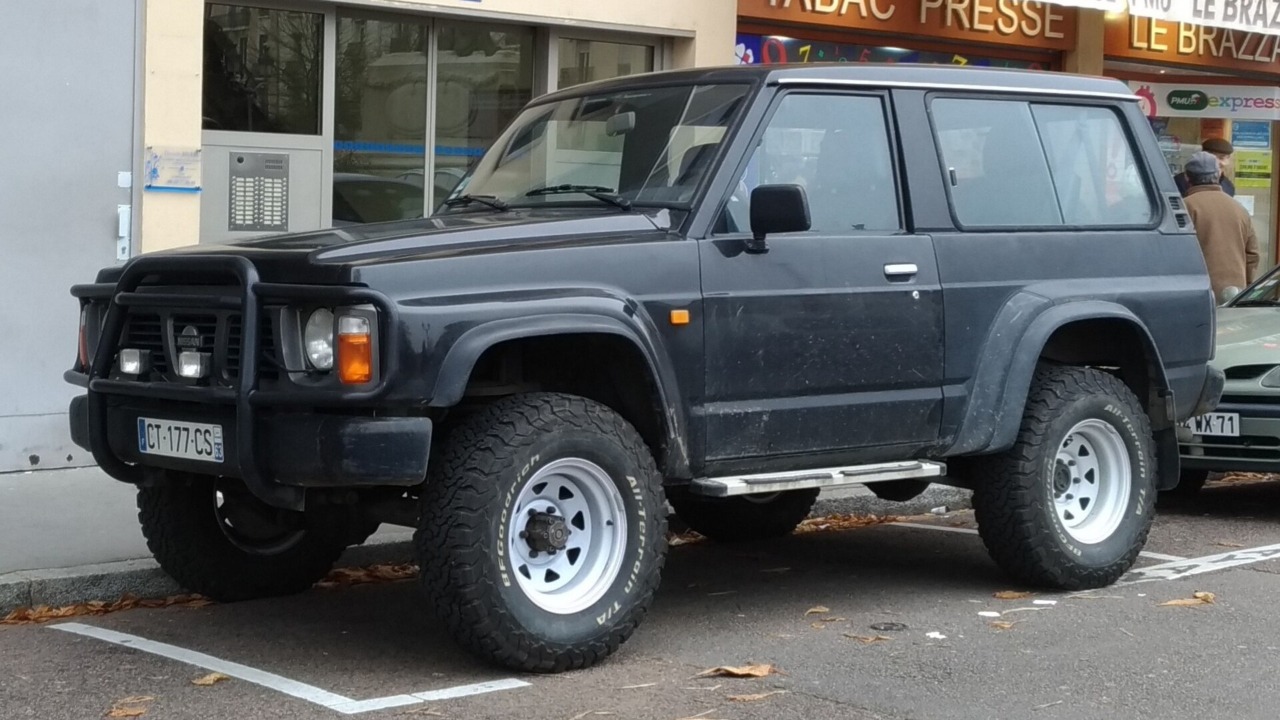
The Nissan Patrol turned 75 this year. Nissan calls it the company’s longest-serving nameplate, with seven generations and more than two million sold worldwide. That count includes Patrol-family models such as the Safari in Japan and the Armada in the U.S. A run that long takes more than good marketing. The Patrol built its name in the Australian outback, in Middle Eastern sand and on rally stages. Even so, not every version was flawless, and a couple of its engines had weak spots worth knowing about before you buy. So these are our picks: nine Patrol 4x4s, from the 1950s originals to the V8 Y62, that in our view rarely let anyone down. The verdict is our opinion. However, the years, engines and outputs come from Nissan’s own history and from Australian 4×4 references. 1. 1958 Nissan Patrol 4W61 Nissan’s first Patrol almost didn’t happen. Japan’s government asked Toyota and Nissan for a Jeep-style utility vehicle, and Toyota won the contract. Nissan went ahead anyway, and Practical Motoring’s history of the Patrol dates the first production 4W to September 1951. In fact, Nissan says a 4W-series truck climbed Mount Fuji that same year. The 4W61 followed in 1955 as the first real update. Its new 3.7-liter NB six made 92 PS, and later a 4.0-liter NC engine with 105 PS took over. Other changes included a one-piece windscreen and a wider passenger seat. Meanwhile, Practical Motoring notes that the early 4W trucks went to Russia and South America as well as Japanese buyers. Our take: the 4W61 belongs here because it set the recipe every later Patrol followed. You get a big, lazy six-cylinder in a plain body that asks for very little. As a result, there’s not much to break, and most of it can be fixed with basic tools. If you find one, treat it as a restoration project first. Parts hunting will take longer than the wrenching, so budget your patience along with your money. 2. 1970 Nissan 60 Series Patrol The second-generation Patrol arrived in October 1960 and stayed in production for two decades. Under the hood sat the P engine, a 3,956 cc overhead-valve inline-six. Nissan says the first big shipment went to Colombia, and then Australia and the U.S. followed in 1961. American buyers lost the Patrol name after 1969. Nissan is only now bringing it back, on the 2027 Armada Patrol PRO-4X. Australia is where the 60 Series made its name. In 1962, Reg Sprigg’s family crossed the Simpson Desert in one, averaging just 5 km/h, according to Practical Motoring. Nissan goes further and calls the Patrol the first motorized vehicle across the Simpson. By Nissan’s count, that trip covered more than 1,100 sand dunes in 12 days. That kind of story is why we rate a late-1960s or early-1970s 60 Series so highly. It has a big six, few electrics and a body that wasn’t designed to be clever. Instead, it was designed to get home. If you want one, look for a truck with its original P engine and a clear history. Then plan on a careful check of the floors and the chassis before anything else. 3. 1979 Nissan Patrol G60 soft-top Australians call the second generation the G60, and a 1979 soft-top is about as late as the breed got. Practical Motoring sums up its long run bluntly: it “didn’t change much over the years.” The headline updates were power-assisted front drum brakes and a third windscreen wiper. Early trucks used a three-speed gearbox with a two-speed transfer case and part-time four-wheel drive. Later ones got a four-speed. The design was simple enough for an army. In 1969, the Indian Army adopted a military version called the Jonga, as both Practical Motoring and Just4x4s record. Even the replacement leaned on the old truck. The 1980 G61 put G60 bodywork on the new MQ running gear, with a full-synchro four-speed and an improved engine. Why pick a soft-top from the final years? Because it’s the most developed version of the simplest Patrol, and the canvas roof keeps the weight and the complexity down. In our view, that’s the purest way to enjoy an old Patrol on a weekend trail. If you’re shopping, check the body for rust before you worry about the engine. Also, make sure the soft-top frame and its mounting points are all there, since those can be harder to replace than mechanical parts. 4. Nissan Patrol 160 The third-generation Patrol 160 launched in 1980, and Nissan says it brought five-door and seven-seat versions. Buyers could pick from the L28 and P40 petrol sixes or the SD33 diesel. In Japanese form, that 3,246 cc diesel six made 95 PS. Then, in 1983, the 160 got its first turbo-diesel engine. That same year, it became the first Nissan built in Europe, at the Barcelona plant. Competition did the rest. Nissan says the Patrol won the unmodified division of the Australian Off-Road Championship for 15 consecutive years from 1983. In 1987, the “Fanta Limon” Patrol 160 finished in the overall top ten at the Paris-Dakar Rally. Nissan calls it the first diesel-powered vehicle to do so. In Australia, this generation went by MQ, with leaf springs at both ends as standard. Just4x4s’ Patrol timeline adds that 1983 also brought a five-speed manual and front suspension upgrades. By 1986, power steering and the five-speed were standard. Our take: the leaf springs make for a firm ride, but they’re simple and easy to service. We’d hunt for a later, five-speed truck with the SD33 diesel if your trips are long and slow. 5. Nissan Patrol Y60 3-door The Y60 changed how the Patrol rode. Nissan launched it in 1987 as the first Patrol with coil-spring suspension. Just4x4s notes a five-link rear axle, rear disc brakes and vacuum-operated rear diff locks, too. Australians know this generation as the GQ, and the short three-door body is the version to find if you want a tight turning circle on narrow tracks. With the Y60, engine choice matters more than on most Patrols. The range included the TD42 diesel, the TB42 petrol, the RD28T turbo-diesel and the RB30 six. The 4.2-liter TD42 has a reputation for being very reliable, provided it gets proper cooling. By contrast, the RD28T and the TB42 could suffer head gasket problems when owners drove them with a heavy foot. Patrols of this era also have a name for strong axles. That’s why the Y60 earns its place, with one condition. In our view, a TD42 three-door is one of the safest old 4×4 buys around, and we’d rank it next to the vintage 4x4s tougher than modern SUVs we’ve covered before. Buyer advice: seek the TD42, then make the radiator and the cooling system your first inspection. If you’re looking at an RD28T or a TB42, ask for proof of a recent head gasket job. 6. 1988-1994 Ford Maverick (rebadged Nissan Patrol Y60) Here’s a Patrol that wore a blue oval. Ford Australia sold the Y60 as the Ford Maverick between 1988 and 1994. Just4x4s lists the Maverick as the GQ’s direct equivalent from 1988. When the next-generation Patrol arrived, Practical Motoring notes, the Maverick line didn’t continue with it. Underneath the badges, you get the same coil-sprung GQ layout described above. That means the five-link rear axle and the rear disc brakes. So the mechanical advice for the Patrol applies to the Maverick, too. Look for the diesel, check the cooling system and confirm what’s been done to the head gasket on the petrol and smaller diesel engines. So why list a Ford separately? Because it’s easy to miss. Shoppers who search only for “Patrol” will never see these, and that leaves more of them for anyone who knows the trick. Our take: a well-kept Maverick is a GQ Patrol with a different grille, and it deserves the same respect. It’s also a neat bit of Australian car history, from a time when Ford and Nissan shared products down under. If you want one, add “Ford Maverick 4×4” to your saved searches. 7. 1994 Nissan Patrol GQ Series II ST cab chassis The GQ got a meaningful update in 1992. Practical Motoring says the Series 2 brought a fuel-injected 4.2-liter engine, refined transmission and suspension, and bigger brakes and wheels. It also added standard limited-slip differentials, automatic freewheeling hubs and side intrusion bars. Then, from 1994, a coil-sprung Patrol ute joined the range. The ST cab chassis is the working end of that range. It’s the bare-bones working version, built to carry a tray and a load rather than a family. Just4x4s says the 1995 update was little more than a grille change. As the site puts it, “if it ain’t broke…” We rate the 1994 cab chassis because it combines late GQ updates with a body built for work. It’s the same idea that made the 1994 Toyota Land Cruiser such a durable rival. Our take: a tired tray is a cosmetic problem, while a tired chassis isn’t. So look under the tray first, and check the springs and mounts for the abuse a working life brings. A straight one with service records is worth paying more for. 8. 1999-2006 Nissan Patrol GU ST cab chassis The fifth-generation Y61, called the GU in Australia, first appeared in December 1997. Engines at launch included a 4.5-liter petrol and 2.8-, 3.0- and 4.2-liter turbo-diesels. From 1999, Practical Motoring says, the cab chassis came with the 4.2 diesel in turbo or non-turbo form, with leaf or coil rear springs. In 2000, the 3.0-liter ZD30 replaced the 2.8 with 116 kW and 354 Nm. The GU lasted remarkably well. Nissan says two Y61 Patrols completed the 15,000-mile “Long Way Down” expedition in 2007, from John O’Groats to Cape Town, with just one puncture. Production finally ended in 2024. Not every engine aged equally, though. The ZD30 had well-known troubles, and the 2005 facelift addressed them. Meanwhile, the 4.2 diesel was discontinued in 2007. Our pick from this group is a 4.2 diesel cab chassis built before that engine went away. In our view, it’s the GU that best carries the old Patrol formula into the modern era. Buyer advice: if you’re looking at a ZD30, favor a post-2005 truck and ask for a full service history. For the 4.2, a clean cooling system and steady oil changes are what you want to see. We’d call it one of the vintage 4x4s that will outlive us all in the making. 9. Nissan Patrol Y62 The sixth-generation Y62 launched in Abu Dhabi on 13 February 2010. It went petrol-only, with a 5.6-liter V8 rated at 400 hp in upper trims. When it reached Australia in 2013, Just4x4s gives the figures as 298 kW and 560 Nm, and Practical Motoring adds that 90 percent of the torque arrives from 1,600 rpm. Nissan also sold a version in the U.S. as the 2017 Armada, with 390 horsepower. It’s the most sophisticated Patrol of the lot. The Y62 uses four-wheel independent suspension with Hydraulic Body Motion Control, plus Nissan’s ALL MODE 4×4 system with sand, rock and snow settings. Many Australian owners held on to their diesel GUs after it arrived. So the V8 had to earn its spot, and it did. Our take: the Y62 is the best Nissan Patrol for long highway trips that end on sand. It’s also the one we’d pick if you’re towing something heavy. Buyer advice: budget for fuel, because a big V8 will always cost more to run than an old diesel. Nissan points to proof of its muscle, too. In 2013, a Y62 towed a 170.9-metric-ton aircraft 50 meters to set a Guinness World Record.

 Liked by Sarah Pelletier, Zoë Clark





 Liked by Sarah Pelletier, Zoë Clark