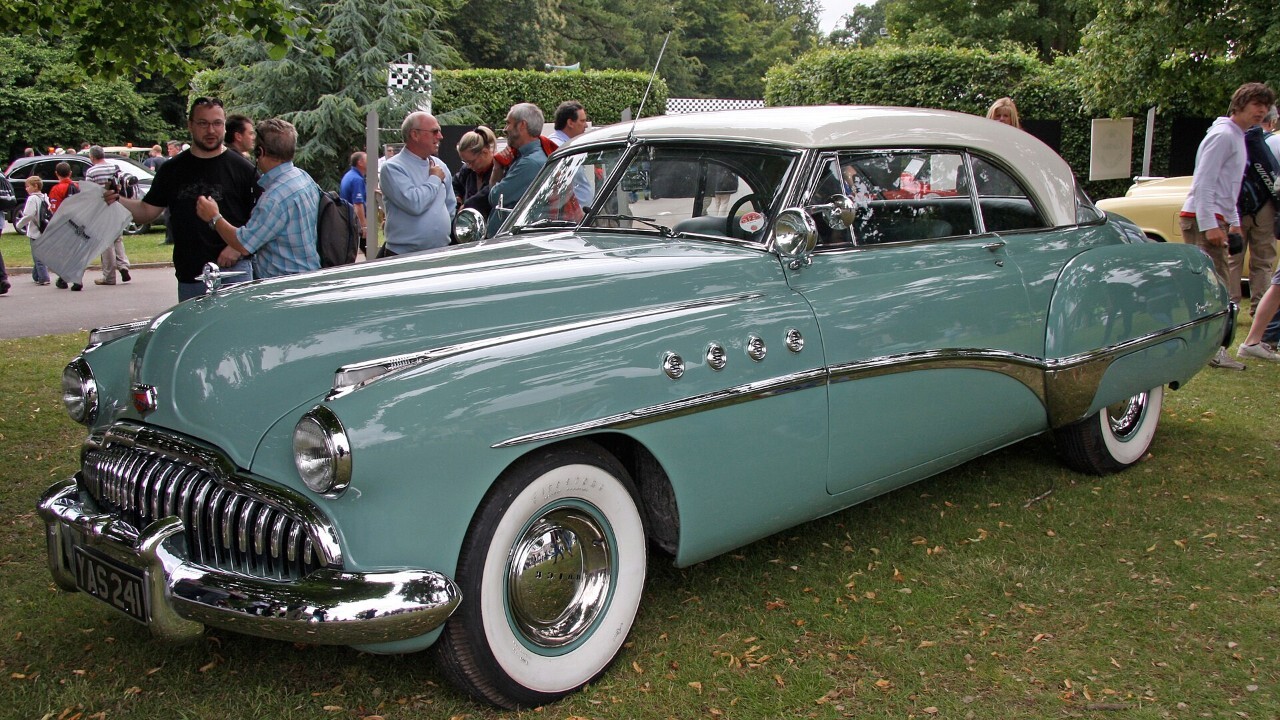
The 1958 Buick Limited stretched more than 227 inches from bumper to bumper, and its grille alone used 160 chrome squares. That was the chrome era in one car. Between 1955 and 1959, Detroit’s stylists piled on fins, two-tone paint, wraparound glass and bright trim as fast as the factories could stamp it. Many of those cars are now common sights at shows. A few, though, draw a crowd every single time they roll onto the grass. They have a gimmick, a story or a production run so small that most visitors have never seen one before. These are our picks: 12 vehicles from the late 1950s that we think stop people in their tracks at any car show. The years, engines and production figures come from the records, while the verdicts are our own opinion. Every one of them was built between 1955 and 1959. 1. 1958 Buick Limited Buick revived the Limited name for 1958 to mark General Motors’ 50th anniversary. It was a one-year halo car, and Buick had last used the name from 1936 to 1942. The timing had a clear target, too. Chrysler’s Forward Look styling had been luring luxury buyers toward the Imperial, and GM wanted them back. The 1958 Buick Limited came as a four-door hardtop, a two-door hardtop and a convertible. According to The Truth About Cars, the Limited used Buick’s 364-cubic-inch Nailhead V8 with up to 300 hp, paired with the Dynaflow automatic. The four-door hardtop started at $5,112, which put it above a Cadillac Series 62 four-door hardtop. As a result, Buick sold only 7,438 Limiteds that year, including 839 convertibles. Our take: few cars capture the excess of 1958 like the Buick Limited. The side trim carried 15 slashes in groups of five, and the overall length dwarfed most cars in the parking lot. In our view, that sheer scale is why the 1958 Buick Limited draws a crowd at every show. If you want one, budget heavily for brightwork, because replating that much chrome costs a fortune. 2. 1959 Edsel Corsair convertible The Edsel had a rough start in 1958, so Ford toned it down for 1959. The new grille used a finer bar pattern, and the controversial styling became calmer overall. At the same time, the Corsair became Edsel’s premium model, replacing the Citation. It now rode on the 1959 Ford Fairlane 500 platform with a 120-inch wheelbase. Ford also added a convertible to the Corsair range that year. However, the brand’s sales kept falling. Ford built just 1,343 Corsair convertibles for 1959, all for the U.S. market. That was only about 14% of the 9,318 Corsairs built that year. Prices had dropped by about 15% that year, yet buyers kept staying away. Then Ford dropped the Corsair after 1959, and the Edsel brand itself didn’t last much longer. In our view, the 1959 Corsair convertible is one of the best show cars from Ford’s most famous flop. People recognize the Edsel name, but few have seen an open one up close. That combination of notoriety and rarity always draws questions. If you want one, check that the trim pieces are complete, since Edsel-specific parts are scarce. 3. 1956 Dodge Custom Royal La Femme Dodge aimed the La Femme package squarely at women buyers in 1955 and 1956. The 1955 car came in Sapphire White and Heather Rose with a matching pink calfskin purse. For 1956, Dodge switched to Misty Orchid and Regal Orchid paint. It also dropped the purse but kept a matching raincoat, rain cap and umbrella. The cabin went just as far. According to Curbside Classic, the 1956 interior used white seat cloth with a lavender-and-purple loop pattern, a white headliner with gold flecks and matching loop carpet. Dodge also offered the more powerful D-500 engine that year. Even so, buyers didn’t bite. Fewer than 300 La Femmes left the factory over the two years, and Dodge offered no La Femme package at all for 1957. Our take: no car at a 1950s show starts more conversations. The color scheme, the accessories and the marketing story make it a rolling time capsule. If you find one, insist on documentation, because restorers can paint any Royal Lancer purple. A real La Femme with its accessories is a very different car from a tribute. 4. 1955 Pontiac Star Chief Custom Safari Pontiac developed the Safari alongside the Chevrolet Nomad, so the two share the same idea. Both were two-door sport wagons with sleek, hardtop-style rooflines. However, Pontiac gave its version its own Star Chief trim, its own grille and its own V8. Side by side, the two cars look like cousins rather than twins, and most people need a second glance to tell which is which. The Safari was expensive and exclusive. At launch in 1955, it cost $2,962, making it the most expensive Pontiac line before options. It was also the lowest-production Pontiac that year, with 3,760 built. Under the hood sat Pontiac’s 287-cubic-inch V8, rated at 180 hp with a two-barrel carburetor or 200 hp with a four-barrel. In our view, the Safari is the smart alternative to a Nomad. Nomads are everywhere at shows these days, while a Safari makes people stop and look twice at the badges. That surprise factor is half the fun. If you want one, check the tailgate and rear roof area for rust. Also, remember that Safari-specific trim is much harder to source than Chevrolet parts. 5. 1955 Chrysler New Yorker Deluxe hardtop Chrysler’s 1955 cars marked a sharp break from the tall, boxy designs that came before them. Virgil Exner led the redesign, borrowing cues from his 1952 Imperial Parade Phaeton show car. The result looked lower, longer and far more modern than anything Chrysler had sold in years. For a brand that had built its reputation on engineering rather than style, it was a huge shift. That year, every New Yorker carried the “DeLuxe” suffix. The two-door hardtop was the most stylish body in the range, with no B-pillar to break up the side glass. Meanwhile, the cabin held a new trick. For 1955, Chrysler moved the PowerFlite automatic’s control lever onto the instrument panel. Under the hood sat Chrysler’s Hemi V8, with its hemispherical combustion chambers. Our take: the 1955 New Yorker hardtop is one of the most underrated cars of the decade. It wears clean Exner lines without the wild fins that came later. In our view, that restraint makes it stand out at a modern show. If you want one, check that the Hemi is original. The engine is what makes the car special. 6. 1958 Plymouth Belvedere convertible Plymouth offered its convertible only in the top Belvedere line from 1956 to 1958, and only with a V8. No six-cylinder Belvedere convertible ever left the factory. By 1958, the Forward Look styling had grown its tall rear fins, which first appeared on Plymouths in 1956. Those fins gave even this mid-priced convertible a dramatic profile. Underneath, the Belvedere had real engineering to back up the looks. It used Chrysler’s Torsion-Aire torsion-bar front suspension, which every Chrysler product adopted from 1957. In addition, Plymouth offered the 350-cubic-inch “Golden Commando” V8 with dual four-barrel carburetors on all 1958 models. Buyers who wanted something milder could choose a 301-cubic-inch Fury V8 instead. The Fury name later became Plymouth’s top range for 1959. In our view, the 1958 Belvedere convertible is the best-value way to show up with full-size fins. It has the same Exner drama as costlier Chryslers, with a top that drops for summer cruising. If you want one, look for a car with the Golden Commando engine. Also, inspect the floors and rear quarters carefully, because rust repair on a 1958 body gets expensive fast. 7. 1957 Buick Century Caballero The Caballero Estate was Buick’s hardtop station wagon, offered only for 1957 and 1958. It took the wagon body and removed the fixed B-pillars, giving it the same open side view as a hardtop sedan. That made it one of the most stylish family cars of the decade. GM built hardtop wagons for other divisions as well, but the Buick version paired the idea with real muscle. Because it wore the Century badge, it also had serious performance. For 1957 and 1958, the Century topped out at 300 hp from a bored-out 364-cubic-inch V8. In other words, this wagon carried the same kind of engine as Buick’s flagship cars. Then, after just two seasons, Buick dropped the Caballero for 1959. Our take: the Caballero is a show-stopper because it breaks expectations. People expect a wagon to look practical, and instead they find a long, low, chrome-trimmed hardtop with a big V8. In our view, it outshines most sedans of the era. If you want one, check the roof seals and rear gate carefully, because a pillarless body depends on good weatherstripping. 8. 1956 Oldsmobile 98 Starfire The Starfire name started on a 1953 Motorama dream car, and Oldsmobile named it after the Lockheed F-94 Starfire jet fighter. That link to the jet age suited the brand perfectly, since Oldsmobile already called its V8 the Rocket. Oldsmobile then used the name on its top 98 convertibles from 1954 to 1956. For 1956, Oldsmobile reshaped the front end to look more like the original concept, with a large, wide grille. Automatic transmission also became standard that year, so every 1956 Starfire buyer got a self-shifting car. Previously, the 98 Starfire had sold well, with 9,149 built for 1955. So by 1956, it was already the convertible that well-off Oldsmobile buyers wanted. Our take: a 1956 Starfire tells the whole story of the era’s jet-age dreams. The name came from a fighter plane, the styling from a show car, and the buyers from America’s booming suburbs. In our view, a well-restored example draws a crowd because it looks so confident. If you want one, check the convertible top mechanism and all the chrome trim. Both cost serious money to restore. 9. 1957 Chevrolet One-Fifty The One-Fifty was the plainest 1957 Chevrolet you could buy. Chevrolet aimed it at fleets and budget buyers, so it came with limited options and simple trim. It was also the last year of the One-Fifty name before the Delray replaced it. Most buyers chose sedans, though Chevrolet also sold a two-door Handyman wagon in the range. Yet the One-Fifty had a secret. Chevrolet’s full engine list for 1957 ran from a 140 hp six to a 283-cubic-inch V8 with Rochester Ram-Jet fuel injection, rated at 283 hp. In theory, buyers of the cheapest model could order those bigger V8s too. Meanwhile, a race-ready version, often called the “Black Widow,” carried black-and-white paint, heavy-duty brakes, six-lug wheels and dual shock absorbers. In our view, a One-Fifty steals attention at shows because it is the opposite of the usual Bel Air. It has less chrome, fewer gadgets and a no-nonsense attitude. Chevrolet built about 75,000 two-door sedans that year. If you want one, decide early between a stock restoration and a sleeper build, because both have devoted fans. 10. 1957 Imperial Crown Southampton Chrysler made Imperial a separate make in 1955 to take on Cadillac and Lincoln. Then, for 1957, Virgil Exner’s Forward Look styling went even further on the Imperial. The car became longer, lower and more dramatic, and buyers loved it. Tall fins and that new curved glass made it impossible to mistake for a Cadillac, which was exactly what Chrysler wanted. In fact, 1957 became the best-selling year Imperial ever had, with 37,593 cars produced. The Crown was the mid-range trim, and Southampton meant a pillarless hardtop, in two- or four-door form. Imperial was also the first U.S. production car to use curved side glass. Under the hood, the 392-cubic-inch Hemi was standard for 1957, along with Chrysler’s Torsion-Aire suspension. Our take: a 1957 Imperial looks bigger and stranger than people expect, and that is why it draws a crowd. The four-door Southampton shows off the curved glass and pillarless profile best. In our view, it is the most dramatic luxury car of 1957. If you want one, inspect the lower body closely, and look for a complete set of its unique trim. 11. 1956 Packard Executive Packard introduced the Executive on March 5, 1956, to fill a price gap between its senior Patrician and the newly separate Clipper line. It was a clever piece of parts-bin engineering, aimed at buyers who wanted a Packard badge without paying senior Packard prices. Packard combined the Clipper Custom’s body and tail lights with the front-end parts of the senior Packards. Power came from Packard’s 352-cubic-inch V8, rated at 275 hp. However, the timing was terrible. The Executive had only a shortened model year, from March to June. Packard built only 2,779 of them, made up of 1,031 two-door hardtops and 1,748 four-door sedans. Then, on June 25, 1956, all Detroit production of Packard and Clipper cars ended when the Conner Avenue plant closed. In our view, the Executive draws people at shows because of what it represents. It was one of the very last cars Packard built in Detroit before the company’s decline. That makes it a rolling piece of history. If you want one, prepare to hunt through the Packard club community for trim and parts. 12. 1959 Ford Galaxie Skyliner Ford called it the “Hide-Away Hardtop.” At the push of a button, the Skyliner’s steel roof folded at the front and disappeared beneath the rear deck lid. Ford built the system around electric motors rather than hydraulics, using six motors on 1959 models, plus four lift jacks, ten limit switches, ten solenoids and 610 feet of wiring. Early in 1959, the Skyliner joined the new Galaxie series, so these cars wore both Fairlane 500 and Galaxie badges. The standard engine was a 292-cubic-inch V8 rated at 200 hp. However, the folding roof filled almost the entire trunk when lowered, which hurt sales. Ford built 12,915 Skyliners in 1959, the last of three model years, down from 20,766 in 1957. Our take: we think no car on this list draws a bigger crowd than a Skyliner putting on its show. In our view, watching that steel roof fold away is the best free entertainment at any show. If you want one, have a specialist check every motor and switch before you buy. Ford built 48,394 Skyliners from 1957 to 1959.

 Liked by Connor Carter, Annabelle Scott
 Liked by Connor Carter, Annabelle Scott