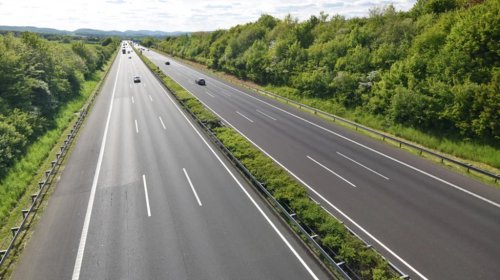
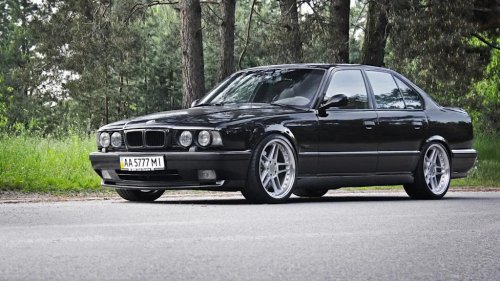
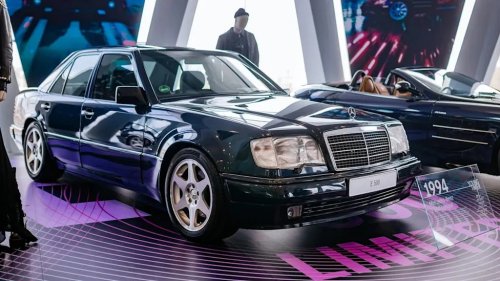
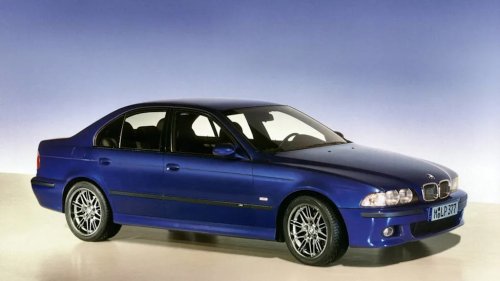
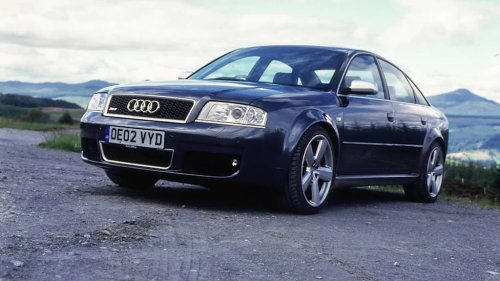
Autoblog and Yahoo may earn commission from links in this article.When Germany turned horsepower into a national competitionIt wasn't too long ago that three of Germany's biggest luxury automakers were deep in an engineering arms race almost exclusively emphasizing sedan horsepower. This horsepower war, centering on BMW, Mercedes-Benz, and Audi, gained momentum in the late 1980s, accelerated into the 1990s, and lasted through the early 2000s. These manufacturers continually one-upped each other with better technology and higher speeds, with the Autobahn being an ideal testing ground. The goal of capturing global markets drove each brand, and storied motorsport histories furthered rivalries. Let's take a closer look at four of the vehicles defining Germany's horsepower war, starting with one of the earliest major shots fired.GettyBMW M5 (E34) (1988 to 1995) It's only natural that we'd start with engine and horsepower when evaluating the BMW M5 (E34), which marked the manufacturer's next leap in the super sedan segment. The model started with a 3.6-liter inline-six in 1988, delivering 311 to 315 horsepower, but for the 1992 model year, it received a 3.8-liter inline-six, increasing horsepower to 340. These specs made it the biggest six-cylinder engine ever built by BMW at the time. It's no surprise that the E34 M5's engine was an evolution of the M88 straight-six in BMW's M1 supercar, and that lineage was already established in the first M5, the E28 (1982 to 1988 model years), which used the M88/3. The E34 evolved past the E28 with a forged crankshaft, revised compression (starting with the 1992 engine upgrade), and equal-length exhaust manifolds. Each E34 was hand-assembled at BMW's M GmbH facility in Garching outside of Munich, and the automaker only produced 2,676 left-hand-drive 3.8-liter European units. The BMW M5 E34 ultimately raised the benchmark for executive sedan performance, and with a title like being the most powerful series sedan in Germany, Mercedes-Benz had to respond.AdvertisementAdvertisementRelated: Sedan vs Coupe: The Difference Is Not As Simple As It Used To BeMercedes-BenzMercedes-Benz 500 E (1991 to 1995)The Mercedes-Benz 500 E was born out of a collaboration with Porsche. In 1988, Daimler-Benz AG commissioned Porsche to design the lightning-fast touring saloon. Core requirements included the vehicle having the 500 SL's five-liter V8 four-valve engine. Michael Hölscher, Project Manager Development for Porsche during the 500 E's development, described the vehicle: "Thirty years ago, I drove to Lake Constance with three colleagues. We spent the entire trip talking to each other. At one point, one of them looked at the speedometer and had quite a shock when he realized the needle was showing 250 km/h. We had tuned the chassis, brakes and engine to perfection."Despite its understated "sleeper" appearance, the 500 E could jump from 0 to 62 mph in 6.1 seconds (depending on the model year) with its 321-horsepower, 5.0-liter, naturally aspirated, 32-valve V8 engine. Mercedes-Benz supplied body parts, and Porsche assembled the body using these components, along with in-house parts. The 500 E didn't just give BMW a run for its money during the early-1990s portion of Germany's horsepower wars; it also saved Porsche from a severe financial crisis in the late 1980s stemming from declining sales in major export markets like Japan and the United States.Need new tires? Save up to 30% at Tire RackFind the perfect tires for your exact vehicle and driving style. Click here to shop all top-tier brands, including Michelin, Bridgestone, and more, directly at Tire Rack.BMWBMW M5 (E39) (1998 to 2003) BMW fired back at Mercedes-Benz in a major way in the late 1990s with what enthusiasts often view as the defining M5: the E39. Like any German horsepower war staple, the M5 E39's appeal was primarily rooted in its engine, and BMW took a significant risk by dropping the previous M5's 7,200 rpm straight-six. However, this risk paid off, as the M5 E39's 4.9-liter V8 increased low-end torque for more effortless acceleration. This dynamic was complemented by a robust 394 horsepower, a 7,000 rpm redline, and other enthusiast favorites such as a six-speed manual and a limited-slip differential. BMW also took a page out of the Mercedes-Benz 500 E's playbook by giving the E39 more of a balance between luxury and performance. In contrast, the E34 leaned more toward being an analog-heavy sports sedan. BMW rivals knew the sedan bar had once again been raised.Thinking about selling your car? Get an instant cash offer online now. Click here to get started.AudiAudi RS 6 (C5) (2002 to 2004) The RS 6 C5 is considered Audi's definitive entry into the super-sedan market. Under the hood was a 4.2-liter, 40-valve, twin-turbocharged V8 packing a serious punch with 444 horsepower in its standard version. The RS 6 Avant Plus generated even more thrills via 473 hp. Audi achieved this horsepower increase by adding two additional radiators behind the side-mounted intercoolers and remapping the engine control unit (ECU). Drivers also received standard quattro all-wheel drive. Audi's splash in the German horsepower wars pushed rivals into forced induction and V10s if they hoped to keep up. For example, models like Mercedes-Benz's E55 AMG W211 (2003 to 2006) ditched a naturally aspirated engine in favor of a 5.4-liter supercharged V8 engine boasting 469 horsepower.Shopping for a new car? Click here to get a great deal on your next vehicle. Powered by Carvana, no haggle pricing, 100% online.Final thoughtsThroughout the late 1980s, 1990s, and early 2000s, BMW, Mercedes-Benz, and Audi continually forced one another to raise the sedan performance bar. As rivalries progressed, so did engines, chassis engineering, and suspension tuning. Direct descendants of Germany's horsepower wars include, but aren't limited to, Mercedes-AMG's E 63, Audi's RS 6 Avant, and Audi's RS 7. Head over to Road Ethos to get the latest on what's going on with new German performance sedans like Audi's third-generation RS 7.AdvertisementAdvertisementRelated: The 7 Best BMW Models of the 21st CenturyThis story was originally published by Autoblog on Jun 30, 2026, where it first appeared in the Features section. Add Autoblog as a Preferred Source by clicking here.

















 +14 others