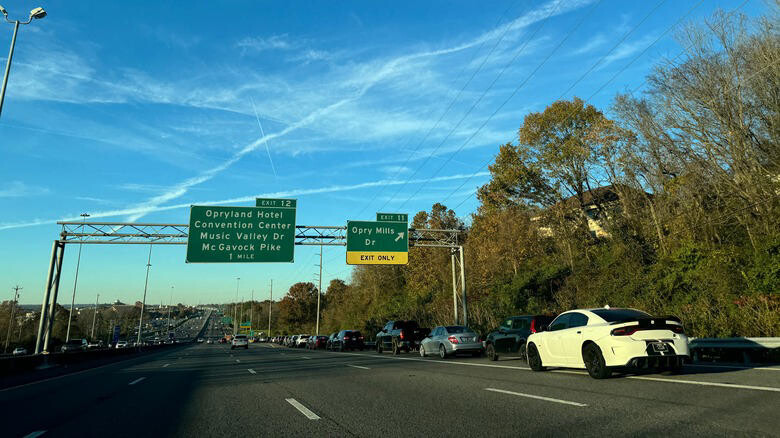
Nevada – 1.5 deaths per 100 million milesWhile it isn't subject to quite as many deaths per 100 million miles as the very worst-ranked states in America, Nevada's fatality rate is still significantly above the national average, at 1.50 per 100 million miles. According to the report, car occupants made up only 28% of reported fatalities in 2022, while pickup and SUV occupants made up 22%. A further 21% of reported fatalities were motorcyclists, with Nevada being one of only five states in the country where motorcyclists accounted for 20% or more of the total reported figure. Another 20% of Nevada's road fatalities were pedestrians, while 4% were bicyclists. Just 2% of fatalities were occupants of a large truck.Urban areas in Nevada see significantly higher fatality levels than rural areas, with 70% of fatalities taking place on urban roads. Nevada's authorities are aware of the state's higher than average rate of fatalities, and implemented a new version of its Strategic Highway Safety Plan (SHSP) in 2021. According to its website, the plan aims to focus on eight key areas of road safety, including cracking down on speeding and impaired driving, boosting awareness of motorcycle safety, and improving roads for pedestrians.Alaska – 1.5 deaths per 100 million milesAt first glance, Alaska's road fatality figures seem less problematic than many of the other states in the report. Just 82 deaths were recorded on the state's roads in 2022, a stark contrast to the 4,428 deaths reported in California, the highest number in the country. However, Alaska's small population means that, per 100 million vehicle miles travelled, its fatality rate is still among the worst in the country. In fact, it's worse than California, which averaged 1.4 deaths per 100 million vehicle miles travelled.67% of fatalities were recorded as the occupants of cars, pickups, and SUVs, with that figure accounting for both drivers and passengers. Motorcyclists and pedestrians made up a relatively small percentage of deaths compared to national levels, comprising 10% and 16%, respectively. Over half of the state's fatal crashes were recorded as being multiple-vehicle crashes, and despite Alaska's limited urban area, 50% of fatal crashes took place on urban roads.Texas – 1.52 deaths per 100 million milesTexas, the second most populous state in America with over 30 million residents, also has one of the highest annual road fatality rates in the country. According to the report, 4,408 fatalities were recorded in Texas in 2022, giving the state an overall death rate of 1.52 deaths per 100 million vehicle miles travelled. Fatalities were nearly evenly divided between single-vehicle and multi-vehicle collisions, with almost two-thirds of fatal crashes occurring on urban roads.A recent safety campaign by the Texas Department of Transportation highlighted the state's fatality rate, noting that at least one person had died on Texan roads every single day since Nov. 7, 2000. One particular area of concern for the campaign is drunk driving, with the IIHS report estimating that 38% of all fatal collisions involved a driver proven to be impaired.Tennessee – 1.58 deaths per 100 million milesSeveral cities in Tennessee have taken an unusual approach to tackling speeding, encouraging drivers to pay attention to speed limit signs by enforcing unusual limits on certain roads. For example, Opry Mills Drive in Nashville sports a 24 mph speed limit sign, while other towns feature a 31 mph or 19 mph speed limit. That hasn't stopped Tennessee from having one of the highest road fatality rates in the country, at 1.58 deaths per 100 million vehicle miles driven.Two-thirds of fatal crashes in Tennessee involve occupants traveling in a car, pickup, or SUV, while 12% of crashes result in a motorcyclist losing their life. The state is also a relatively dangerous place for pedestrians, with 210 pedestrians killed in 2022, around 16% of the overall tally. A total of 50% of fatally injured vehicle occupants were not wearing a seat belt, despite high levels of seat belt use observed overall across the state.Oklahoma – 1.59 deaths per 100 million milesOklahoma is another state where the majority of fatal crashes occur on rural roads, although not to as large a degree as Montana. According to the report, 59% of fatal crashes in Oklahoma occurred in rural areas, while 41% occurred in urban areas. The Oklahoma Highway Safety Office manages the state's fatality reduction program, and its latest report placed the blame on young drivers for the higher road fatality rate. According to the report, teenage drivers are over-represented in the state's crash and death statistics. In particular, the report claimed Native American teens were far more likely to die in a road accident, noting that more needed to be done to engage with local communities on the best way to promote road safety. The report acknowledged that pedestrian fatalities were forecast to increase and highlighted the absence of effective fatality reduction programs at this time. Delaware – 1.64 deaths per 100 million milesMany of the most dangerous states for road users see higher levels of vehicle occupants who don't wear seatbelts properly, but Delaware bucks the trend. Across the state, 60% of vehicle occupant fatalities recorded in the report were correctly restrained in their vehicles, the highest rate in the country. However, this does not indicate a lower overall road fatality rate; Delaware experience 1.64 deaths per 100 million miles in 2022, the seventh worst in the nation. Delaware's fatal accidents are split 50/50 between rural and urban roads, and 24% of recorded fatalities involved a driver that was over the drunk driving limit. The latter figure is among the lowest of any state. In September 2024, the Delaware Office of Highway Safety announced a new program to improve road safety, particularly targeting speeders and those who drive under the influence of alcohol or drugs. As well as tougher enforcement, the program also aims to spread awareness through ads in bars, restaurants, and education centers.Arizona – 1.71 deaths per 100 million milesWith an unusually high level of pedestrian deaths and almost two-thirds of fatal crashes occurring in urban areas, Arizona's cities fare particularly poorly for road safety. The state overall had a fatality rate in 2022 of 1.71 deaths per 100 million vehicle miles travelled, being only one of four states to average 1.7 or higher. In October 2024, the state's Department of Transportation published a plan aimed at reducing the number of deaths and serious injuries on the roads, with several key areas cited for improvement.Those areas included road planning, with the state aiming to make future road projects more inclusive of pedestrians and cyclists. In particular, state highways were noted as a source of concern, with "location-specific projects" recommended to make it easier for road users on foot or bicycle to navigate larger, busier roads. The plan aims to reduce life-altering crashes by 20% by 2030 — a modest goal given that traffic fatalities have increased by 55% since 2013, according to the same report.New Mexico – 1.74 deaths per 100 million milesAcross all road users, New Mexico sees relatively high levels of seat belt usage according to the report. Around 90% of drivers are observed as following seat belt rules correctly, and those that don't are overrepresented in fatality data. A reported 51% of fatally injured vehicle occupants were not correctly restrained, while 41% were properly restrained. In the remaining 8% of fatalities, restraint was unknown.Drivers involved in fatal crashes in New Mexico also had high average levels of alcohol in their system, with 38% of those drivers reported to be over the legal limit. Most deaths involved the occupants of a car, pickup, or SUV, but 20% of recorded deaths were pedestrians. A total of 3% of deaths were recorded as occupants of large trucks, while bicyclist deaths remained very low, comprising only 1% of fatalities. Motorcyclists made up the remaining 12%.