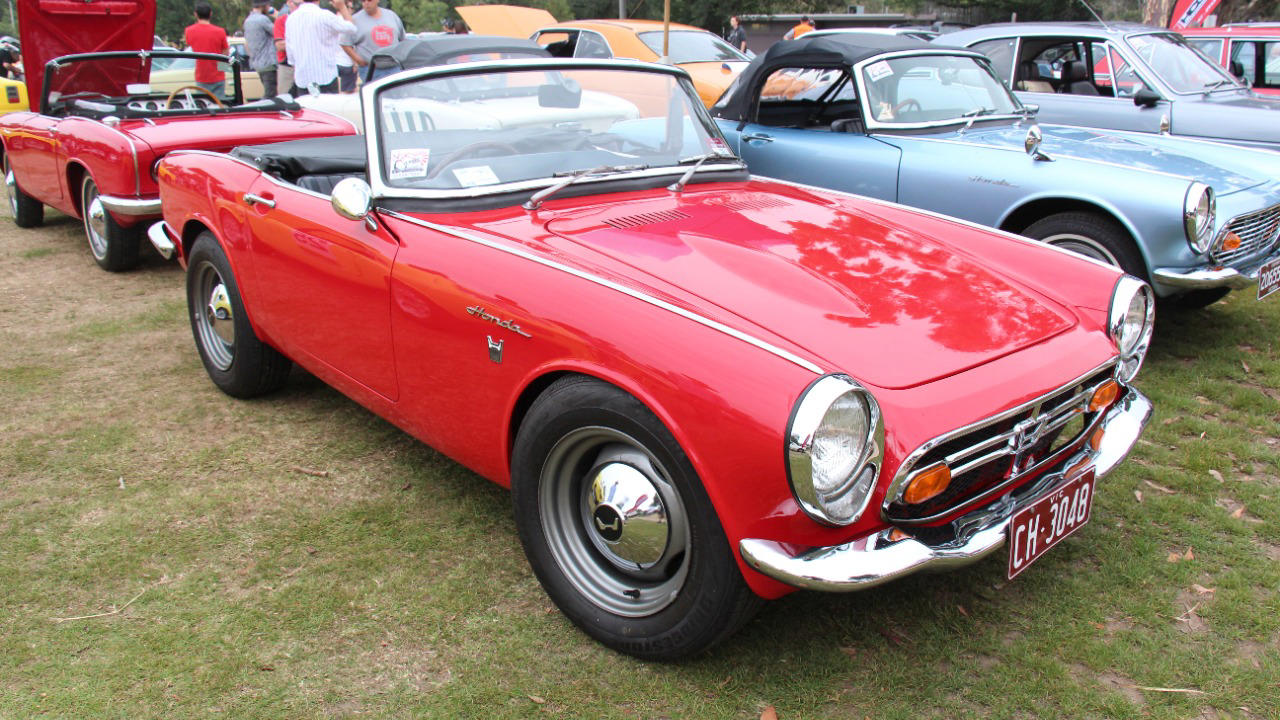



















Small but capable the 1967 Honda S800 proved high revs matteredHonda’s first serious sports cars were tiny, fragile-looking machines that behaved like racing bikes with number plates. Among them, the 1967 Honda S800 marked the moment the company proved that small capacity and sky-high revs could beat bigger engines on character and, often, on speed. Light, tightly packaged and obsessed with the redline, it showed that engine speed could matter more than engine size. When people talk about high-revving Hondas today, they usually jump straight to VTEC icons or the S2000. The S800 quietly laid that groundwork decades earlier, wrapping serious engineering in a modest footprint that still feels startlingly modern in spirit. The last and wildest of Honda’s early S cars The Honda S800 arrived as the third step in a short but intense series of sports cars that began with the S360 prototype, continued with the S500 and S600, then reached maturity with the 800 cc model. According to Honda S800 records, the car was offered as both a roadster and a coupe and carried over the advanced thinking of its predecessors rather than watering it down for volume. This meant a tiny inline four with motorcycle roots, a highly stressed valvetrain and a willingness to spin far beyond what European rivals of the time attempted. The S800’s displacement climbed to 800 cc, a modest figure on paper, yet the character of the engine mattered more than the capacity. The car’s layout and styling stayed compact and simple, but under the skin Honda treated it as a showcase of what careful engineering could do with very little metal. Production of the S800 tailed off toward the end of the 1960s, with final United Kingdom sales continuing into 1970 according to Production records from the Honda S800 Sports Car Club. By then, the template was set: Honda could build a sports car that felt precise and sophisticated without relying on brute force. A tiny engine with race bike manners At the heart of the S800 sat an alloy inline four that behaved less like a conventional car engine and more like a racing motorcycle unit. A detailed look at a competition version describes how the alloy engine had a swept capacity of 791 cc, a roller bearing crankshaft and an appetite for revs that bordered on the extreme for a road car of its time, as outlined in a feature on a rare Nov racing S800. Contemporary driving impressions repeatedly highlight that hunger for revs. Modern testers who have driven well-kept examples talk about how the little four pulls cleanly to a five-figure redline, with some road tests describing the unit spinning to around 10,000 rpm and others pointing to an even more optimistic tachometer. One video review of a 1967 car refers to it as the S2000’s grandfather and notes that it revs to 10,000 rpm, a figure that would still be impressive on a modern sports car, never mind a small 1960s roadster. Another clip from a social media reel celebrating a restored S800 mentions a redline at 8,500 rpm, reinforcing how central engine speed is to the car’s identity. The exact number depends on the specific car, tune and how brave the driver feels, but the pattern is clear. Honda built this engine to live at the top of the rev range. Why high revs mattered more than displacement Honda’s decision to chase rpm rather than cubic inches was not a marketing quirk. It came from the company’s deep experience in motorcycles and early Formula One projects. One period racing car, the RA271, used a 1.5-liter V-12 mounted transversely, a configuration that made clear how comfortable Honda’s engineers were with complex, high-speed engines. That mindset filtered directly into the S series. A detailed retrospective on the origin of high-revving Hondas explains that the move to an 800 cc inline four in the S800 marked a major step in the company’s pursuit of power through revs rather than through sheer size. Higher engine speed allowed the modestly sized unit to breathe and produce power that surprised drivers used to larger European fours and sixes. Modern commentators who have driven the car describe how the S800 only truly wakes up once the needle sweeps past the mid-range. One enthusiast video that revisits the car’s legacy argues that Honda’s obsession with revs did not begin with the S2000, the Integra Type R or VTEC, but in the 1960s with cars like this Honda S800. The idea was simple: if the engine could safely spin faster, it could make more power without adding weight. Driving experience: light, sharp and noisy Contemporary road tests and modern video reviews paint a consistent picture of what a 1967 S800 feels like on the road. One detailed review of a classic Japanese roadster shows the presenter climbing into a tiny cabin, turning the key and watching the tachometer leap eagerly toward its upper range while he talks through the car’s history in a Jun video review. The soundtrack is thin but intense, rising to a high-pitched wail as the car accelerates. A separate modern test of a 1960s S800, filmed from behind the wheel, emphasizes just how frantic the little car feels when driven hard. The host describes it as a tiny 1960s sports car that can spin to 11,000 rpm, while the footage shows the tachometer sweeping past five, six and seven thousand with ease in a Driving review. The car looks busy on modern roads yet never overwhelmed, helped by its light weight and narrow track. Print and online testers echo those impressions. A feature that calls the S800 coupe a tiny bundle of outrageous energy describes how the car’s small footprint and screaming engine combine to create a sense of speed that is out of proportion to the actual numbers, while also noting the link to earlier projects like the RA271 Formula One car. Another review of a roadster variant on social media calls it a charming blend of precision engineering and spirited driving, highlighting how the S800 marked Honda’s transition from motorcycles to cars in a Honda Roadster feature. Period-style live axle handling and a short wheelbase keep the driver busy, but the car rewards smooth inputs. Enthusiasts who have raced them in vintage events describe the S800 as a giant killer that can humiliate larger, more powerful cars, as one listing for a Vintage Race Roadster puts it. The combination of revs, lightness and balance makes the most of modest power. From obscure roadster to ancestor of the S2000 For years, the S800 lived in the shadow of later Honda sports cars. That has started to change as enthusiasts trace the company’s high-revving philosophy back to its roots. Several modern reviews explicitly describe the 1967 S800 as the S2000’s grandfather, pointing to the way both cars rely on small-displacement, high-rpm engines and tightly focused chassis tuning, as seen in coverage that compares the S800 to a modern Ford Fiesta in Britain in terms of price. One detailed buyer’s guide argues that there is a common misconception that the Mazda MX-5 was the first truly successful Japanese take on the classic roadster formula. In reality, Honda had already explored that template with the S series, and the guide’s Honda Overview stresses how the S800 offered a Japanese spin on European-style sports cars decades earlier. It was small, light and relatively affordable, yet packed with engineering that would not have looked out of place on a race grid. Video essays that look at how the S800 laid the foundation for Honda sports cars today make the same point in visual form. One such piece walks through the car’s design, engine and legacy, arguing that this is how the S800 laid the groundwork for later icons. By the time the S2000 arrived with its own stratospheric redline and compact footprint, Honda already had decades of experience building small, high-revving sports cars for the road. How it stacked up against Europe and America In the late 1960s, the sports car market was dominated by European brands and, in the United States, by larger domestic machines. Against that backdrop, the S800 looked almost toy-like. Yet on a twisty road or tight circuit, it could embarrass bigger rivals. A feature that revisits a 1967 S800 in a modern context points out that in Britain, the price of a good example roughly matched that of a new Ford Fiesta, inviting readers to consider whether a modern hatchback can really offer the same sense of mechanical drama. Another retrospective video frames the S800 as part of the moment when Japan beat Europe and terrified American manufacturers. The host explains that Honda’s obsession with revs did not start with later performance models like the Integra Type R or with VTEC, but with 1960s sports cars that made power through engine speed. Against softly tuned British roadsters and torquey American sixes, the S800’s willingness to spin to five figures felt like something from a different category. Even in coupe form, the S800 weighed far less than many European competitors, which helped offset its modest power output. A social media post about a featherweight 1969 S800 MK2 coupe describes it as a diminutive Japanese sports car that achieved a remarkable engineering feat. That combination of lightness and revs let the S800 punch above its weight class in period and continues to charm modern drivers. Survivors, restorations and the modern cult Half a century on, surviving S800s are rare, but the cars that remain often receive obsessive care. A detailed restoration of a 1969 MK2 coupe highlights how much work is required to bring one back to as-new condition, from rebuilding the tiny four-cylinder to refreshing the delicate chassis, as seen in coverage of a Coupe Few that returned to the road after a fresh restoration. Clubs and online communities keep the knowledge base alive. The Honda S800 Sports Car Club maintains archives on the history of the S type, documenting how Honda adapted and changed its sports car formula through the 1960s. Enthusiasts share tips on sourcing parts, tuning the delicate engine and preserving original details, from dashboard switchgear to period-correct wheels. On social media, owners celebrate their cars with short clips that show the tachometer sweeping toward that famous redline. One reel invites viewers to bring the past back to life with a redline at 8,500 rpm, featuring a pint-sized Let Honda S800. The message is clear: this is not a static museum piece, but a machine meant to be driven hard. Why the S800 still matters In an era of turbocharged torque and quiet cabins, the idea of a sub-1.0-liter engine that needs to be worked to the limit might seem quaint. Yet the S800’s legacy runs deeper than nostalgia. It proved that careful engineering could let a small engine deliver big thrills, and it set the tone for decades of high-revving Hondas that followed. More from Fast Lane Only Unboxing the WWII Jeep in a Crate 15 rare Chevys collectors are quietly buying 10 underrated V8s still worth hunting down Police notice this before you even roll window down