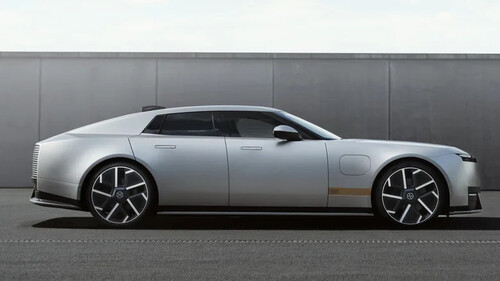
Rolls-Royce got the jump on the rest of the car market with the launch of the Spectre in 2023. The British ultraluxury maker was the first to build a two-door, four-seat EV coupe, and nearly four years later it still exists in a segment of one. For 2027, the Spectre is being given a modest set of revisions and a Series II suffix, meaning Rolls has managed to facelift its pioneering electric coupe before competitors have managed to even get off the line.
Buying a Spectre is both simple and hugely complex. The range is split between the regular Spectre and the more powerful Black Badge version. Beyond that, the vast range of options and bespoke trim and material possibilities makes for choices that are close to limitless.
The Lowdown:
The two variants share powertrain hardware, but the Black Badge gets a more dynamic tune for its adaptive suspension and a boost in performance for the dual-motor, all-wheel-drive powertrain. With up to 670 horsepower and 811 lb-ft of torque, increases of 20 hp and 18 lb-ft over the pre-facelift version, the Black Badge Spectre becomes the most powerful factory-built Rolls-Royce car to date. The standard Spectre has a lesser 592-hp power rating but the same torque peak.
A revised battery pack with 112.4 kWh of usable capacity will move the EPA range over 300 miles. The Spectre’s 195-kW peak DC charging speed has become unexceptional by the standards of newer EVs, but Rolls-Royce says that few owners actually recharge away from home. For those that do, there’s a new NACS charging port, allowing use of Tesla Superchargers and other compatible stations.
Our expert editors test every vehicle we review. Read more about how we test and review cars here.
- Vehicle Tested: 2027 Rolls-Royce Black Badge Spectre Series II
- Base Price: $468,749
- Price as Tested: $TBC
- Location: Stockholm, Sweden
How Does It Drive?
Electrification is well matched to Rolls-Royce’s historic mission to combine what the brand used to term adequate performance with minimal disruption. The Black Badge easily over-delivers on the first half of that equation, and during my drive in Sweden it felt barely less refined than the standard Spectre.
The Series II has the effortless pace common to punchier EVs, even with a peak output well short of some alternatives. The cheaper Bentley Torcal EV will be more powerful in its base 809-hp configuration than the range-topping Black Badge Spectre, and many cars in this part of the market now boast nominal four-figure power outputs.
No matter, with no transmission delays and almost instantaneous responses, the Black Badge gathered pace at a rate just short of delivering the physical discomfort that comes with an aggressive launch of a really fast EV. In the switchable Infinity mode, the Black Badge is claimed to be capable of dispatching the 0-to-60-mph benchmark in just 4.1 seconds. Which is plenty quick enough for anything wearing a Rolls-Royce badge.
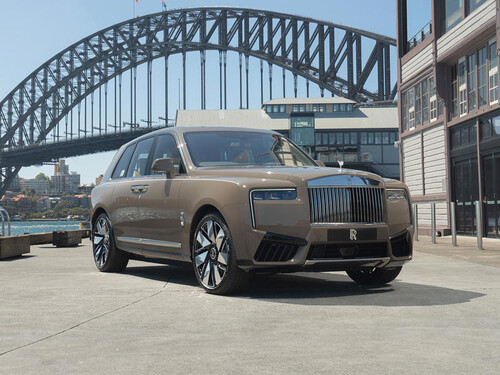
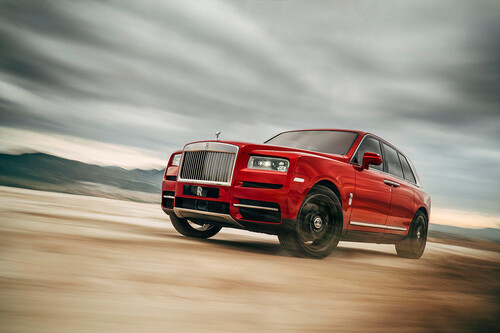
Another brand attribute is the magical ability to turn weight from a bug into a feature, and that holds true in the Spectre. Although it tips the scales—and maybe bends the needle—at a hefty 6450 pounds on the company’s official figure, the delta between that and Rolls’s V-12-powered cars is not especially large; the Cullinan SUV is over 6000 pounds. The Black Badge rode over bumps and undulations with imperious disdain thanks to the combination of pliant air springs and active dampers, as well as an electric anti-roll system fighting lean when cornering. The mass felt obvious when asking the Black Badge to change direction, but the steering was accurate and grip levels sufficient for hustling the big car at atypical Rolls-Royce velocities.
Attempts to give the Black Badge a different character than the standard Spectre have yielded mixed results. Heavier steering felt less natural than the more generously assisted rack of the standard car, and in both versions the steering wheel rim felt too thick, especially when compared to my memories of the Phantom VII’s narrow-rimmed wheel and its finger-light assistance.
On the plus side, the Black Badge’s accelerator calibration was better than the regular Spectre’s, which suffered nonlinear responses presumably intended to help with smoothness. It also had less regenerative braking in its regular Drive mode, which felt more natural than the standard car’s treacly off-throttle reactions. A single-pedal “B” mode can also be selected with a button on the column-mounted gearshift wand, but this lacks the ultimate stopping smoothness of the new “invisible stop” system that BMW has introduced on the iX3. That was also true for the adaptive cruise function, which reacted late and with less finesse than better, more modern systems.
But one advantage of the Spectre’s lack of cutting-edge features is a focused purpose. This isn’t an EV trying to be a Rolls-Royce so much as a Rolls-Royce that happens to be an EV; beyond the lack of the engaging V-12 soundtrack of the brand’s other cars, the driving experience is close to identical. Other than the Black Badge’s Infinity setting, and the one-pedal B mode, there are no switchable dynamic settings, something even Bentley offers a multitude of. The Rolls does have a switchable artificial “acceleration sound” that plays in the cabin in relation to throttle position. This played only briefly during my drive before being switched off again—silence suited the Spectre much better.
What’s It Like to Live With?
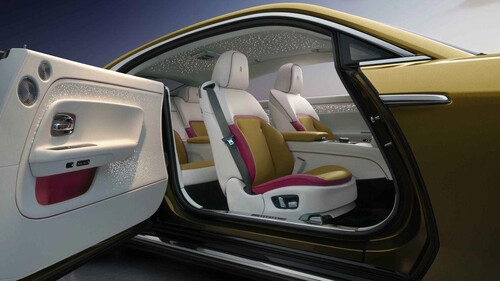
Theatricality is more important than practicality in a Rolls-Royce, but the Spectre manages to deliver both qualities simultaneously. The brand’s trademark rear-hinged doors work better on a two-door coupe than they do at the rear of one of the company’s sedans, the longer aperture improving both looks and ease of access. Plus, everybody is going to look every time they power themselves open or shut.
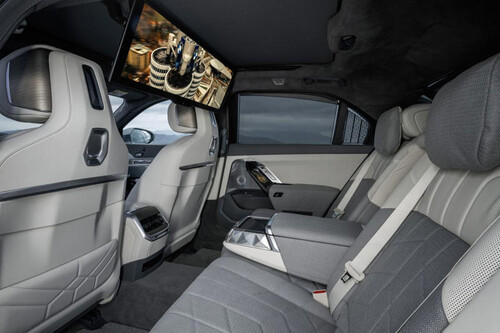
Despite the length of the doors, getting in and out is made less easy by the height of the floor—the battery pack being beneath it—and the lowness of the roofline. There is usable room for adult occupants in back, but access to the second row is tight and awkward around the folded front seats. As Spectre owners are more likely to be driving themselves than those with Rolls-Royce sedans, this isn’t likely to be a regular problem.
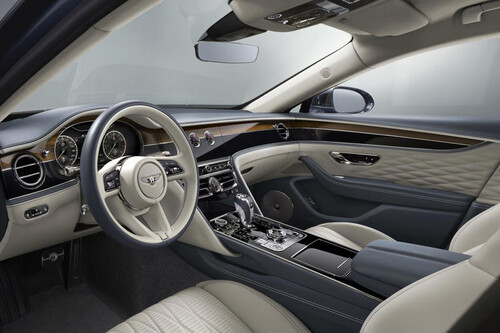
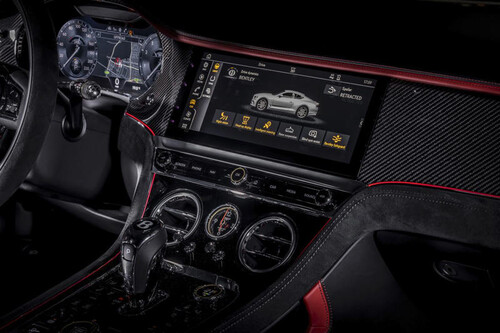
The design of the Spectre’s interior remains very similar to that of Rolls’s gasoline-powered models. Character hasn’t been sacrificed by an ill-conceived digital makeover to match the electric powertrain; this must be the only EV in the world with analog, rotary controls for heating and ventilation. These feel great to touch, as do the circular metal vents. There is also a digital display, but with a modestly sized 10.5-inch touchscreen running a redesigned version of BMW’s old operating system, a point made by the continued presence of a rotary iDrive controller and a row of shortcut buttons very similar to the ones BMW introduced in 2005.
Less impressive was the small clock that sits next to the touchscreen and above a tiny Spirit of Ecstasy model. The small diameter of the clockface and the diminutive size of the figurine meant this looked more like a gift store souvenir than the design centerpiece it is meant to be. The design of the digital instrument pack was also a little basic, especially compared to the animated graphics of cars like the Torcal, although for the first time the “power reserve” meter that Rolls-Royce uses instead of a rev counter for its gasoline models makes sense, this moving in direct relation to throttle position.
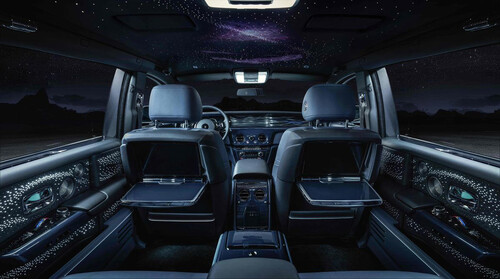
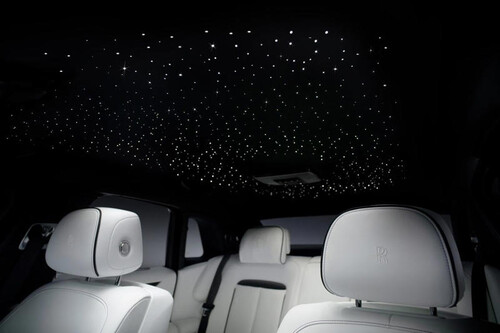
Spectre buyers have a huge range of choices when it comes to interior trim, from mild to wild. My test car’s combination of black and white upholstery, an illuminated fascia facing the front passenger, and “shooting star” headliner felt plenty special, but much more traditional variations on wood and leather are also available.
Should I Buy One?
If you want an ultraluxury EV coupe, the Spectre remains your sole choice. That’s not to say there aren’t electric cars with varying overlap on price or presence, with cars like the forthcoming Ferrari Luce, AMG GT 4-Door Electric, and even the Jaguar Type 01 all playing at least in part to a similar design- and brand-led audience. Of those, only the Ferrari has a higher base price than the Spectre.
The more relevant question is whether the Spectre is the Rolls-Royce you really want to own. For most potential buyers, this is likely a moot point: The typical Spectre owner has at least seven cars in their collection, at least one of which is likely to be another Rolls-Royce. But, as we noted with a very different electrified Rolls-Royce, the Halcyon Corniche, the silence and serenity natural to an EV is less emotionally engaging than the hush of a supremely refined gasoline engine. Despite its performance and tranquility, the Spectre is not better at being a Rolls-Royce than its more charismatic combustion siblings, although this is the only way to get a coupe in the current lineup.
And finally, if you have decided on a Spectre, which version to go for? The Black Badge has the cachet of a small amount of extra performance and of being the most expensive version, something which exerts a strangely powerful attraction in this rarefied part of the market. But the regular Spectre has a softer dynamic demeanor that suits the car’s relaxed personality a little better—plus you can spend the savings delving deeper into bespoke optioning.
Highlights and Lowlights:
We Love:
- Strong performance from the (usually) silent powertrain.
- Pretty good fun to hustle in the corners.
- Rear-hinged doors combine style and practicality.
We Don’t:
- Awkward rear proportions: Rolls has built better-looking coupes.
- Too much regenerative braking in regular version.
- Acceleration sound is silly and breaks the magic.
Favorite Detail:
Those analog heating and ventilation controls. Not only do they feel great, they also have a simple usability that makes using them without taking eyes off the road simple: left for cold, right for hot. Honestly, they work so much better than every digital alternative.