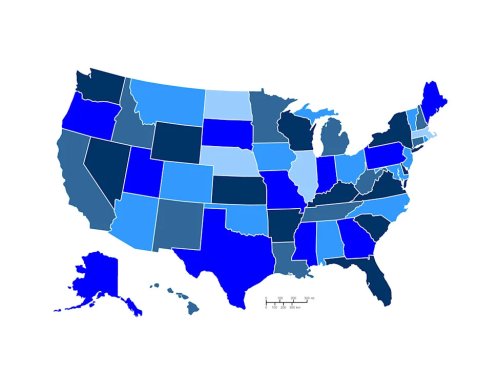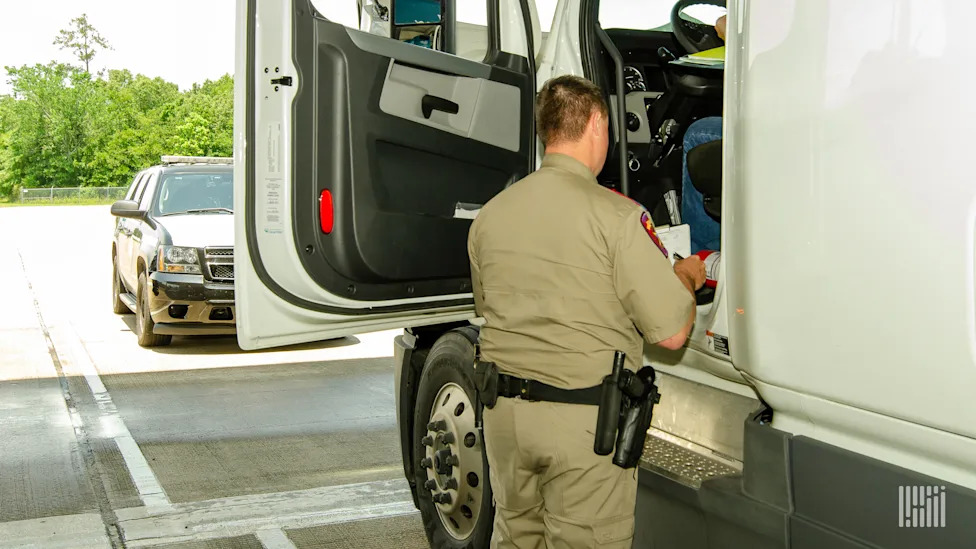


















A commercial motor vehicle stopped at a roadside inspection station, with an enforcement officer conducting a North American Standard Level I inspection. (Photo: Jim Allen/FreightWaves)The Day 2 NumbersThrough two days of the 2026 International Roadcheck, FMCSA inspection records show 6,406 total inspections conducted, 11,010 violations logged, 2,055 out-of-service orders issued, and 5,217 distinct carriers inspected. Data via searchcarriers.com/blitz, which aggregates live FMCSA inspection records and refreshes daily during the event at no cost.Isolating Day 2 from the cumulative totals: Tuesday’s enforcement added approximately 4,826 inspections, 8,373 violations, and 1,559 OOS orders to the running count. That puts Day 2’s OOS rate at approximately 32.3% — slightly higher than Day 1’s 31.4% — and the daily violations-per-inspection rate at approximately 1.73. The daily inspection chart shows Tuesday volume came in slightly above Monday, with roughly 3,350 inspections on Day 2 compared to approximately 3,050 on Day 1.The scale of Day 2 enforcement matters for a specific reason: the 2025 full-event vehicle OOS rate across all 56,178 inspections was 18.1%. Two days into 2026, the OOS rate is running nearly double that benchmark. That gap cannot be explained by enforcement concentration alone. It reflects the condition of trucks on the road.Pennsylvania Is Running the EventThe state-level data through two days tells a story that every operator running the Northeast corridor needs to understand. Pennsylvania led all states in Day 1 inspections with 217. Through Day 2, Pennsylvania’s cumulative inspection count stands at 1,156 — meaning the state ran approximately 939 inspections on Tuesday alone, nearly 20% of the entire national Day 2 volume. No other state is close. Oklahoma is second at 533 cumulative. Kentucky is third at 399. New Jersey is fourth at 359. Alabama is fifth at 327.AdvertisementAdvertisementThe full top ten through two days: PA (1,156), OK (533), KY (399), NJ (359), AL (327), MI (294), NM (184), NE (179), SD (178), LA (174).Pennsylvania, Oklahoma, and Kentucky together account for 2,088 of the 6,406 cumulative inspections — 32.6% of all inspections in three states. The geographic concentration of enforcement in the Northeast and through the mid-South is not random. These are high-volume freight corridors, and enforcement personnel are deployed where freight moves. If your loads are running I-78, I-76, I-81, or I-40 through Oklahoma, the inspection probability on Day 3 is at least as high as it was on Day 2.New Jersey and Pennsylvania also dominate the worst individual inspection lists across both days, which is a separate signal from volume. High inspection counts in a state produce high violation counts by volume. But NJ and PA are generating the highest per-inspection violation totals as well, which suggests the inspection intensity in those corridors is finding more violations per truck, not just more trucks.The Worst Individual Inspections From Day 2The cumulative worst inspections list through two days shows how significantly Day 2 raised the severity bar on the vehicle side. The single worst inspection by total violations remains the Day 1 NJ inspection SPEPI02245, which logged 30 total violations including 28 vehicle violations. But Day 2 added four new entries to the top five.AdvertisementAdvertisementPennsylvania inspection C208613208 from May 12 came in second with 27 total violations. Kansas inspection PD83971978 logged 26. New Jersey’s SPSHI00417 and Pennsylvania’s E953613227 each logged 24.The worst OOS list has shifted more significantly. New Jersey’s SPPSI04143 from May 12 logged 9 OOS conditions out of 14 total violations — a 64% OOS rate within a single inspection. Wyoming’s PTLP000665 from Day 1 holds second with 9 OOS from 20 violations. Texas inspection V262347853 from Day 1 and New Jersey’s SPSSI01091 from Day 1 each produced 8 OOS. Pennsylvania’s C208613208 from Day 2 also logged 8 OOS out of its 27 total violations.The driver violation totals from Day 2 are the most significant numbers in the dataset. Alabama inspection 1440004561 from May 12 logged 17 driver violations out of 18 total — the highest single-inspection driver violation count across both days by a wide margin. Pennsylvania’s E953613226 logged 16 driver violations out of 23 total. Those numbers are not the product of one missed annotation or an expired document. An inspection that produces 16 or 17 driver violations found comprehensive driver compliance failure: credential problems, HOS violations, ELD documentation failures, and regulatory violations stacked within a single cab.Which Carriers Are Generating the Most Inspection ActivityThe most inspected carriers through two days reflect the scale of large national fleets moving freight through high-inspection-density corridors. United Parcel Service Inc (DOT #21800) leads all carriers with 29 inspections, 11 violations, and a 3% OOS rate. New Prime Inc (DOT #3706) has 27 inspections, 22 violations, and a 7% OOS rate. Federal Express Corporation (DOT #86876) has logged 23 inspections, 31 violations, and a 9% OOS rate. Central Transport LLC (DOT #661173) is at 22 inspections with a 14% OOS rate. Tornado Bus Company (DOT #565859) has completed 21 inspections with only 3 total violations and a 0% OOS rate.AdvertisementAdvertisementThe worst carriers list by OOS rate — minimum 10 inspections — surfaces names that are not household brands. Annett Holdings Inc (DOT #87409) leads at 27% OOS rate: 3 of 11 inspections resulted in OOS orders with 6 total violations. Western Express Inc (DOT #511412) is at 21% with 4 of 19 inspections OOS and 36 total violations. Swift Transportation Co of Arizona LLC (DOT #54283) is at 15% with 2 of 13 OOS and 16 violations. Central Transport LLC at 14% and Schneider National Carriers Inc (DOT #264184) at 13% round out the five.Western Express’s 36 violations across 19 inspections — nearly 1.9 violations per inspection — combined with a 21% OOS rate is the worst overall compliance profile among carriers with significant inspection volume through Day 2. That combination of high violation density and high OOS rate reflects systemic maintenance and compliance gaps, not a run of bad luck in inspection lanes.The best carriers list shows what compliance looks like under sustained inspection pressure. Autobuses Ejecutivos LLC (DOT #1044521) has completed 18 inspections with 0 violations — a perfect record through two days. Gemini Motor Transport LP (DOT #913300) is at 0.13 violations per inspection across 15 inspections. Tornado Bus Company holds at 0.14 violations per inspection across 21 inspections. Wal-Mart Transportation LLC (DOT #63585) is at 0.27 across 11 inspections. Krise Transportation Inc (DOT #550782) is at 0.30 across 10 inspections.Eighteen inspections with zero violations is not a result that happens to compliant operators by accident. It is the output of a maintenance and compliance program that runs the same way every day, regardless of whether blitz week is on the calendar.The 2026 Focus Areas: What Day 2 ConfirmsThe ELD tampering and cargo securement focus areas designated by CVSA for 2026 are being validated by the violation data coming out of both days. The driver violation totals from Day 2’s worst inspections — 17 driver violations in Alabama, 16 in Pennsylvania — reflect the kind of compounded HOS and ELD compliance failures that the focus area was designed to surface. A 17-driver-violation inspection in a single stop is not an inspector finding one falsified log. It is an inspector working through an ELD record with multiple edit anomalies, HOS patterns that don’t align with supporting documents, and credential issues that compound the underlying records problems.AdvertisementAdvertisementOn the vehicle side, the inspection results that produced 27 and 26 vehicle violations in single stops in Pennsylvania and Kansas are almost entirely mechanical: brake systems, tires, lighting, and coupling devices. Those numbers confirm what the 2025 Roadcheck data showed and what the 2026 data is continuing to show — cargo securement is not generating the extreme per-inspection violation totals that show up in the worst inspection lists. The highest-severity single inspections are dominated by brake, tire, and lighting failures. Cargo securement violations are consistent and widespread, but the catastrophic per-inspection totals are coming from mechanical maintenance failures.That distinction matters for small carriers setting maintenance priorities heading into Day 3 and beyond: cargo securement is the named focus, but brake and tire condition is what is producing the worst individual inspection outcomes in the data.What to Do on Day 3: The Owner-OperatorDay 3 closes out tonight. The enforcement posture does not drop until the event ends. Pennsylvania ran nearly 940 inspections on Tuesday. If your truck is moving through I-78, I-81, I-76, or the Oklahoma turnpike system today, the inspection density has not changed since yesterday.The pre-trip process is the compliance program. Brake hoses for visible air leaks. Tires for inflation, tread depth, and sidewall damage. Lights front to rear on both the tractor and trailer. These are not Roadcheck preparations — they are the pre-trip requirements under 49 CFR 396.13 that apply every dispatch. A tire violation found at a Pennsylvania scale on Day 3 was a tire problem that existed before the truck left the yard.AdvertisementAdvertisementOn the ELD side: the Alabama inspection that produced 17 driver violations on Day 2 is the data point every owner-operator should understand going into the last day. Seventeen driver violations in a single stop represents a record so compromised that an inspector spent significant time working through it. The most common way an ELD record gets into that condition is not deliberate fraud — it is accumulated documentation errors: unassigned driving events that were never resolved, edits made without annotations, gaps that don’t align with supporting documents. Open your 8-day log before you roll today. If there are unassigned events, resolve them before you reach a scale.What to Do on Day 3: The Small FleetIf you have trucks moving today, the state data tells you where to focus driver communication. Pennsylvania, Oklahoma, Kentucky, and New Jersey are the four highest-volume enforcement states through two days. If any of your trucks are running those corridors on Day 3, those are the drivers who need a specific pre-dispatch conversation about ELD record cleanliness and cargo securement — not a general reminder, a specific one.The carrier data through two days also provides a benchmark worth internalizing. The best carriers on the list — Autobuses Ejecutivos at 0.00 violations per inspection across 18 stops, Gemini Motor Transport at 0.13 — are not exempt from scrutiny. They are passing inspections at volume. A small fleet with 5 to 15 trucks does not have the inspection volume of a UPS or New Prime, but the compliance posture that produces a 0.00 violation rate is available at any fleet size. It is a maintenance program, a driver training program, and a pre-trip discipline that runs the same way on Day 3 of blitz week as it does on a Tuesday in September.On the shipper data: if any of your trucks are currently hauling USPS, Lowe’s, or Amazon freight, flag those drivers specifically for a pre-dispatch compliance check. Not because the freight creates the violation — it doesn’t — but because those shipper lanes are producing the highest OOS rates in the current data, which means inspectors processing freight in those lanes are finding compliance problems at elevated rates across the carrier pool. Your truck’s compliance is your responsibility regardless of whose freight is on it.Three Questions Operators Are Actually AskingQ: My truck got placed OOS on Day 2 for a brake violation. The inspector cited 20% defective brakes. What does that actually mean and how do I get back on the road?AdvertisementAdvertisementThe 20% defective brakes standard means that at least 20% of the vehicle’s total braking capacity has been found in an OOS condition — a brake out of adjustment, a brake with a cracked or broken component, or a brake that is otherwise inoperable. For a standard 18-wheel combination vehicle, that typically means two or more brakes are defective. The truck is parked at the inspection location until a qualified brake technician certifies that the violation has been corrected. You cannot simply adjust the brakes yourself and release the truck — the correction needs to be documented and the truck released by the officer or through a process the officer specifies. Call a mobile heavy-duty brake service that can come to the location, document the repair, and get the truck cleared. Keep the repair invoice. It is your evidence that the violation was corrected properly, and you will need it if the inspection record is ever questioned.Q: Western Express has a 21% OOS rate and 36 violations across 19 inspections. Does that kind of carrier performance data affect the loads I can get from brokers?Not directly from this data — brokers and shippers primarily use FMCSA CSA BASIC scores and safety ratings, not real-time Roadcheck dashboards, for carrier vetting decisions. But the Roadcheck violation data feeds directly into CSA scores, which brokers do check. The violations being generated during blitz week are entering FMCSA’s Safety Measurement System right now and will be reflected in BASIC scores within the next reporting cycle. A carrier whose HOS Compliance or Vehicle Maintenance BASIC score climbs above 65% as a result of Roadcheck violations will see that reflected in broker load board visibility and shipper tender acceptance. The connection between this week’s inspections and next month’s freight access is direct — it just runs through the CSA scoring system rather than a real-time feed.Q: Day 3 is the last day. Is there any reason to think enforcement will be lighter today than it was Tuesday?AdvertisementAdvertisementNo. CVSA and its partner agencies staff the full 72-hour event window. There is no documented pattern of Day 3 enforcement being lighter than Days 1 or 2. The Pennsylvania data is the most relevant indicator here — the state ran 217 inspections on Day 1 and approximately 939 on Day 2. Day 3 deployment follows the same assignment structure. The trucks that cleared Days 1 and 2 without an incident did so because they were compliant on those days. The same compliance posture that produced a clean Day 1 and a clean Day 2 is what produces a clean Day 3. If your pre-trip was complete this morning, roll. If it wasn’t, do it before you leave the yard.The post Roadcheck Day 2 Nearly Tripled Day 1 Volume. The Violation Data Shows Where Trucks Are Failing. appeared first on FreightWaves.