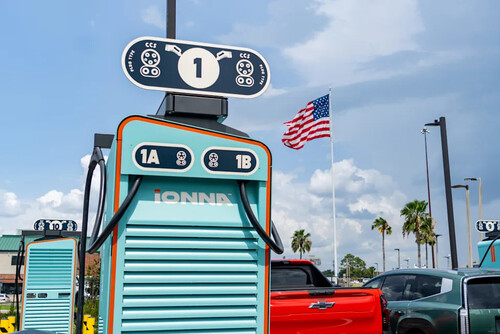
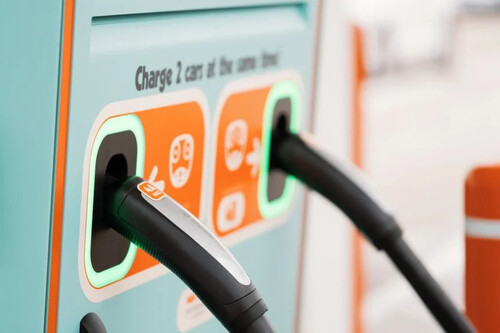
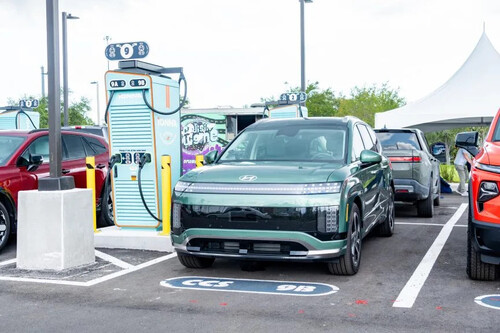
Back in the olden days, EV charging stations were lonely affairs, loitering like hungry ghosts at the edges of a stopover, exposed to the inclinations of the weather and the interest of passing toddlers eager to explore the potential of charging cables to serve as a sort of swing. In other words, not in with the in crowd. So much for the olden days. Automakers and other electrification stakeholders have been leveling up the EV charging game, and the results show. From EV Charging To The IONNA Rechargery Model Somewhere around the time of the COVID recovery period, automakers finally realized that they needed to take charge of the EV charging environment. After all, look at a typical stopover or gas station. If EV chargers are present, they appear as an afterthought, located on the fringes of the site without any shelter from the elements. Transforming the charging experience into an EV-centric destination is the mission of IONNA, an automaker joint venture that launched in 2023 with BMW, General Motors, Honda, Hyundai, Kia, Mercedes-Benz, and Stellantis on board (Toyota joined later). Each “Rechargery” location features sheltered charging stations and a retro chic, lounge-like atmosphere with Wi-Fi, light snacks and beverages, and of course, the all-important bathroom. The first Rechargery broke ground in North Carolina in 2024. The network has been growing like hotcakes since then, regardless of last year’s sharp U-turn in federal energy policy. As of March, IONNA reported that it had almost 1,000 EV charging bays in operation, distributed among more than 100 sites, with another 4,700 bays under contract. Of those 4,700, almost 1,500 were already in construction or awaiting final sign-offs. That’s just for starters. The consortium has expanded its vision to include IONNA-branded charging stations at locations outside of its freestanding Rechargery locations, aiming for 30,000 ultra-fast charging points by 2030. The effort kicked off in April, when IONNA announced the new “Rechargeries @ Circle K” partnership, bringing its retro-branded chargers to more than 350 Circle K stores in the US, where EV drivers can find all the conveniences of the popular C-store chain. Is It Working? EV charging station reliability has improved in recent years, so IONNA is facing some stiff competition. The joint venture got some good news in that regard, when it nailed down the top slot in JD Power’s 2026 U.S. Electric Vehicle Experience (EVX) Public Charging Study in August. “IONNA Ranks Highest among DC Fast Charger Stations in First Year of Award Eligibility,” reads the headline at JD Power, adding “New OEM-backed charging networks elevate the public charging experience” in a sub-heading. So yes, it’s working. “Newer, higher-speed chargers, larger charging sites, destination-style locations with more amenities and more seamless payment options are reducing failed charging attempts and delivering a more reliable charging experience, helping to support continued EV adoption,” JD Power further notes. That pretty much sums up the Rechargery model, but there’s more. In California, for example, Rechargeries partner with local EV dealers and other stakeholders to stage driver information and support events, further encouraging EV uptake. IONNA has also taken on the rising challenge of app fatigue. Instead of using a bespoke IONNA charging app, drivers can deploy their own. The company currently lists ChargeHub, ChargePoint, EV Connect, Ford, Kia Access, Lexus, Mercedes Benz, MINI, My BMW, myCadillac, myChevrolet, myGMC, MyHyundai with Bluelink, My Porsche, Presto, Rivian, Stellantis Free2Move Charge, Toyota and Volvo Cars among the compatible apps. The Speed-To-Charging Factor Of course, no story about EV charging is complete without a mention of the Tesla Supercharger network — and no story about Tesla is complete without a mention of Tesla CEO Elon Musk’s role in the malevolent clown car that passes for the US government these days. In the latest news, US Secretary of “War” Pete Hesgeth has tapped Musk to co-lead a “future of warfare” task force. While we’re waiting for The Onion to interpret that news, let’s take a look at Tesla’s new plan for accelerating the build-out of the Supercharger network. A fresh burst of activity by the Supercharger team is something of a surprise, considering that Musk abruptly fired almost the entire Supercharger team (and hired some back) in 2024. That same year, Tesla also lost out on contracts for high-traffic rest stops on the Interstate network in New Jersey and Pennsylvania. Nevertheless, the Supercharger build-out continued to move forward. Earlier this year, Tesla introduced a new factory-assembled charging station model that folds up like an accordion for ease of transportation and speedier installation. “Tesla says that 33% more units can fit on a delivery truck, overall installation costs are cut 20%, and deployment is twice as fast,” CleanTechnica reported in March. Rounding out the news from Tesla is the Tesla Diner, which opened to much fanfare on Santa Monica Boulevard in West Hollywood, California to much fanfare in July of 2025, complete with a generous array of Supercharger stations on site. The stations are still in use, but traffic at the Tesla Diner has diminished. “LA’s Tesla Diner is so dead, even the protesters gave up,” the news organization SFGate reported in March of this year. “Just eight months in, not even the tech bros are eating there,” SFGate adds. Among the fallout was the head chef, who lasted about six months before leaving to start a deli. A popcorn-serving humanoid robot also booked, and dining-room hours were cut back from the promised 24/7 model. Musk’s social media musings once indicated that the West Hollywood location could serve as a model for many others across the country, if it were successful. So… Next Steps For EV Charging In The US Style factor aside, public EV charging is the key that unlocks the EV sales bottleneck. As may be expected, the overwhelming majority of EV drivers prefer the convenience and security of home charging, but millions of drivers live in multi-unit housing and other sites where on-site charging is limited or simply unavailable. IONNA and Tesla are just two examples of rapid acceleration in the pace of public charging. The leading firm EVgo is also on the move. On September 29, EVgo unveiled a new “power-sharing” charging station model that can deliver up to 750 kilowatts of charging power. “Features include better cable maneuverability, a touchless payment interface, and advanced hardware and firmware to bolster reliability and streamline the charging experience,” EVgo notes. The magic happens when EV drivers can choose any port at an EVgo station, regardless of their vehicle. EVgo’s dynamic power sharing system automatically adjusts the output for each EV. “Drivers won’t have to worry about finding a certain power-level stall because every stall is the right one for their vehicle,” EVgo emphasizes. Innovators in the charging station field are also beginning to take on the challenge of finding space for EV charging in densely packed cities. Keep an eye on the US startup Voltpost, which is installing modular chargers on existing lampposts and other street furniture. Another area to watch for rapid acceleration is standalone curbside charging stations, where the Brooklyn-based startup It’s Electric is among those staking out new territory. Photo: The IONNA consortium is scaling up its plans for public EV charging stations in the US, anticipating future growth in EV sales despite last year’s sharp U-turn in federal energy policy (courtesy of IONNA via CleanTechnica archive).