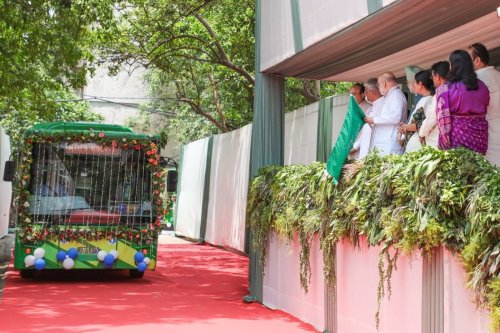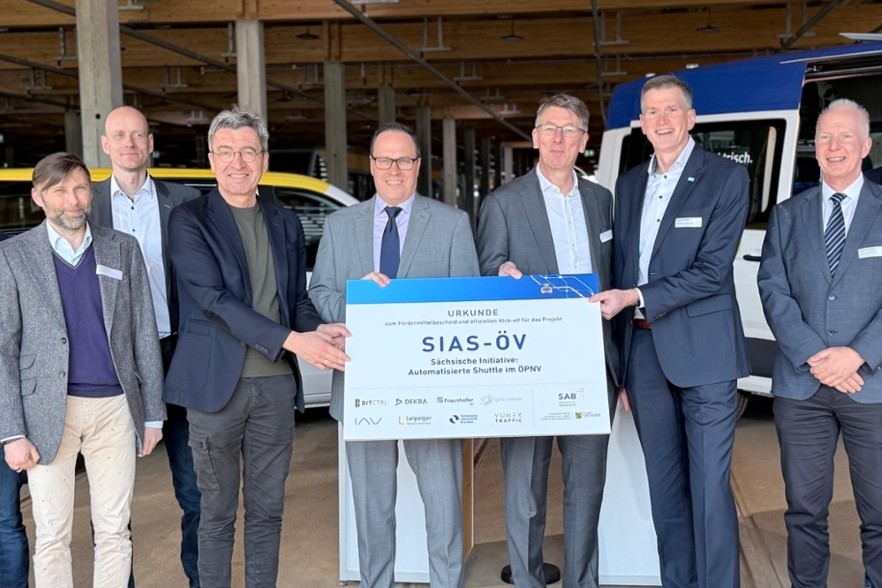



















Image: Sächsisches WirtschaftsministeriumThe project aims to develop a fully integrated mobility system for highly automated shuttles at SAE Level 4 automation, which will eventually operate without onboard personnel. Project results are expected by mid-2028 and will serve as a foundation for further pilot applications and the future scaling of automated shuttle services across Saxony, according to the project partners.The initiative is being funded with 9.5 million euros through the Saxon ERDF (European Regional Development Fund) technology funding programme for 2021-2027, which is financed by EU resources. On Monday, Saxony’s Minister for Economic Affairs, Dirk Panter (SPD), presented the funding notifications in Leipzig.He stated: “In Saxony, innovative partners are developing the mobility of the future. By advancing autonomous driving in public transport, this project not only strengthens the competitiveness of participating Saxon companies but also helps society adapt to demographic challenges.”Panter was referring to the potential of autonomous shuttles to address key challenges faced by public transport providers, such as the growing shortage of drivers, rising operational costs, and evolving mobility needs. When integrated into existing public transport systems, these shuttles could provide a valuable addition, particularly in urban outskirts and rural areas, where regular bus services with high frequencies are economically unviable. For this reason, SIAS-ÖV primarily focuses on on-demand services that function like modern shared taxis—only without drivers and booked via an app by users.“Strategically, we aim to combine our popular on-demand service Flexa with autonomous vehicles. The goal is to provide affordable mobility and further improve accessibility as part of public services,” said Ulf Middelberg, spokesperson for the management of Leipziger Verkehrsbetriebe (LVB).Under the name Flexa, LVB launched a service in 2019 in Leipzig’s outlying districts, where shuttle vehicles can be booked via an app. This allows multiple ride requests to be pooled—essentially ridepooling. Flexa is highly cost-effective for users, as only a standard LVB ticket (currently priced at 3.60 euros), an LVB monthly pass, or the Deutschlandticket is required for use.In addition to the experience gained from Flexa, LVB plans to incorporate findings from its earlier research project ABSOLUT, in which an automated shuttle regularly travelled to the BMW plant, into the new project. They are also exchanging insights with other providers.“By collaborating with pioneers such as RMV from Frankfurt and colleagues from other cities, we can accelerate implementation. Autonomous public transport is already operating on a large scale worldwide. SIAS-ÖV will help us bring this to Saxony, as this project is the first to introduce an industrial Level-4 shuttle into our public transport system,” Middelberg continued.It remains unclear when or on which routes the autonomous vehicles from the new project will operate. However, according to a report by MDR, the test route previously mapped for the ABSOLUT project—between the trade fair grounds and the BMW plant—will be reused to further develop a corresponding shuttle vehicle to series production maturity. Regular operations could then become feasible from 2030 onwards.The specific vehicles to be used in the project have not yet been confirmed. However, the involvement of VW subsidiary IAV and the Austrian startup eVersum in SIAS-ÖV suggests that shuttles similar to those used in the Ahoi project in Hamburg may be deployed. There, electrically powered shuttles from eVersum, measuring 6.90 metres in length and offering nine seats plus space for a wheelchair or pram, are in use.sachsen.de, ardmediathek.de (Video; both in German)